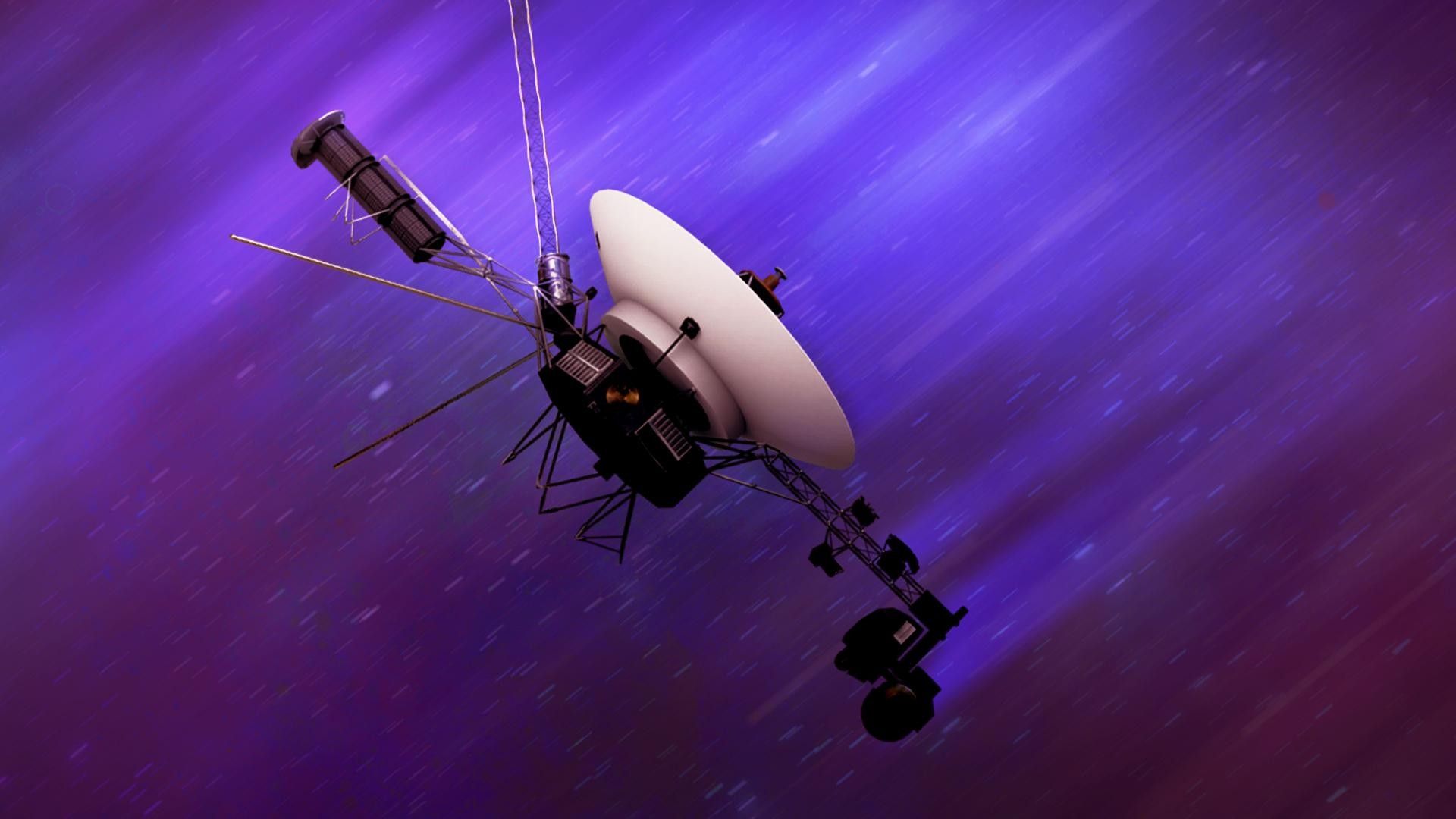
NASA Voyager 1 to Reach Historic One Light-Day Milestone From Earth
The Tech TL;DR:
- Voyager 1 hits a distance of one light-day from Earth on November 18, requiring a 24-hour signal travel time each way.
- Launched in September 1977, the probe operates nearly 50 years after its initial liftoff while traversing interstellar space.
Voyager 1 will reach a distance of one light-day from Earth, establishing a new milestone as the farthest human-made object in history, Live Science reported.
On Nov. 18 at 5:16:07 a.m. ET, the spacecraft will sit 16 billion miles away from its home planet, according to Live Science. At that distance, radio signals traveling at the speed of light require a full 24 hours to complete a one-way trip.
“If you want to say ‘hello’ to Voyager, you send your message and then you go home and you wait two days before you finally get a response,” Suzanne Dodd, Voyager project manager at the Jet Propulsion Laboratory, said in a statement.
Decades of Interstellar Travel
Launched in September 1977, the twin Voyager probes outlasted many of the engineers who built them. Voyager 1 currently travels through space at a steady 37,763 mph, a speed it achieved after a gravity-assisted Saturn flyby in 1980, CNET reported.

While the probe crossed the boundary of the heliosphere in 2012, it remains gravitationally bound to the sun. NASA estimates the spacecraft will require approximately 300 years to reach the inner edge of the Oort Cloud.
“If anything, it reminds us of the sheer vastness of space and time, and how this spacecraft is just a little mote of dust that’s barely drifted out of the solar system still,” Pascal Lee, a planetary scientist at the SETI Institute who was part of the Voyager 2 team at NASA’s Jet Propulsion Laboratory during its Neptune flyby in 1989, told Live Science.
Engineers Manage Dwindling Power Through Device Reconfigurations
Operating a half-century-old probe presents persistent engineering challenges. Because solar panels cannot function in the outer solar system, Voyager 1 relies on radioisotope thermoelectric generators that convert heat from decaying plutonium into electricity.
As power supplies dwindle, NASA engineers implemented power-saving reconfigurations. An initiative dubbed “The Big Bang” involved shutting down three devices and powering on low-power alternatives to keep the spacecraft operational in the cold conditions of interstellar space, CNET reported.
Aish.com said that engineers spent five months troubleshooting a failed memory chip in late 2023 by rerouting computer code into available memory space. Voyager 1 currently operates with only two active science instruments.

Mission Operations May End as Power Supplies Drop
NASA also organized a Shine Bright event inviting the public to transmit the letters “V-G-R” in Morse code toward the spacecraft, according to DJ Mag.
NASA expects power supplies to drop sufficiently to halt basic engineering communications around 2036. Until then, the mission team continues making adjustments to extend operations.
“Knowing that Voyager will continue its mission long past my lifetime actually gives me comfort,” Perry told Live Science via email. “Although I won’t be able to speak to the Voyager spacecraft any more, I love knowing that I’ll always be able to look to the stars and know they’re still on their way.”
Always consult with certified IT and cybersecurity professionals before altering enterprise networks or handling sensitive data.