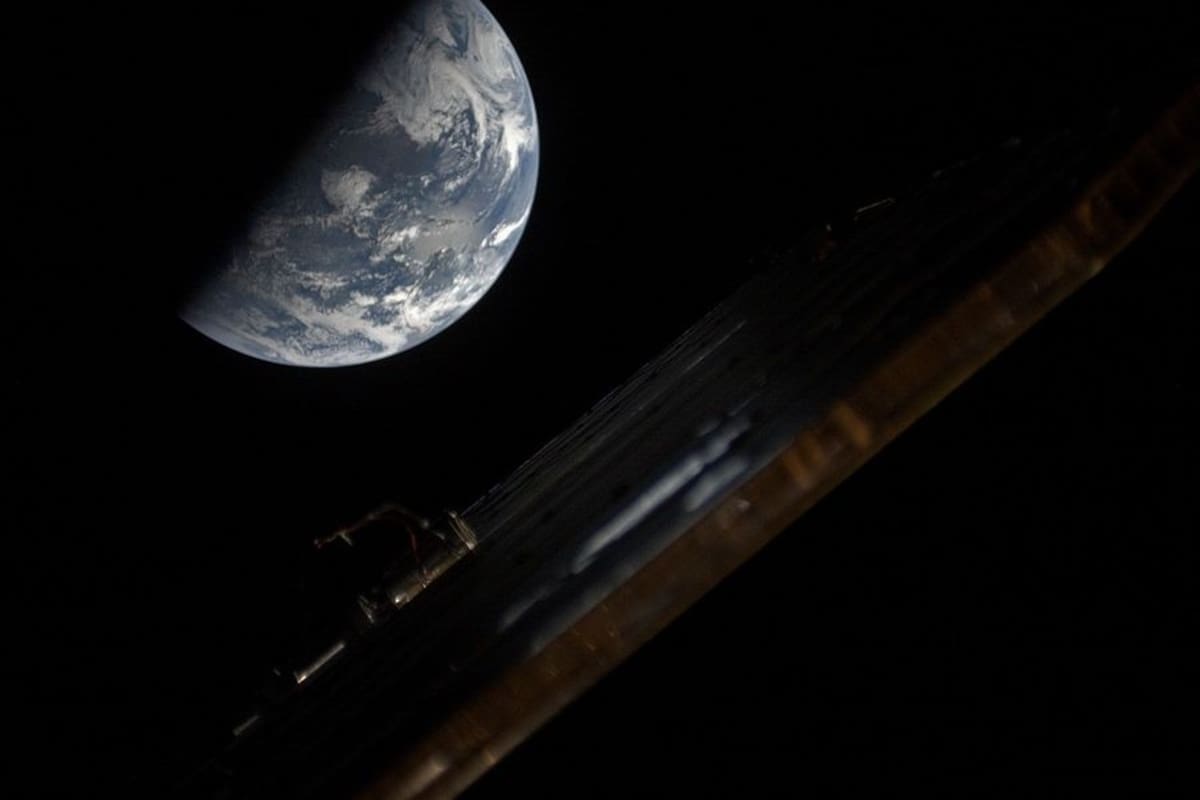
NASA Twin Probes Capture Infrared Earth Views Before Mars Gravity Assist
Two twin spacecraft captured uncommon infrared views of Earth from 62,000 kilometers away before heading toward Mars.
The Escape and Plasma Acceleration and Dynamics Explorers mission recorded the western hemisphere on November 9, approximately three hours after its closest approach to Earth, La Nación reported, according to LA NACION. The images reveal color contrasts marking warmer and cooler regions across the planet.
The camera used is a Visible and Infrared Imaging System, provided by Northern Arizona University, according to infobae. In the color scale used, the areas that appear in white, yellow, and green are warmer than the areas in blue tones. One of the spacecraft’s solar panels appears in the foreground of the image.
- Two twin Escapade spacecraft flew past Earth on November 7 and 9.
- The journey to Mars will take ten months, with arrival expected in September 2027.
- The mission launched initially in November 2025 from Cape Canaveral, Florida.
The twin probes executed a powered flyby, combining Earth’s gravity with a brief engine ignition to accelerate toward the red planet. According to Foro3D, the maneuver used the Oberth effect to add more than 1,600 kilometers per hour of speed. Aire de Santa Fe said that the spacecraft previously orbited the second Lagrange point, located about 1.6 million kilometers from Earth.
However, due to the unfavorable position of Earth and Mars at the time, the two spacecraft remained for nearly a year in a waiting orbit near the Lagrange 2 point, located about 1.5 million kilometers from our planet, before returning to Earth for the maneuver.

Before the flyby, a commercial satellite named Vantor Worldview Legion spotted the Escapade probes from a distance of about 4,800 kilometers.
The mission ESCAPADE launched in November 2025 from Cape Canaveral, Florida, according to Aire de Santa Fe. After launch, the twin spacecraft did not travel directly to Mars.
To begin their journey, the probes executed a combined gravity-assist and engine burn maneuver. On November 7 and 9, 2026, the spacecraft flew past Earth, igniting their engines to utilize the Oberth effect.
The unprecedented Earth images were captured using a Visible and Infrared Observation System camera. This instrument, provided by Northern Arizona University, recorded color contrasts to show warmer and cooler regions of the planet. La Nación said that the images were taken on November 9, about three hours after the spacecraft’s closest approach to Earth.

Upon reaching Mars in September 2027, the mission will investigate how the solar wind strips away the planet’s atmosphere. The twin probes will operate at altitudes ranging from 160 to 10,000 kilometers to measure magnetic and atmospheric interactions.
The two satellites of ESCAPADE will observe the upper atmosphere and the magnetic environment of Mars from altitudes between 160 and 10,000 kilometers. The NASA said that its two satellites will help study the “real-time response to the solar wind”.
“The ESCAPADE journey began with an orbit around the Lagrange point 2 and then was redirected toward Earth to perform a gravitational assist. Combined with a brief engine ignition, this is the first use of this maneuver by NASA to reach Mars,” the agency said in announcements covered by NTN24.