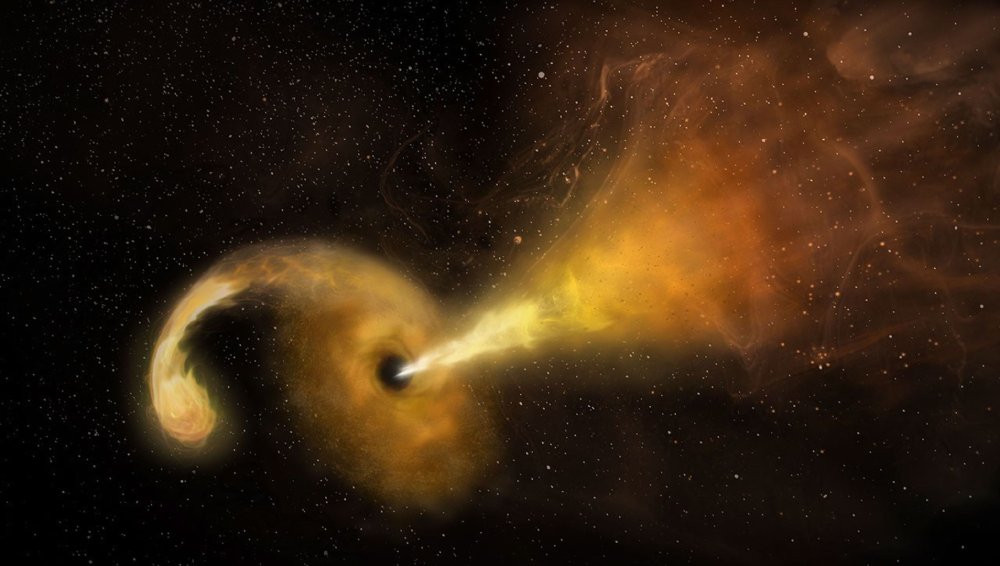
NASA Swift Observatory Captures Rogue Black Hole Tearing Apart Star
NASA’s Neil Gehrels Swift Observatory has detected a rare tidal disruption event in which an isolated black hole, commonly referred to as an “orphan” black hole, violently tore apart a passing star, according to TechNews 科技新报. The cataclysmic event triggered an electromagnetic burst that momentarily rivaled the brightness of ten billion suns.
Detection by the Swift Observatory
The high-energy transient was captured by the Swift space telescope, a multi-wavelength observatory designed to detect gamma-ray bursts and related cosmic phenomena. According to reporting from TechNews 科技新报, astronomers observed the star being pulled apart by extreme gravitational tidal forces as it ventured too close to the unattached black hole. The resulting flare of radiation provided researchers with critical data regarding the mechanics of black holes that exist outside of traditional galactic centers.
Mechanics of the Stellar Disruption
Tidal disruption events occur when a star passes within the intense gravitational field of a massive compact object. The differential pull across the star’s diameter stretches it vertically and compresses it horizontally, a process often termed spaghettification. In this specific case, the event involved an orphan black hole—an object not anchored to the center of a host galaxy. The luminous outburst generated during the destruction reached intensities comparable to ten billion suns, allowing space-based instruments to track the emission across vast interstellar distances.
The observatory continues to monitor the fading afterglow as the remaining stellar debris accretes onto the black hole or escapes into space, with further data analysis scheduled by participating research teams.