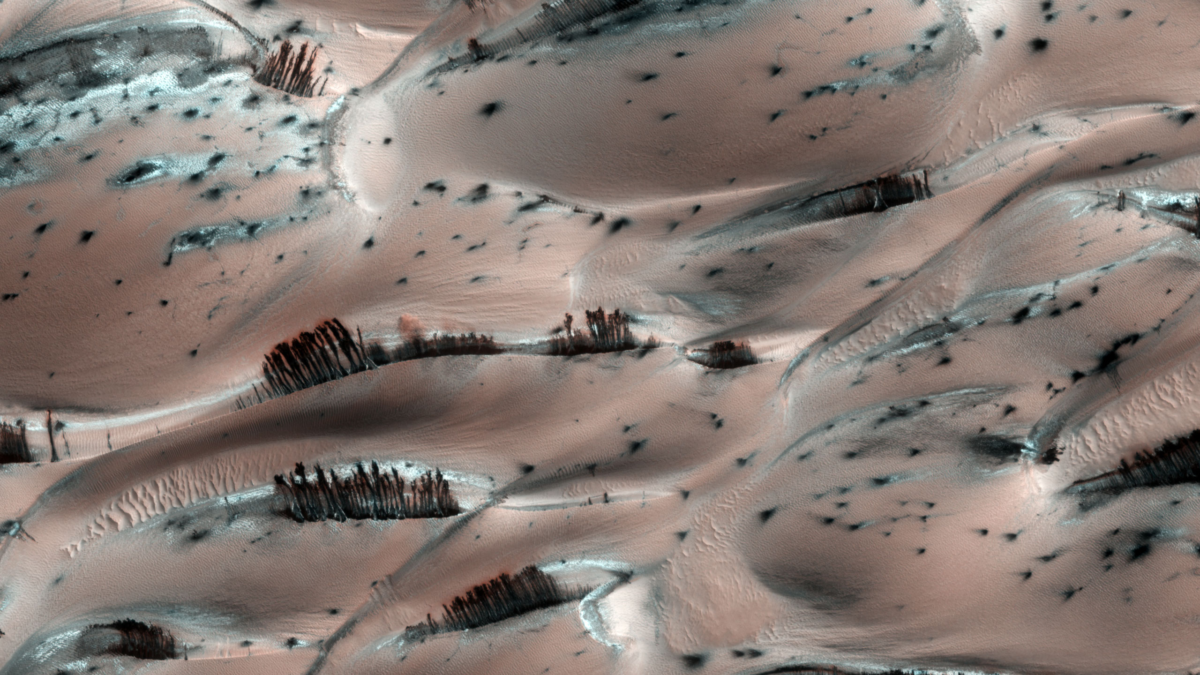
NASA Orbiter Captured 2008 Illusion of Trees on Frozen Mars Dunes
To the best of all humanity’s understanding, nothing seems to grow on the Red Planet, with neither a rover nor an orbiter ever catching wind of a single alga, cactus, or spindly tumbleweed, ScienceAlert reported.
That absence makes a photograph snapped by NASA’s Mars Reconnaissance Orbiter in 2008 all the more startling, as thickets of scraggly trees appear to stand bolt upright from the crests of frozen dunes near the Martian north pole.
High-resolution orbital observations resolved fine-scale structures on the frost-covered dunes, with imagery documenting active surface changes driven by seasonal conditions, according to Astronews. Orbital data allow researchers to better track wind patterns, seasonal frost cycles, and sublimation processes across the Martian terrain.
Mars is tilted relative to the Sun and marches through its own progression of seasons every year. During the bitterly cold Martian winter, atmospheric carbon dioxide freezes into snow and frost, blanketing the polar surface in a layer of dry ice. When spring arrives, that ice sublimes directly back into the atmosphere instead of melting into liquid.

Feeble sunlight warms the ice along the dune crests, weakening and cracking it. Sunlight can also penetrate the translucent ice and warm it from below, producing accumulations of gas that eventually burst outward and carry sand along.
As the sand cascades down the steep slopes, it leaves behind long, dark streaks. In the 2008 image, the High Resolution Imaging Science Experiment actually captured a small dust cloud kicked up by material cascading down a dune.
A 2011 study by the late planetary scientist Candice Hansen-Koharcheck of the Planetary Science Institute and her colleagues compared northern polar dune images over successive Martian years. The study found some dunes formed new gullies and alcoves while others gained fresh sand at their bases. In five dunes measured, lower slope edges advanced between 2.2 and 4.7 meters over a single Martian year.
Founded in 1972 by William Kenneth Hartmann, the Planetary Science Institute is a non-profit research institute based in Tucson, Arizona. It actively participated in NASA’s Dawn mission, managing the Gamma Ray and Neutron Detector spectrometer that mapped Vesta and Ceres to determine how they formed and evolved. The institute also operated orbit@home, a distributed computing project through which the public could help search for near-Earth objects.
By summer, the ice and dark streaks vanish, and Martian winds redistribute the sand to gradually smooth the slopes before the next winter freeze restarts the cycle.