NASA ESCAPADE Mission Twin Satellites Study Mars Atmospheric Loss
Two twin satellites are traveling toward Mars to study how the planet lost most of its atmosphere, NASA announced.
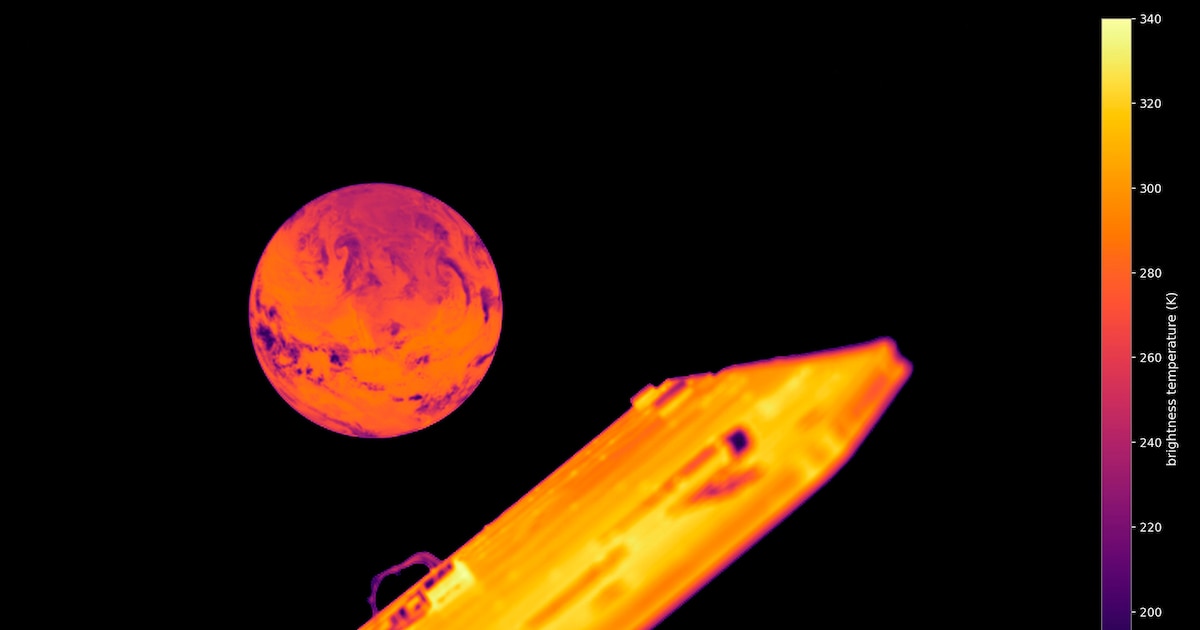
The ESCAPADE mission, which stands for Escape and Plasma Acceleration and Dynamics Explorers, utilizes the two identical spacecraft to investigate the atmospheric depletion of the red planet. One of the vessels captured images of Earth’s western hemisphere on November 9, approximately three hours after its closest approach to the planet.
The photographs were taken from a distance of 62,000 kilometers using a camera capable of recording both visible and infrared light. This imaging occurred following a gravity assist maneuver, a technique where the spacecraft combined engine burns with Earth’s gravitational pull to begin a 10-month journey.
The spacecraft used the Visible and Infrared Observation System, provided by Northern Arizona University, to capture the images of Earth, according to infobae. This instrument allowed for the recording of radiation reflected or emitted by the planet across visible and infrared wavelengths.
The mission’s primary scientific goal is to measure how the solar wind—a stream of charged particles from the Sun traveling at roughly 1.6 million km/h—interacts with Mars’s hybrid magnetosphere. Because Mars lacks a strong, global magnetic field like Earth’s, it only possesses magnetized zones in its crust and a partial protective field created by solar wind interactions.
| Metric | Value |
|---|---|
| Travel time to Mars | 10 months |
| Earth distance at Lagrange 2 | 1.6 million km |
| Observation altitudes | 160 to 10,000 km |
NASA explained that the mission will investigate “how the solar wind interacts with the magnetic environment of Mars and how this interaction drives the loss of the planet’s atmosphere.”
The two satellites will observe the upper atmosphere and magnetic environment from altitudes ranging between 160 and 10,000 kilometers. Upon reaching Mars, the spacecraft will fire their engines for 11 minutes to slow down and enter orbit, with each vehicle arriving several days apart.
The mission follows a complex trajectory. While the satellites launched from Cape Canaveral, Florida, on November 13, 2024, they did not begin a direct trip because the planetary alignment was not favorable. Instead, they remained in a waiting orbit around Earth’s second Lagrange point, located about 1.6 million kilometers from Earth in the direction opposite the Sun.
NASA has planned two distinct observation campaigns. In the first, the satellites will follow a “string of pearls” formation, flying in nearly the same orbit with one trailing the other by a margin of 30 minutes. In the second campaign, the ships will occupy different orbits to measure different regions simultaneously, allowing one to record conditions before solar wind reaches Mars while the other analyzes the interior of the magnetosphere.
As an independent agency of the U.S. federal government, NASA is organized into three mission directorates: Human Spaceflight, Research and Technology, and Science. This structural framework allows the agency to manage diverse objectives, ranging from civil space programs to aeronautics research.
The agency also maintains ten field centers across the US to support its operations. Within this organizational structure, the Launch Services Program oversees operations for uncrewed launches, facilitating the deployment of robotic missions like the ESCAPADE satellites.
Scientific operations are expected to begin in 2028 after the spacecraft complete their orbital adjustments.