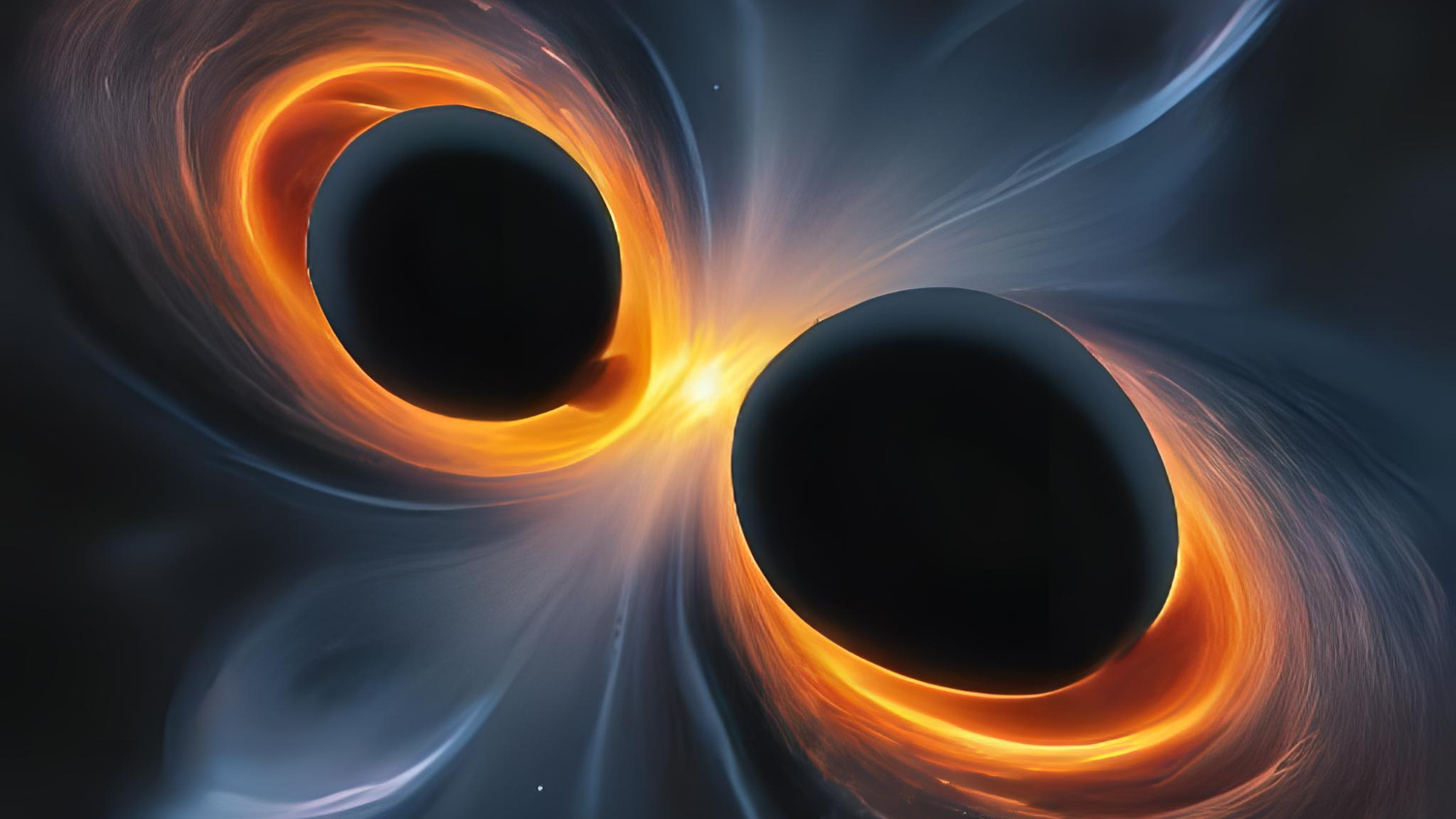
Mystery of Impossible Black Hole Merger Solved by Magnetic Field Theory
Spacetime Warps and Magnetic Fields: Solving the Impossible Black Hole Merger
According to analysis published by researchers, the event involved two black holes with masses measured at approximately 103 and 137 solar masses, alongside extreme rotation speeds near the theoretical maximum limit of general relativity. These measurements placed at least the lighter compact object squarely within the forbidden upper mass gap, forcing astrophysicists to re-evaluate how massive stars collapse under extreme physical conditions.
The Tech TL;DR:
- The Anomaly: GW231123 involved black holes sized between 70 and 140 solar masses—a range where pair-instability supernovae should completely vaporize the progenitor star without leaving a remnant.
- The Mechanism: Advanced computational simulations show that magnetic field pressure within the collapsing stellar debris disk drives high-speed mass outflows, allowing massive stars to shed weight into the mass gap.
Decoding the Upper Mass Gap and Pair-Instability Supernovae
Under conventional stellar physics, stars with initial masses exceeding roughly 130 solar masses encounter a critical thermodynamic threshold. According to data detailed by exploratory analyses of the event, high-energy core photons collide to create electron-positron pairs, sapping the radiation pressure that supports the star against gravitational collapse. This loss of thermal support triggers a catastrophic thermonuclear runaway known as a pair-instability supernova, an explosion so violent that it obliterates the entire stellar core, leaving no black hole behind.
Yet, the 2023 gravitational wave signature recorded by laser interferometers—systems sensitive to spatial distortions a fraction of the width of a proton—shattered this boundary. With one black hole weighing 103 solar masses and its partner reaching 137 solar masses, the system forced researchers to look beyond standard nuclear reaction rates. As noted in multi-institutional reporting, these objects also maintained rapid, near-maximum angular momentum, presenting a dual puzzle for astrophysicists trying to reconcile mass and spin.
Simulating Magnetized Stellar Collapse and Angular Momentum
To resolve how such massive objects could form and retain extreme spin, astrophysicists turned to high-performance computing clusters. A comprehensive set of numerical simulations run by a team from the Flatiron Institute’s Center for Computational Astrophysics (CCA) demonstrated that magnetic fields play a decisive regulatory role during core collapse. When a 250-solar-mass progenitor star collapses, the leftover matter forms a rapidly rotating accretion disk rather than falling straight into the singularity.

Strong magnetic pressure within this disk drives energetic outflows and relativistic jets that eject massive amounts of stellar material before it can be swallowed. This magnetic mass-loss mechanism scales inversely with field strength:
- Strong Magnetic Fields: Drive massive outflows, producing lighter final black holes that fall into the mass gap with slower rotation rates.
- Weaker Magnetic Fields: Restrict material ejection, allowing the newborn black hole to accrete more mass and retain an extreme, near-maximum spin rate characteristic of the GW231123 event.
Computational Modeling Implementation

import numpy as np

def calculate_black_hole_properties(progenitor_mass, magnetic_field_strength):
    # Base retention coefficient governed by magnetic pressure
    retention_factor = 1.0 / (1.0 + (0.15 * magnetic_field_strength))

    final_mass = progenitor_mass * retention_factor
    # Spin scaling relative to light speed limit
    final_spin = min(0.99, 0.5 + (0.5 * (1.0 - retention_factor)))

    return {"Mass_Solar": round(final_mass, 2), "Spin_Parameter": round(final_spin, 2)}

# Test parameters for a 250 solar mass progenitor with moderate-weak field
result = calculate_black_hole_properties(250.0, 1.2)
print(f"Simulated Remnant: {result}")