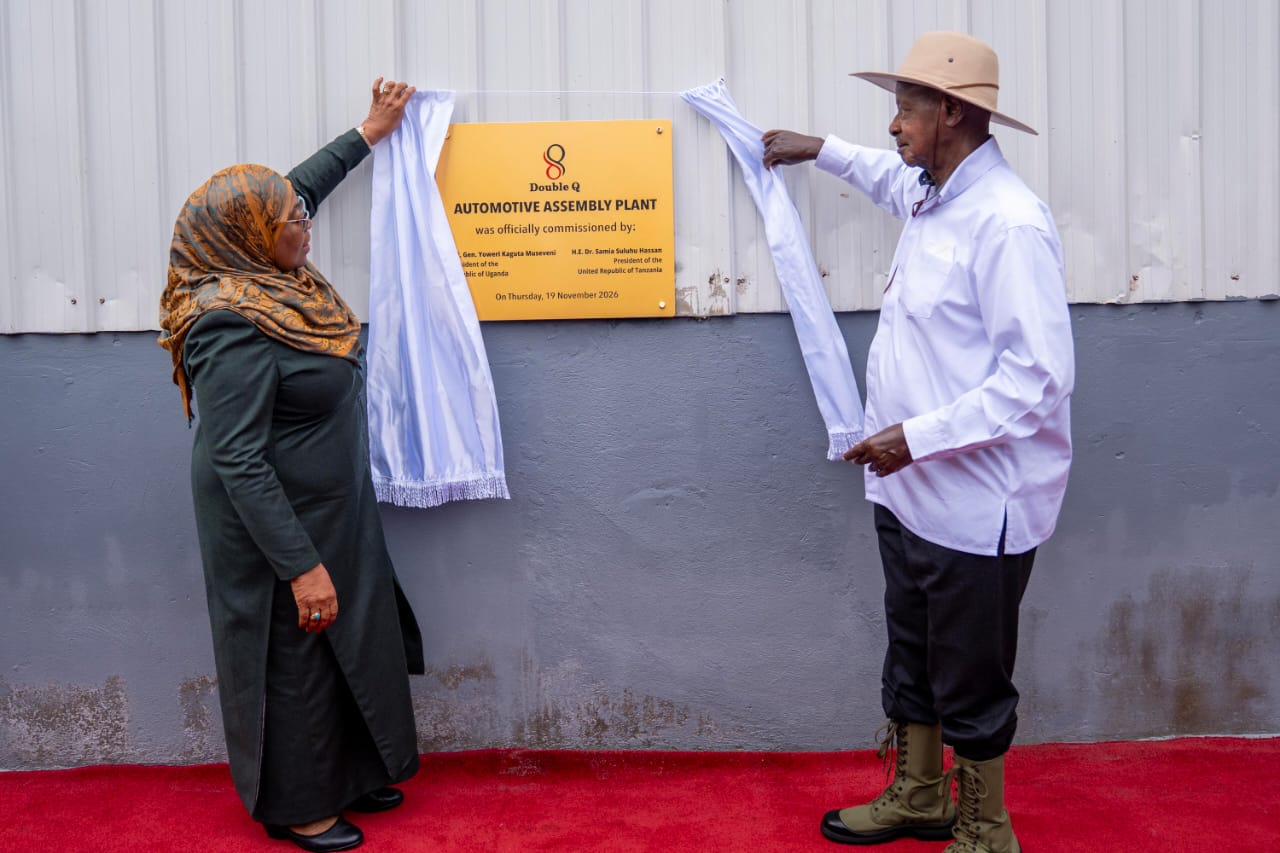
Museveni and Suluhu Call for Regional Industrial Integration at Launch of $30m Uganda Truck Plant
Presidents Yoweri Museveni and Samia Suluhu Hassan called for East African industrial integration on Thursday at the launch of Uganda’s $30 million Double Q truck assembly plant in Nakirebe, Mpigi District.
The launch, covered by Monitor, draws together two heads of state around a single factory floor — and around a shared argument that Africa’s 1.5 billion people, projected by the leaders to reach 2.5 billion within 30 years, can only be served by factories on the continent rather than imports from outside it.
The plant itself is the case study. Built on 45 acres of privately acquired land, it assembles Sinotruk heavy-duty trucks and holds the local franchises for GMC and XCMG, with an annual assembly capacity of 4,000 trucks, according to reporting by PML Daily. The company already runs vehicle body-building operations that add roughly 20 per cent local value.
Museveni wanted more. “On behalf of Uganda, I want to thank you so much for investing in Uganda, to assemble trucks, and also to build local parts, and eventually link up with the local steel industry,” he said, per PML Daily’s report from the event.
The market argument
Monitor reported that Museveni framed Africa as “the business centre of the future,” telling investors the continent’s population growth would create a vast market for goods and services — if countries can produce for it. Fragmented national markets, he argued, cannot sustain large-scale manufacturing.
“If you want to succeed, you need a united market for Africa,” he said, according to PML Daily.

He paired the two neighbours’ endowments as complementary inputs. “You find that Tanzania has got gas, Uganda has got iron ore, and other products. So, when you put them together, instead of using them in a fragmented way, you will do better business. You succeed more easily,” Museveni said.
Monitor reported that he listed four pillars of economic transformation: harnessing natural resources, producing goods and services, creating a united market, and building the transport and communication infrastructure trade runs on. He warned that ignoring them could expose Africa to the same vulnerabilities that enabled the slave trade and colonialism.
What Suluhu brought to the podium
Tanzania’s president tied the factory to freight. Cargo handled at Dar es Salaam Port had risen to 33 million tonnes in 2026, she said, creating demand for the trucks the plant assembles — vehicles that move goods between East African countries.
“Let us turn from being consumers of imported goods to regional production and marketing hubs. We should aspire to manufacture, assemble, and produce,” Suluhu said, as reported by PML Daily.
She also issued a caution that cuts against duplication. Citing Sinotruk’s operations in both Uganda and Tanzania, she urged governments to treat such investments as complementary rather than competing.
“East Africa must compete with the world, not within itself,” she said.
Suluhu called for harmonised regulations governing vehicle assembly across the East African Community, and revealed Tanzania is exploring partnerships for a railway locomotive manufacturing plant. She praised Uganda’s support for domestic manufacturers including Double Q Automotive and Kiira Motors, and described her two-day visit as a marker of the two countries’ bilateral commitment, per Monitor.
Where the reporting differs
The three accounts agree on the substance but diverge on emphasis. Monitor leads with the demographic case — the 1.5 billion to 2.5 billion projection — and Museveni’s challenge to African journalists to cover economic transformation rather than politics. The plant’s economics stand out: the $30 million price, the 45 acres, the 4,000-truck capacity. The $30 million figure features in the coverage alongside the leaders’ joint push for regional industrialisation.
The sources also differ in what they leave out. Only PML Daily reports the 20 per cent local value-addition figure and the locomotive plant plans. Only Monitor carries Museveni’s warning about the slave trade and colonialism, and his appeal to the media.
Why this matters now
Uganda has been trying to widen its manufacturing base and attract investment that creates jobs and technical skills, and the Nakirebe plant fits that effort directly, Monitor reported. The factory sits along the Kampala–Masaka corridor, a main artery for regional freight — the same routes the assembled trucks would serve.
The practical question for the region is whether complementary industrial policy can survive national competition. Suluhu’s harmonisation call puts that burden on EAC regulators; Museveni’s steel-linkage demand puts it on investors to source locally rather than import parts.
Businesses weighing entry into this expanding assembly, logistics and cross-border trade space — from haulage operators to parts suppliers — will need vetted local partners, legal counsel on EAC trade rules, and industrial land advisors as the regulatory harmonisation agenda moves forward.
Museveni pledged government support for the venture and thanked China for its partnership with Uganda, Monitor reported. The next test of the integration argument arrives with Tanzania’s proposed locomotive plant — whether it is built to complement Uganda’s industry, or to rival it.