
Boosting Perovskite Stability with Advanced Ligand Design
Perovskite materials have emerged as frontrunners in the next generation of solar cell technology, promising higher efficiencies and lower production costs than customary silicon-based cells.However, a key challenge hindering their widespread adoption is their instability – they degrade quickly when exposed to moisture, heat, and light. Recent research focuses on improving perovskite stability through innovative ligand design, specifically utilizing multivalent, resonance-stabilized amidinium ligands. These advanced ligands offer stronger chemical coordination and reduced deprotonation compared to conventional monovalent ammonium ligands, leading to more robust and efficient perovskite structures.
Understanding Perovskites and Their instability
Perovskites are a class of materials with a specific crystal structure similar to that of calcium titanate (CaTiO3). The term “perovskite” now broadly refers to materials with a similar structure, frequently enough containing organic and inorganic components. In the context of solar cells, hybrid organic-inorganic perovskites are most commonly used. These materials excel at absorbing sunlight and converting it into electricity, boasting power conversion efficiencies that have rapidly increased over the past decade, now rivaling those of silicon.
Despite their promise, perovskites are notoriously sensitive to environmental factors. Moisture, oxygen, and even prolonged exposure to light can trigger degradation, reducing the cell’s performance and lifespan. This instability stems from the inherent weaknesses in the chemical bonds within the perovskite structure and the tendency of the organic components to decompose. The ligands – the molecules that bind to the metal cations in the perovskite structure – play a crucial role in both the formation and stability of the material.
The Role of Ligands in Perovskite Structure
Ligands act as “glue” holding the perovskite structure together. They coordinate with the metal ions (typically lead or tin) and influence the overall arrangement of atoms. Conventional perovskite formulations often employ monovalent ammonium ligands. While effective in forming the perovskite structure, these ligands have limitations:
- Weak coordination: Monovalent ligands provide relatively weak chemical bonding to the metal cations, making the structure susceptible to disruption.
- Deprotonation: Ammonium ligands can readily lose protons (deprotonation), leading to the formation of defects within the perovskite film and accelerating degradation.
Introducing Multivalent Amidinium Ligands: A Stability Breakthrough
Researchers have turned to multivalent amidinium ligands as a solution to these challenges. These ligands,unlike their monovalent counterparts,possess multiple positive charges and a unique resonance stabilization. This combination offers important advantages:
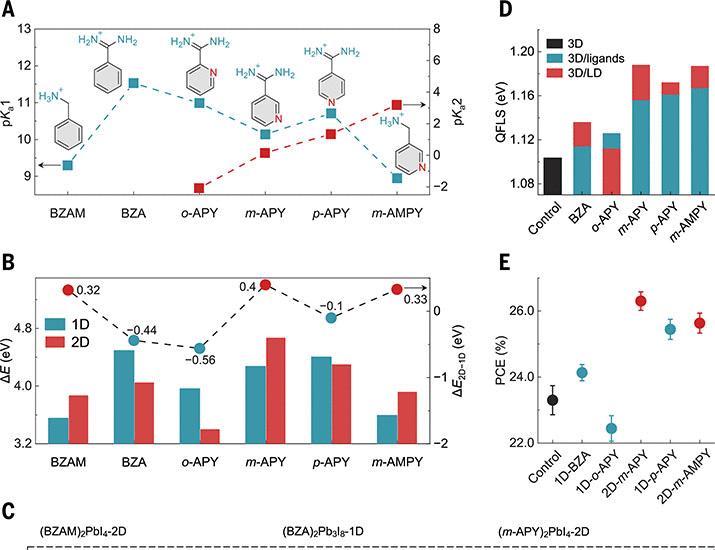
- Stronger Coordination: The multiple positive charges enhance the electrostatic attraction between the ligand and the metal cation, resulting in a much stronger chemical bond. This stronger bond makes the perovskite structure more resistant to disruption.
- Reduced Deprotonation: The resonance stabilization within the amidinium structure makes it less prone to deprotonation, minimizing the formation of defects and improving long-term stability.
A recent study demonstrated a controllable one- to two-dimensional transition in perovskite structures using these ligands, further enhancing stability and tailoring material properties.Source: Science advances
How Resonance Stabilization Works
Resonance stabilization refers to the delocalization of electrons within a molecule. In the case of amidinium ligands, the positive charge is not localized on a single atom but is spread out over several atoms within the molecule. This delocalization lowers the overall energy of the molecule, making it more stable and less likely to participate in chemical reactions like deprotonation. Think of it like distributing weight evenly across a platform – it’s more stable than concentrating the weight in one spot.
Controlling Dimensionality for Enhanced Performance
The ability to control the dimensionality of perovskite structures – whether they are three-dimensional (3D), two-dimensional (2D), or a mixture of both – is crucial for optimizing their performance. 3D perovskites generally exhibit higher efficiencies but are more susceptible to degradation. 2D perovskites are more stable but typically have lower efficiencies.
Multivalent amidinium ligands allow researchers to fine-tune the perovskite structure, creating materials with a controlled transition between 1D, 2D, and 3D arrangements. This control enables the creation of perovskites that balance high efficiency with improved stability. By carefully adjusting the ligand structure and concentration, scientists can engineer materials with tailored properties for specific applications.
Future Directions and Potential Applications
The development of multivalent, resonance-stabilized amidinium ligands represents a significant step forward in perovskite technology. Ongoing research focuses on:
- Ligand Optimization: Designing even more effective ligands with enhanced stability and tailored electronic properties.
- Scalability: Developing cost-effective methods for synthesizing these ligands on a large scale to enable mass production of perovskite solar cells.
- Device integration: optimizing the integration of these new perovskite materials into complete solar cell devices.
Beyond solar cells, stable perovskites have potential applications in:
- LEDs (Light-Emitting Diodes): Perovskites can be used as the active material in highly efficient and tunable LEDs.
- Photodetectors: Their excellent light absorption properties make them ideal for creating sensitive photodetectors.
- Catalysis: Perovskites can act as catalysts in various chemical reactions.
Key Takeaways
- Perovskite solar cells offer a promising alternative to traditional silicon-based technology but suffer from instability issues.
- Multivalent, resonance-stabilized amidinium ligands substantially enhance perovskite stability by providing stronger chemical coordination and reducing deprotonation.
- These ligands allow for control over the dimensionality of the perovskite structure, enabling the creation of materials with tailored properties.
- Ongoing research aims to optimize these ligands and scale up production for widespread adoption.
