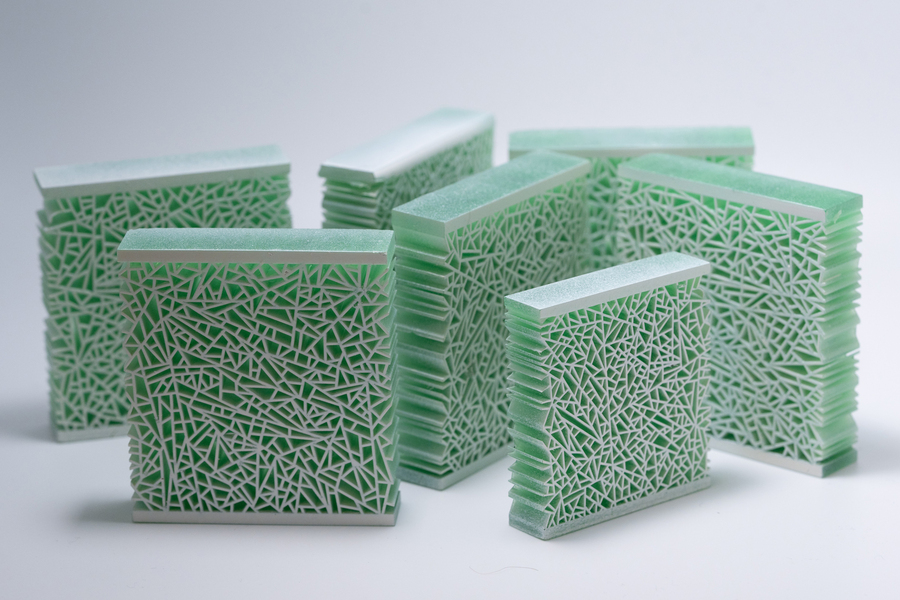
MIT and Northeastern Developed Scale-Rich Metamaterials to Keep Damage More Spread Out During Impacts
Researchers at MIT and Northeastern University have developed scale-rich metamaterials that keep damage more spread out during impacts than conventional designs, according to a study published in Nature on November 11, 2026, 3D Printing Industry reported.
Conventional metamaterials rely on a repeating unit cell, such as a square lattice or honeycomb. While these structures handle loads, they tend to fail in a cascade when one region deforms and triggers neighboring identical cells to buckle, MIT associate professor of mechanical engineering Carlos Portela told 3D Printing Industry.
“Because there is such a richness of length scales in these networked materials, if one part fails, there is a strong web of structures around it that keeps the entire material from failing catastrophically,” Portela said.
“It’s more efficient at distributing damage and absorbing energy,” Portela said.
The team drew inspiration from network science, which maps systems like food webs and neural connections. Co-author Albert-László Barabási, a Northeastern physics professor, collaborated with Portela’s group to see if these principles could build a physical material mimicking leaf veins or dragonfly wings.
To overcome physical limits in beam count, thickness, and spacing, the researchers wrote an algorithm that builds structures one line at a time. The program places points randomly and draws intersecting lines at random angles, creating a dense web of beams ranging from microns to centimeters.
Simulations and tests on credit card-sized polymer resin samples showed that adjusting initial line thickness and drop-off rates can tune stiffness across a wide range. Using a desktop printer, the team achieved densities limited to between 20% and 75%.
Other institutions are also exploring non-uniform geometries. Researchers at the University of Pennsylvania and Aarhus University found that materials with non-uniform lattice geometries exhibited 2.6 times greater toughness than uniform patterns, while Imperial College London developed a topology optimization framework for nonlinear metamaterials.
The study’s co-authors include Andrew Yen-Jong Chen, Mohammad Charara, and Jayna Wadhwa of MIT; Csaba Both and Ting-Ting Gao of Northeastern; and Niek Mooij of Utrecht University. The research was supported in part by the U.S. National Science Foundation’s DMREF program.