
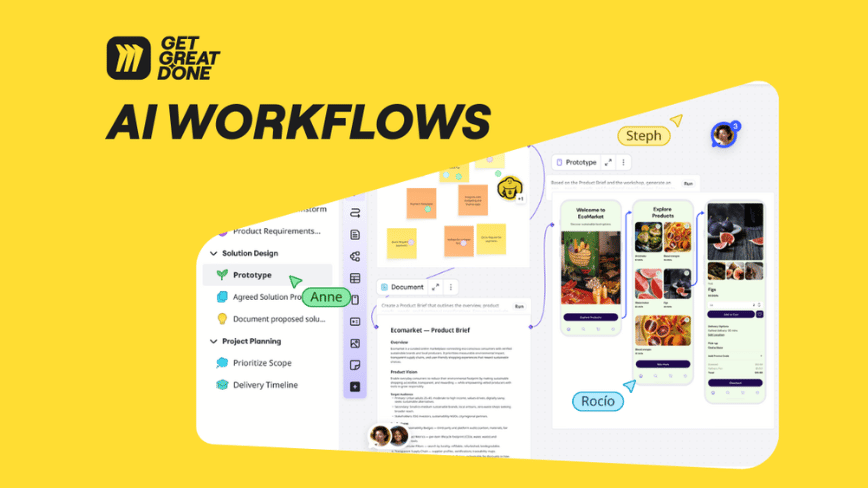
Miro Launches AI Workspace to Bridge the Gap Between Whiteboarding and Collaboration
The “linearity tax” is a hidden cost every architect knows: the grueling process of flattening a multi-dimensional whiteboard session into a one-dimensional prompt for an LLM. Miro is attempting to kill this friction by embedding AI agents directly into the canvas, treating spatial arrangement as primary context rather than a manual export task.
The Tech TL;DR:
- Contextual Automation: AI agents now ingest spatial relationships and whiteboard elements natively, eliminating the need to manually copy sticky notes into prompts.
- Workflow Shift: Moves the AI interaction from a separate “chat” window to an integrated agentic layer on the collaboration canvas.
- Market Consolidation: Follows a broader trend of AI-driven collaboration, mirrored by Microsoft’s recent acquisition of the Cove team to bolster its own AI collaboration stack.
The Linearity Tax and the Spatial Context Problem
For the past two years, the standard operating procedure for leveraging AI in design sprints has been inefficient. Teams spend hours mapping dependencies and user flows on a digital whiteboard, only to spend another hour “translating” that visual data for a chatbot. This process involves copying text from dozens of sticky notes, describing the arrows and groupings in prose, and hoping the LLM can reconstruct the mental model from a wall of text. This is a massive bottleneck in the continuous integration of ideas into technical requirements.
Miro’s deployment of AI agents directly on the whiteboard addresses this by treating the canvas as the source of truth. Instead of a user pushing data to the AI, the AI agent exists within the coordinate system of the project. It understands that a sticky note placed next to a “Payment Gateway” block is functionally related to that block, regardless of the order in which the notes were created. This removes the manual data-entry phase of the prompt engineering cycle.
From a systems perspective, this implies a transition from simple text-based RAG (Retrieval-Augmented Generation) to a spatially-aware context window. The agent isn’t just reading text; it is parsing the metadata of the board—coordinates, groupings, and connector lines—to build a relational graph before generating a response. For enterprise teams, this reduces the cognitive load and the potential for “hallucinations” caused by missing context during manual transcription.
The Collaboration Stack: Miro vs. The Ecosystem
This move doesn’t happen in a vacuum. The race to own the “AI Workspace” is accelerating. While Miro focuses on the canvas, Microsoft is aggressively absorbing specialized talent to achieve similar ends, as seen in their acquisition of the team behind the Sequoia-backed AI collaboration platform, Cove. The goal for both is the same: the elimination of the “context switch.”
When a developer has to abandon their workspace to interact with an AI, there is a measurable drop in flow state. By embedding agents into the tool where the brainstorming actually happens, the AI becomes a collaborator rather than a separate utility. However, the skeptical architect asks: where does this data live, and how is the spatial graph tokenized?
Comparative Analysis: AI Collaboration Frameworks
| Feature | Manual Prompting (Standard LLM) | Miro AI Agents | Integrated Platforms (e.g., Cove/MSFT) |
|---|---|---|---|
| Context Ingestion | Manual Copy-Paste | Native Spatial Parsing | Cross-App Ecosystem Sync |
| Data Structure | Linear Text | Relational Graph/Canvas | Unified Workspace Graph |
| Workflow Friction | High (Context Switching) | Low (In-Canvas) | Very Low (OS/App Level) |
| Primary Bottleneck | Human Transcription | Canvas Noise/Clutter | Inter-app Latency |
Implementation Realities and the Integration Gap
For CTOs and Lead Engineers, the rollout of agentic whiteboards introduces new challenges in governance and data residency. When an AI agent has “read” access to every brainstorm, architectural diagram, and roadmap on a board, the attack surface for sensitive intellectual property expands. The shift toward agentic workflows requires a rigorous review of SOC 2 compliance and complete-to-end encryption protocols to ensure that spatial metadata isn’t leaking into training sets.
Integrating these agents into a broader CI/CD pipeline is the next logical step. Imagine a whiteboard agent that doesn’t just summarize a brainstorm but automatically generates a Jira ticket or a GitHub Issue based on the spatial grouping of “To-Do” sticky notes. This requires a robust API layer that can translate canvas coordinates into actionable structured data.
While Miro handles the frontend experience, the backend orchestration of these agents often requires custom middleware for enterprise-grade security. Companies are increasingly relying on software development agencies to build the bridges between these AI-powered canvases and their internal proprietary databases.
To conceptualize how a developer might programmatically interact with such a context-aware agent, consider a theoretical API request that triggers an agent to analyze a specific spatial cluster on a board:
curl -X POST "https://api.miro.com/v2/ai/agents/analyze-cluster" -H "Authorization: Bearer YOUR_ACCESS_TOKEN" -H "Content-Type: application/json" -d '{ "boardId": "board_12345", "clusterId": "cluster_abcde", "analysisType": "dependency_mapping", "outputFormat": "markdown_table" }'The efficiency of this call depends entirely on the agent’s ability to resolve the clusterId into a set of related objects without requiring the developer to define the coordinates manually. This is the “magic” the PR teams talk about, but for the engineer, it’s simply a more efficient way of handling relational data.
The Security Post-Mortem: Risks of Agentic Access
The proliferation of AI agents within collaboration tools creates a new vector for data exfiltration. If an agent has the authority to read the entire canvas, a compromised account or a prompt-injection attack could potentially scrape an entire product roadmap in seconds. This isn’t just a theoretical risk; it’s a deployment reality.

Enterprise IT departments cannot treat these agents as “plug-and-play” features. There is an urgent need for cybersecurity auditors and penetration testers to evaluate how these agents handle permissioning. Does the agent respect the same granular permissions as the human user? If a user is restricted from seeing a “Budget” frame on the board, can the agent still access that data to provide a “summary” of the project? These are the questions that determine whether a tool is enterprise-ready or merely a productivity toy.
The Architectural Trajectory
We are moving away from the era of “The Prompt” and into the era of “The Environment.” The value is no longer in how well you can write a request, but in how well your tools can capture the ambient context of your work. Miro’s agents are a signal that the interface is becoming the prompt. The canvas is no longer just a place to draw; it is the input layer for the AI.
As this technology scales, the bottleneck will shift from context ingestion to output verification. The challenge for the next generation of Managed Service Providers will be managing the “agent sprawl” as every tool in the tech stack—from the whiteboard to the IDE—deploys its own autonomous agent. The goal will be creating a unified orchestration layer that prevents these agents from operating in silos.
Disclaimer: The technical analyses and security protocols detailed in this article are for informational purposes only. Always consult with certified IT and cybersecurity professionals before altering enterprise networks or handling sensitive data.