Midwives Deliver Babies With Flour-Sack Thread as Yemen Conflict Displaces 320,000
Escalating conflict in Yemen has displaced more than 320,000 people since August, leaving 6,400 pregnant women among them and forcing midwives to deliver babies with flour-sack thread and borrowed razor blades, the United Nations reported Saturday.
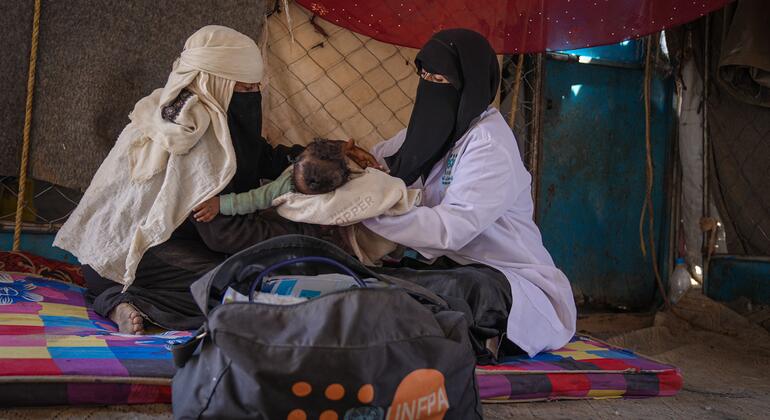
When fighting surged around Taiz two months ago, midwife Anisa Fadhl fled her village with no transport and no time to pack, she told the UN’s sexual and reproductive health agency, UNFPA. “No transportation was available, and we escaped with only our lives,” Fadhl said.
Her clinic was later looted and destroyed. “They stole chairs, mattresses and all electronic medical equipment – looters even carried away the examination beds,” she said. “I would have packed my medical equipment and belongings, but the entire village fled the same day,” she explained.
The International Organization for Migration estimates more than 22 million people in Yemen already required humanitarian assistance this year. October alone saw more than 80,000 new displacements. UNFPA estimates around 600 women will give birth this month without basic sanitary or medical infrastructure, while 1,500 may need emergency obstetric and newborn care. Fewer than two-thirds of health facilities are fully functional, and three women die every day from preventable pregnancy complications.

“She delivered my baby smoothly with zero tools. She tied my baby’s cord with a flour-sack thread and cut it with a razor blade borrowed from a neighbour.”
Um Mohammed, who fled Taiz while heavily pregnant, described the delivery to UNFPA hours after reaching a host family in Aden. “It was the hardest delivery of my life. Not just because of the physical pain, but because of fear and anxiety.” “I was terrified of losing my [pregnancy], getting injured by shelling, or having something terrible happen to my children,” she told UNFPA.
Midwife returns to work within days
Two days after arriving in Aden, Fadhl resumed care across displacement sites despite severe medicine shortages and minimal supplies. She conducts prenatal and postnatal checkups, advises on breastfeeding and hygiene, and provides psychosocial support and family planning services. “Early marriage is widespread,” Fadhl said.
“Girls aged 20 often already have two children without ever receiving birth spacing counselling or family planning services.” Fadhl continued caring for vulnerable people as she fled. “My priority was providing rest for the children and pregnant women,” she recalled. “While walking, a cargo truck passed by; we loaded some pregnant women, elderly women and children onto it.”
UNFPA had trained Fadhl years earlier and helped equip her original practice. As of 30 October, the agency had reached nearly 180,000 people with emergency reproductive healthcare and protection services, deploying mobile health teams and mobilising community midwives, UN News reported. The agency also arranged referrals to specialist facilities.
Funding gap threatens continuity
UNFPA is appealing for $71.9 million in 2026 to maintain support for women and girls. Only one-quarter of that amount is funded to date. The shortfall jeopardises mobile clinics, referral pathways, and the supply chain that allows midwives like Fadhl to operate in displacement camps across Aden, Marib and other governorates hosting the newly displaced.
Founded as the United Nations Fund for Population Activities in 1969 after a 1966 declaration by 12 heads of state, UNFPA became a UN General Assembly body in 1971 and took its current name in 1987. It is the world’s largest multilateral source of funding for population and reproductive health programmes, working in more than 144 countries with around three-quarters of its staff in the field.
Displacement concentrates in southern governorates
Most of the 320,000 people displaced since August have moved toward Aden, Lahj and Abyan, where host communities and existing camps absorb new arrivals with limited water, sanitation and health infrastructure. IOM tracking shows October’s 80,000 new displacements were driven by intensified frontline clashes in Taiz, Hodeidah and Marib, compounding a crisis that has persisted since 2015.
| Indicator | Figure | Period / Source |
|---|---|---|
| People displaced | Over 320,000 | Since August 2026 (IOM) |
| New displacements in October | More than 80,000 | October 2026 (IOM) |
| People needing humanitarian aid | More than 22 million | 2026 estimate (IOM) |
| Pregnant women displaced | Over 6,400 | Current displacement wave (UNFPA) |
| Births without infrastructure this month | Around 600 | November 2026 estimate (UNFPA) |
| Women needing emergency obstetric care | Around 1,500 | November 2026 estimate (UNFPA) |
| Health facilities fully functional | Fewer than two-thirds | Current (UNFPA) |
| Maternal deaths per day | Three | Current (UNFPA) |
| People reached by UNFPA | Nearly 180,000 | As of 30 October 2026 (UNFPA) |
| UNFPA 2026 appeal | $71.9 million | 2026 (UNFPA) |
| Appeal funded to date | One-quarter | As of 21 November 2026 (UNFPA) |