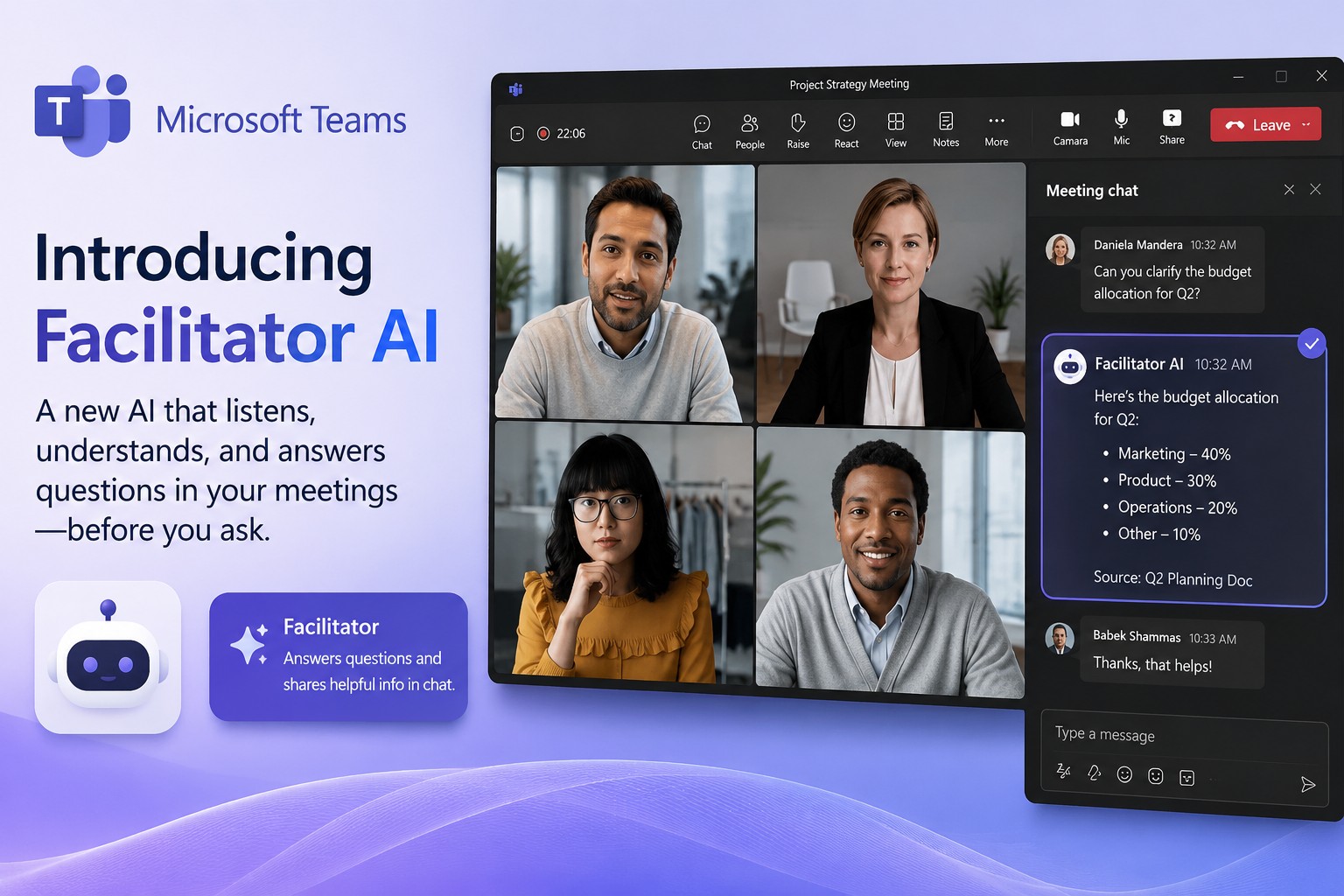
Microsoft Teams Facilitator AI to Automate Meeting Chat Answers
Microsoft Teams Facilitator AI: Architectural Analysis and Enterprise Integration
Microsoft has initiated the rollout of Facilitator AI for Microsoft Teams, an automated meeting assistant designed to process real-time audio streams, synthesize participant discourse, and inject context-aware responses directly into the chat interface. According to official Microsoft documentation, the system leverages Large Language Models (LLMs) to perform semantic analysis on meeting transcripts, aiming to reduce the administrative latency associated with post-meeting documentation and action item tracking.
The Tech TL;DR:
- Automated Contextual Injection: The model operates as an active participant, parsing natural language to generate chat-based answers without manual prompting.
- Latency and Compute: The feature relies on cloud-side inferencing, utilizing Azure’s AI infrastructure to process audio-to-text and intent-recognition pipelines in near-real-time.
- Security Perimeter: Enterprise deployment requires strict adherence to Microsoft 365 data residency protocols and tenant-level compliance configurations to prevent unauthorized data exfiltration during LLM training cycles.
Architectural Implementation and API Constraints
Facilitator AI operates within the existing Microsoft Graph ecosystem. Developers looking to interface with these meeting insights should note that the system relies on the /meetings and /chats endpoints. The underlying architecture functions by hooking into the real-time transcription service, where the LLM performs tokenization and vectorization to determine if a specific query within the chat requires an automated response.

For engineering teams integrating these workflows into custom internal tooling, the following cURL request illustrates how one might query the meeting transcript state that Facilitator AI utilizes for its decision-making logic:
curl -X GET 'https://graph.microsoft.com/v1.0/me/onlineMeetings/{meetingId}/transcripts'

-H 'Authorization: Bearer {access_token}'

-H 'Content-Type: application/json'
As noted in the official Microsoft Graph API documentation, the granularity of these transcripts is subject to regional data sovereignty laws. Organizations must ensure that their [Managed Service Provider] has configured appropriate Purview Information Protection labels to ensure that sensitive meeting data processed by the AI remains within specified geographic boundaries.
The “Tech Stack & Alternatives” Matrix
When evaluating Facilitator AI against industry incumbents, the primary differentiator is the deep integration with the M365 kernel. Unlike third-party transcription services that function as “man-in-the-middle” applications, Facilitator AI is a first-party service, which theoretically reduces the surface area for unauthorized API access.
| Feature | Microsoft Facilitator AI | Otter.ai (Enterprise) | Zoom AI Companion |
|---|---|---|---|
| Integration Depth | Native (Kernel-Level) | Plugin/Third-Party | Native (Zoom Ecosystem) |
| Data Residency | Tenant-Bound (Azure) | Vendor-Cloud | Zoom-Cloud |
| API Latency | Low (Internal Fabric) | Moderate (External REST) | Low (Internal Fabric) |
Cybersecurity and Compliance Triage
The introduction of any LLM-driven agent into a collaborative environment necessitates a review of existing SOC 2 compliance documentation. Cybersecurity researchers suggest that “prompt injection” remains a theoretical risk when AI agents are granted read/write access to persistent chat channels. According to OWASP’s Top 10 for LLMs, developers must implement strict input sanitization protocols when utilizing automated responses.
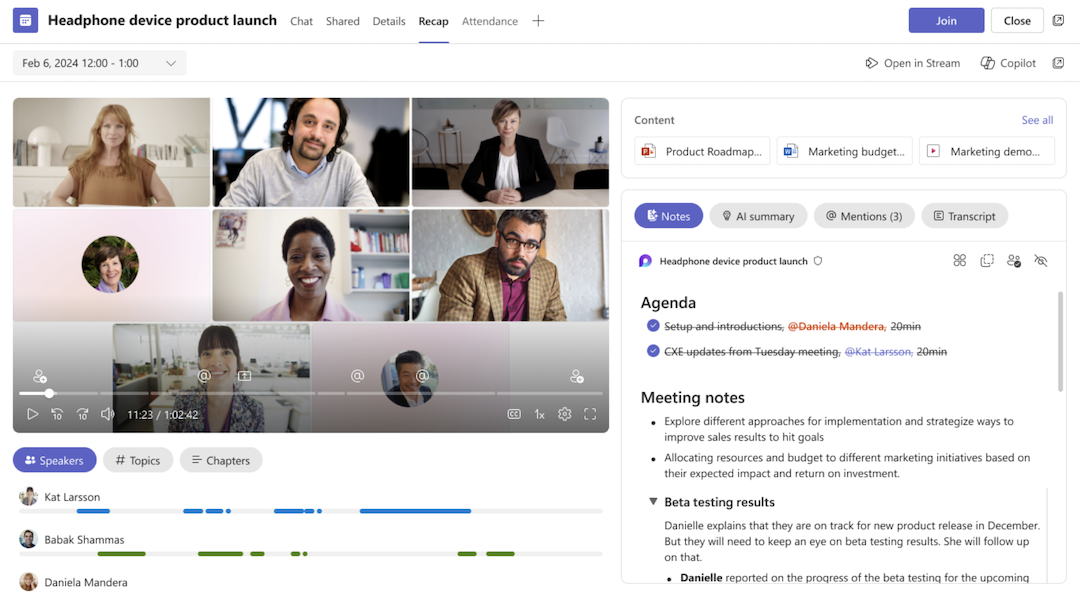
For enterprises managing high-sensitivity environments, deploying [Cybersecurity Auditors] to review the tenant’s “AI Policy” settings within the Microsoft 365 Admin Center is an essential prerequisite. Failure to define the scope of the AI’s access can lead to unintended information disclosure if the model inadvertently summarizes private channel data into shared meeting chats.
Future Trajectory: The Move Toward Autonomous Coordination
The current iteration of Facilitator AI is designed to assist rather than replace. However, the architectural trajectory points toward an era of autonomous project management where LLMs handle Jira ticket updates, GitHub issue assignments, and calendar scheduling without human intervention. CTOs should prioritize the auditability of these logs today to ensure they are prepared for a more autonomous software development lifecycle (SDLC) tomorrow.
As organizations scale their reliance on these tools, the demand for [Software Development Agencies] capable of building custom connectors for these AI agents will increase. The focus will inevitably shift from simply “reading” meetings to “executing” the technical requirements discussed within them.
Disclaimer: The technical analyses and security protocols detailed in this article are for informational purposes only. Always consult with certified IT and cybersecurity professionals before altering enterprise networks or handling sensitive data.