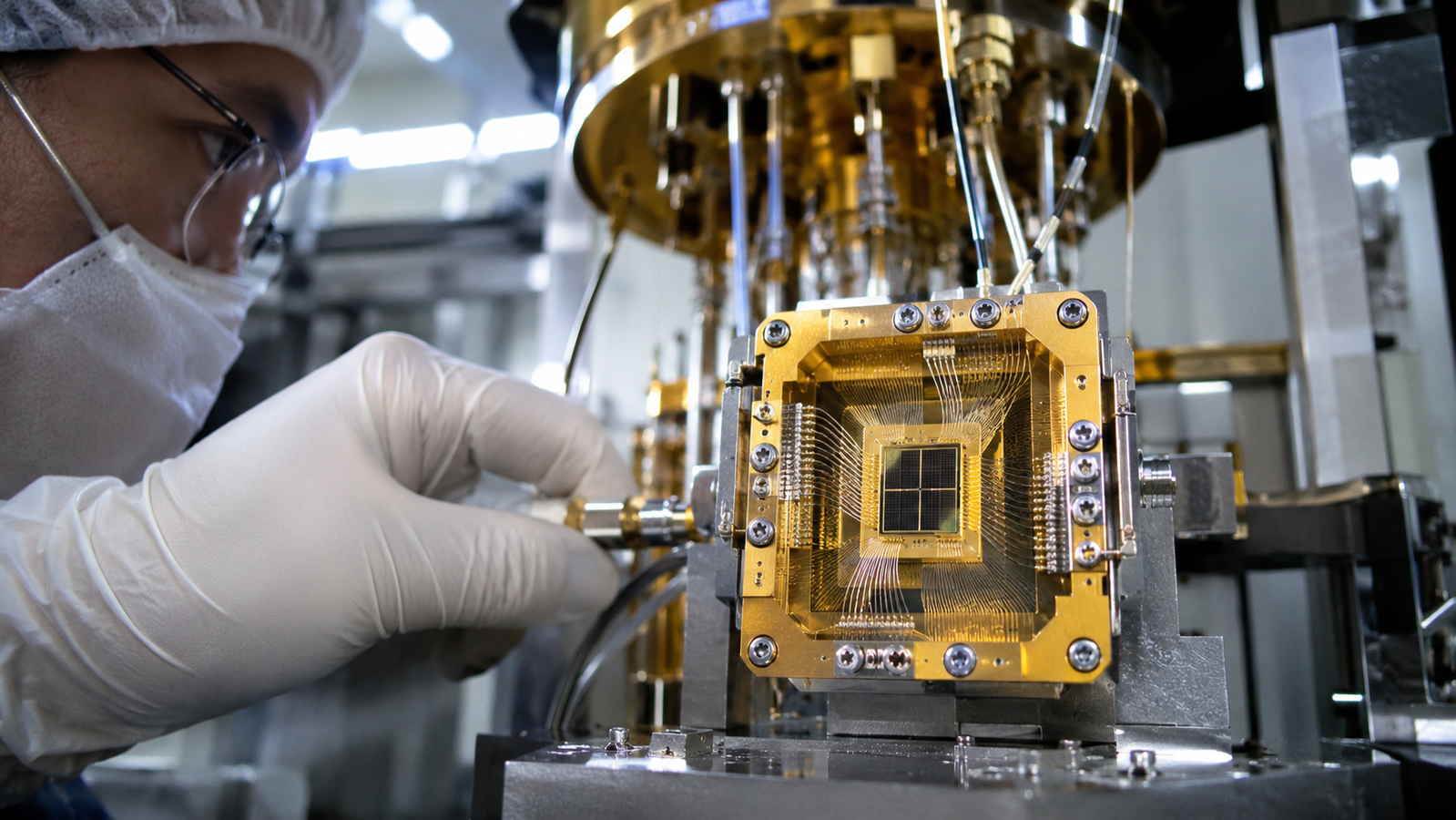
Microsoft Targets 2029 for Scalable, Fault-Tolerant Quantum Computer
Microsoft placed its Majorana 2 quantum chip at the disposal of DARPA at a research center opened in September 2026 with the University of Maryland, according to Tom's Hardware.
Chip Prototype Testing
The U.S. agency can directly verify a prototype designed to safeguard information against disruptions. Enhanced stability could assist quantum processors in carrying out longer calculations with fewer errors.
The data originates from a preliminary study released in June on arXiv without peer review. Researchers estimated a characteristic time of 22 seconds between parity changes in a single nanowire of the prototype, with some intervals reaching about a minute.
Material Modifications
Electronic parity indicates whether the number of electrons in the nanowire is even or odd. For the second-generation chip, Microsoft substituted aluminum with superconducting lead and modified the semiconductor layers.
Lead makes breaking electron pairs in the superconductor harder, reducing a primary cause of parity changes according to researchers. In aluminum devices described by the group in 2025, including in Nature, parity times measured on the order of milliseconds.
Topological Protection and Scale
Effective topological protection during operations could reduce the physical qubits needed for reliable quantum calculations. Topological qubit architecture distributes information between the ends of two nanowires using Majorana zero modes.
These states theoretically render information less vulnerable to disruptions at a single circuit point. A similar approach utilizing anyons for quantum operations appears in separate research.
Quantum Benchmarking Goals
To correct errors during calculations, multiple physical qubits cooperate to form a logical qubit. Reduced errors during operations mean fewer physical qubits could achieve identical reliability, leaving more resources for calculation.
This verification falls under the final phase of the Quantum Benchmarking Initiative, reached by Microsoft through the US2QC pilot program. The agency compares hardware performance against project designs to produce a machine whose calculation value exceeds operating costs.
Microsoft targets 2029 for a scalable, fault-tolerant quantum computer, four years ahead of the timeline indicated in 2025. Determining how long the qubit preserves quantum information requires measuring the stability of the superposition of the two states encoding zero and one on the same device.