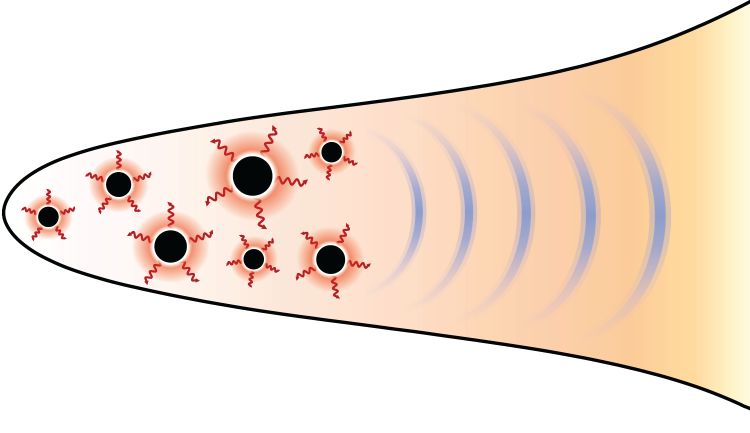
Microscopic Primordial Black Holes May Have Reheated the Early Universe
“The smallest primordial black holes may have been smaller than an atom,” said Nicolas Leister, a PhD student at the PRISMA++ Cluster of Excellence.
A new study suggests these microscopic black holes acted as the heaters of the young universe, generating the hot plasma necessary for matter to form.
Theoretical physicists from Johannes Gutenberg University Mainz and the Institut d’Astrophysique de Paris propose these primordial black holes triggered a second reheating phase shortly after the Big Bang. While the universe experienced an initial period of rapid, exponential expansion between 10⁻³⁵ and 10⁻³³ seconds, it subsequently supercooled.
The study challenges a cosmological assumption that primordial black holes were uniform in size. Previous models suggested that if these objects all shared the same mass, they would have evaporated and exploded simultaneously, producing a massive gravitational wave signal that would have disrupted the formation of atoms.

By simulating a population of black holes with varying masses, researchers found that the resulting explosions occurred at different times. This gradual process suppressed the intensity of gravitational waves, allowing the early universe to maintain conditions suitable for further growth.
“There is strong evidence that the universe went through a phase of extremely rapid expansion right at its beginning, known as inflation”, said Schwaller, theoretical physicist at JGU and PRISMA++ Cluster of Excellence. “But between this reheating and the earliest processes we can trace today, such as the formation of the first atomic nuclei, we know surprisingly little about what happened”, Schwaller explained.

This is equivalent to the weight of a large container ship. The researchers incorporated black holes of various sizes while still respecting this upper limit.
This was crucial because larger black holes exploding at the same time would have produced a very strong gravitational wave signal, much stronger than we have thus far detected. By modeling a population with varying masses, the team found that the resulting explosions occurred at different times, suppressing the intensity of gravitational waves and allowing the early universe to maintain conditions suitable for further growth.
The researchers adhered to an upper mass limit established by Stephen Hawking in the 1970s. Hawking determined that primordial black holes exceeding 10⁹ grams—roughly the weight of a large container ship—would have a lifetime of only one second, a threshold that would have interfered with cosmic chemistry if they all exploded at once.
“But since they would have held almost all of the universe’s energy, their explosions could have filled the entire cosmos with the hot plasma from which matter formed,” said Leister. This model offers a potential explanation for the gap between the initial inflationary expansion and the earliest processes currently traceable by scientists.