Medieval Gold Ring with Blue Gemstone Unearthed in Norway
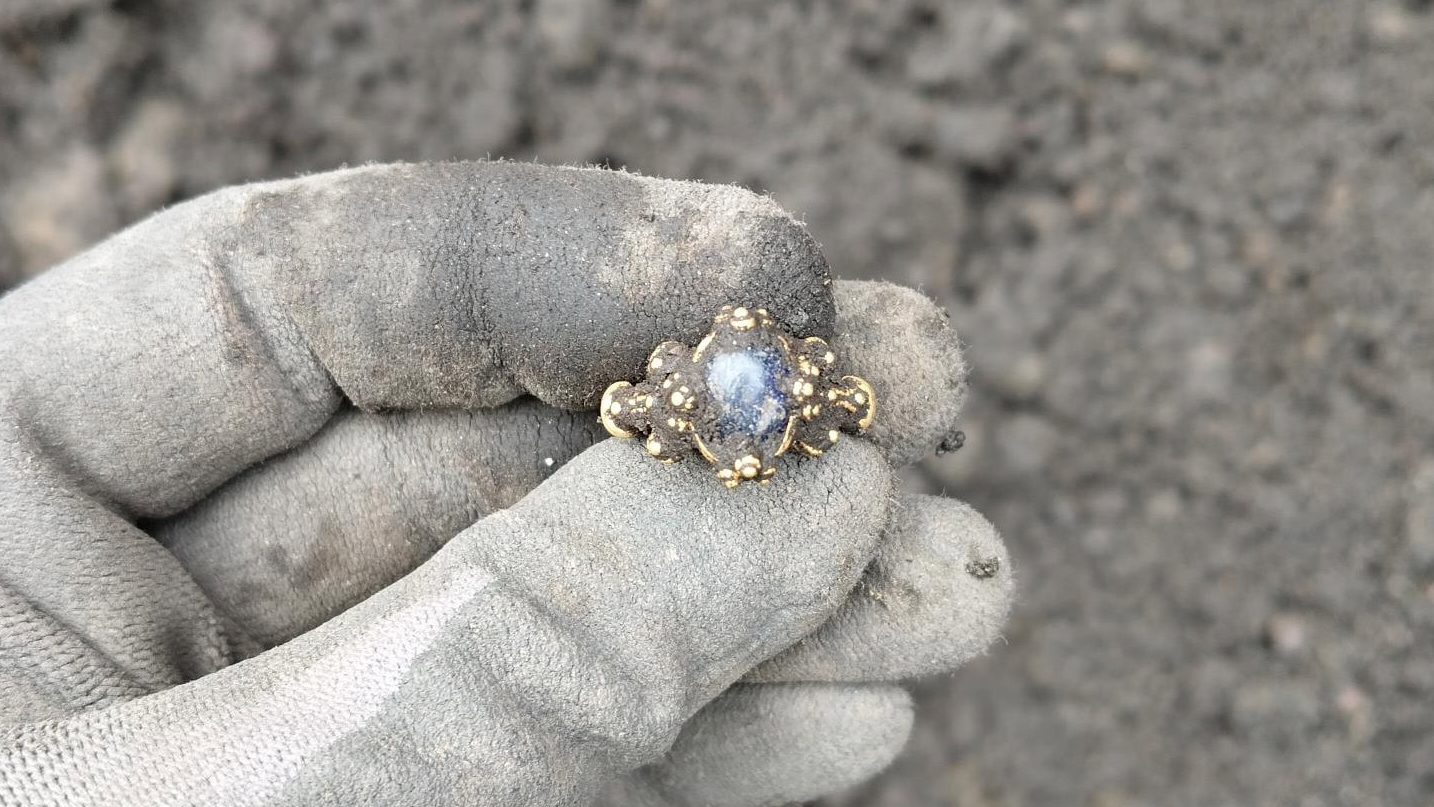
An archaeologist working in the center of Tønsberg, Norway, experienced a moment she described as “out of body” when her trowel struck gold last summer. Linda Åsheim, of the Norwegian Institute for Cultural Heritage Research (NIKU), unearthed a remarkably well-preserved medieval gold ring, a discovery hailed as a “dream find” by the institute.
Åsheim was excavating a site along Prestegaten in Tønsberg, Norway’s oldest city, as part of a larger project to upgrade the area’s stormwater infrastructure. The work, conducted on behalf of Tønsberg Municipality, has revealed remnants of the medieval town, including houses, streets, and evidence of past fires, all situated beneath the former royal fortress of Tunsberghus.
The ring was found just seven centimeters below the surface, within a cultivation layer. Whereas the layer itself has not yet been definitively dated, a spruce twig discovered above it was dated to between 1167 and 1269, providing a timeframe for the ring’s deposition. Åsheim initially questioned whether she was being pranked by construction workers, she said in a statement.
The ring features an oval, deep-blue stone – potentially sapphire or a cobalt-colored glass imitation – set within a finely crafted gold band. Delicate filigree, consisting of thin, twisted gold wires, surrounds the stone, and tiny soldered gold beads, known as granulation, further adorn the design. Archaeologists believe the style of goldsmithing suggests the ring originated sometime between the ninth and eleventh centuries, with techniques likely imported from the Byzantine Empire.
“It has been 15 years since we last found a gold ring in Tønsberg, and this one is a fantastically beautiful and rare specimen,” said Hanne Ekstrøm Jordahl, NIKU archaeologist and project manager.
Based on its size – estimated to fit a finger circumference of 50 to 55 millimeters, equivalent to a U.S. Women’s size 5 1/2 to 7 1/2 – the team believes the ring likely belonged to a woman of high social standing. The ring itself may have been a symbol of wealth and status, while the blue gemstone could have held additional significance. In the Middle Ages, blue stones were believed to offer protection and possess moral qualities, including preserving chastity and providing divine protection.
The excavation site lies within the automatically protected cultural heritage area of Tønsberg medieval town. Previous excavations in the area have uncovered evidence of medieval life, including houses on Vektertorvet, a possible street in Storgaten, a burned building, and defensive structures.
NIKU archaeologists are continuing to excavate the site, with work scheduled to continue as part of the municipality’s ongoing stormwater management project.