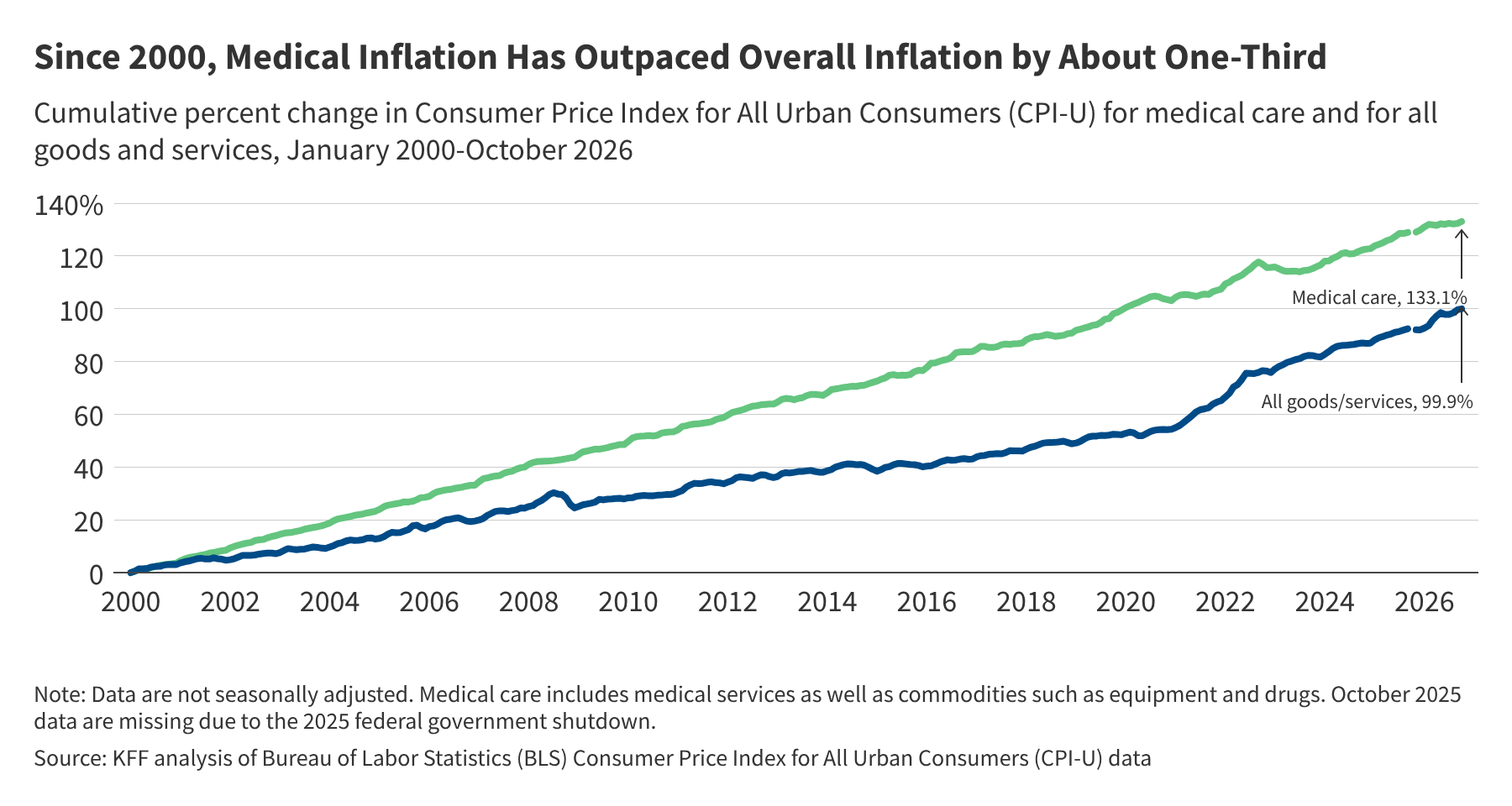
Medical care prices have risen faster than overall consumer prices over the long term
Medical care prices have risen faster than overall consumer prices over the long term, though overall consumer price inflation exceeded medical inflation in recent months, KFF reported.
Between January 2000 and October 2026, medical care prices cumulatively grew 33% more than overall consumer prices, according to a [Peterson-KFF Health System Tracker analysis]. Overall prices for medical care—including insurance, drugs, medical equipment and general healthcare services—increased by 133% during that period, while prices for all consumer goods and services rose by 100%, KFF reported.
Short-term trends show a different pattern. Inflation across all consumer goods and services reached 3.7% from September 2025 to September 2026, surpassing medical inflation of 1.5% during the same timeframe, on.kff.org reported. Annual percent changes for the Consumer Price Index are shown for September 2026 due to missing data following the October 2025 government shutdown, on.kff.org noted.

Within the medical sector, price growth varies widely. Hospital services experienced the fastest growth, with prices quadrupling by 314% since January 2000, according to data from the Bureau of Labor Statistics examined by [KFF]. That hospital price growth outpaced all eight major groups in the Consumer Price Index for All Urban Consumers (CPI-U), which include housing, food and beverages, transportation, apparel, recreation, education and communication, and other goods and services, IQConnect reported.
| Medical and Consumer Sectors | Price Growth Since January 2000 |
|---|---|
| Hospital services | 314% |
| Nursing homes | 179% |
| Dental services | 163% |
| Overall medical care | 133% |
| Prescription drugs | 94% |
| Physicians’ services | 84% |
Other healthcare components also showed distinct trajectories since 2000. Nursing home prices grew 179% and dental services rose 163%, both outpacing the overall medical care increase of 133%, on.kff.org reported.
Meanwhile, prescription drug prices nearly doubled at 94%, tracking close to overall consumer inflation but staying lower than non-medical sectors like housing at 118% and food and beverages at 109%, on.kff.org stated. Physicians’ services grew 84% over the same period, trailing overall medical inflation, on.kff.org noted.