Mechanical Deformation Induces Long-Range Alignment and Material-Dependent Polarization in Ferroelectric Nematic Liquid Crystals
Mechanical deformation can impose long-range, radially symmetric alignment in ferroelectric nematic liquid crystals and select a macroscopic polarization direction that depends on the specific material, researchers reported in Nature. The effect occurs without electrodes or alignment layers and persists only in the ferroelectric nematic phase.
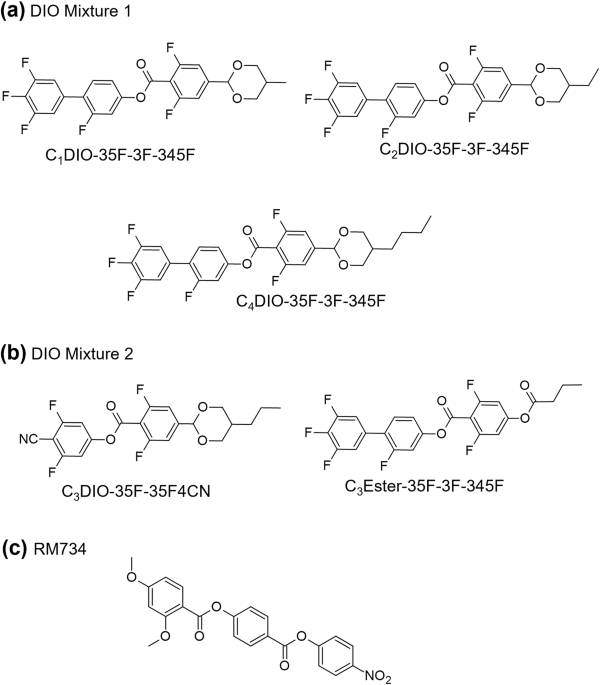
Scientists fabricated hybrid cells with a rigid glass substrate and a flexible cover glass or polyethylene naphthalate film, testing three ferroelectric nematic materials: two synthesized 1,3-dioxane derivative mixtures (DIO Mixture 1 and DIO Mixture 2) and the commercial compound RM734, Nature reported. DIO Mixture 1 contains only DIO-based molecules, while DIO Mixture 2 combines DIO-based and ester-based components.
How does deformation affect alignment across mesophases?
In the nematic phase, deformation caused local thickness changes but preserved the pre-existing director configuration, with full texture recovery upon release. In an intermediate mesophase, deformation produced only a limited, partially radial texture near the pressure point.
In the ferroelectric nematic phase, however, deformation erased domain boundaries over several millimeters, generating concentric colored patterns and distinct radial dark lines that persisted for seconds under sustained pressure, Nature reported. The same long-range alignment appeared in all three materials tested.
Does mechanical deformation select a polarization direction?
Voltage measurements during deformation and release revealed material-dependent polarity in the ferroelectric nematic phase. DIO Mixture 1 generated a negative voltage during deformation and positive upon release, indicating polarization toward the thinner end of the tapered cell. DIO Mixture 2 and RM734 showed the opposite polarity, with polarization pointing toward the thicker end, Nature reported. No consistent signals were detected in the nematic phase, while intermediate-phase responses were weak and inconsistent.
Why do materials with similar components behave differently?
DIO Mixture 1 and DIO Mixture 2 contain the same DIO-based molecules yet select opposite polarization directions under identical deformation geometry. RM734 has a wedge-like molecular structure, while DIO-based molecules are more rod-like. The researchers concluded that the preferred sense of spontaneous splay is governed not by individual molecular shape alone but by collective factors including intermolecular packing and dipolar interactions, Nature reported. The microscopic mechanism remains unresolved.
How does surface anchoring change the response?
In cells treated with a planar-degenerate alignment layer, mechanical deformation preserved the pre-existing striped multidomain texture instead of erasing it, and voltage signals were negligible. The surface anchoring competed with and largely suppressed the deformation-induced alignment observed in untreated cells, Nature reported.