
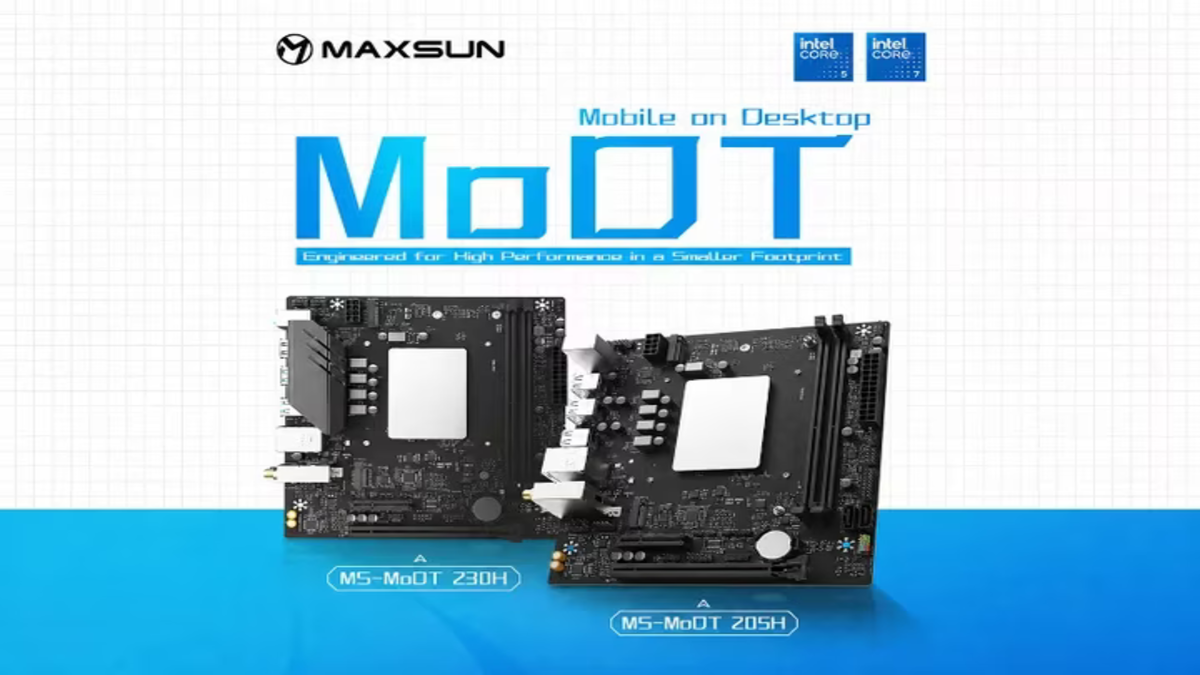
MaxSun Launches MoDT Motherboards With Intel Core 200H CPUs
MaxSun is attempting to blur the lines between mobile efficiency and desktop utility with its latest MoDT (Mobile on Desktop) rollout. By slapping “Core 200H” branding on what is fundamentally Raptor Lake silicon, the manufacturer is targeting the budget SFF (Small Form Factor) market, though the naming convention is a masterclass in consumer obfuscation.
The Tech TL;DR:
- The Hardware: New MS MoDT 230H D4 WIFI and 205H D4 WIFI boards featuring soldered Intel Raptor Lake mobile CPUs.
- The Spec: The flagship Core 7 230H delivers 10 cores (6P + 4E) and 16 threads with a 5.2 GHz boost clock.
- The Trade-off: High value and low power draw (45W base) exchanged for zero CPU upgradeability due to BGA packaging.
The industry is currently seeing a surge in “hybrid” hardware—components that migrate mobile SoCs (System on a Chip) into desktop form factors to undercut the price of traditional LGA socketed combos. This approach solves the immediate bottleneck of high entry costs for budget gaming and home-server builds, but it introduces a significant lifecycle risk: the CPU is soldered. When the silicon hits its performance ceiling, the entire motherboard becomes e-waste. For enterprise deployments, this shift requires a different procurement strategy, often necessitating the guidance of IT hardware consultants to balance initial CapEx savings against long-term TCO (Total Cost of Ownership).
Architectural Breakdown: Raptor Lake in Desktop Clothing
The core of the controversy lies in the branding. While “Core 200H” suggests a new generation, these boards are powered by Raptor Lake architecture. The Intel Core 7 230H is a mobile-derived chip optimized for a 45W base power envelope, though it can spike to 115W during maximum turbo bursts. This makes it an ideal candidate for passive or low-profile cooling solutions in SFF builds where thermal throttling is the primary enemy.
From a technical standpoint, the use of DDR4 memory on these boards is a strategic move to maintain affordability. While the industry is pushing DDR5, the latency and cost benefits of DDR4 remain relevant for the value segment. However, the lack of a socket means these boards are essentially “frozen” in time. If a vulnerability is discovered at the microcode level that requires a hardware revision, or if the workload demands more threads, there is no path forward other than a full board replacement.

| Specification | Intel Core 7 230H (MS MoDT) | Architecture Note |
|---|---|---|
| Core Configuration | 10 Cores (6 Performance / 4 Efficient) | Hybrid Architecture |
| Thread Count | 16 Threads | Hyper-Threading enabled on P-cores |
| Boost Clock | Up to 5.20 GHz | Dynamic Frequency Scaling |
| Cache | 24 MB | L3 Smart Cache |
| Power Profile | 45W Base / 115W Max Turbo | Mobile TDP optimization |
| Memory Support | DDR4 | Legacy value optimization |
For developers and sysadmins deploying these boards as lightweight Kubernetes nodes or edge computing gateways, verifying the hardware topology is critical. Because these are mobile chips, the OS may report them differently than standard desktop CPUs.
# Verify CPU topology and core distribution on Linux lscpu | grep -E "Architecture|CPU(s):|Thread(s) per core|Core(s) per socket|Model name" # Check for BGA (Ball Grid Array) status via dmidecode sudo dmidecode -t processor | grep "Socket Designation"The SFF Bottleneck and Thermal Realities
The move toward MoDT boards is a response to the “DDR5 price crisis” and the increasing demand for power-efficient compute. By utilizing a mobile SoC, MaxSun reduces the VRM (Voltage Regulator Module) complexity required on the motherboard, allowing for a more compact design. However, the 115W turbo power creates a thermal density challenge. In a cramped SFF chassis, the delta between the 45W base and 115W peak can lead to aggressive thermal throttling if the cooling solution is undersized.
“The proliferation of BGA-based desktop boards represents a shift toward ‘appliance-style’ computing. We are moving away from the modular PC and toward a world where the motherboard is a disposable component, much like a laptop.”
This “appliance” approach is efficient for scaling, but it creates a nightmare for sustainability and repair. When a capacitor blows or a trace fails on a soldered board, the user cannot simply swap the CPU to test for failure. This increases the reliance on specialized hardware repair services capable of board-level micro-soldering, as traditional consumer-grade repairs are impossible.
MaxSun MoDT vs. Traditional Desktop Combos
When comparing these boards to a traditional B760 or Z790 setup, the trade-off is clear: immediate affordability versus future-proofing. A traditional build allows for the adoption of the latest Intel generations via socket updates (within the same platform lifecycle). The MoDT approach is a dead end by design. It competes less with high-end desktops and more with Mini-PCs from the likes of Beelink or Minisforum, but with the added benefit of using standard desktop RAM and PCIe expansion slots.
For those integrating these into a production environment, the focus should be on the Intel ARK specifications to ensure the TDP fits the chassis thermal budget. Monitoring the Linux hardware database is essential for ensuring driver compatibility with the specific mobile-to-desktop bridge chips MaxSun employs.
The Verdict: Value or Vaporware?
MaxSun isn’t selling a revolution; they are selling a shortcut. By repurposing Raptor Lake mobile silicon, they’ve created a highly competitive entry point for users who need “enough” power without the “socket tax.” The “Core 200H” branding is a marketing sleight of hand, but the hardware itself is a pragmatic solution to the current pricing volatility of the PC component market.
As we move toward an era of NPUs (Neural Processing Units) and integrated AI accelerators, the MoDT trend will likely accelerate. We will see more “desktop” boards that are actually mobile SoCs, as that is where the most aggressive efficiency gains are happening. For the CTO or lead engineer, the question is no longer about peak performance, but about the lifecycle of the silicon. If you are building for a three-year refresh cycle, these boards are a win. If you are building for a decade, stay away from the BGA.
Whether you are scaling a server farm or building a budget workstation, the move toward integrated silicon requires a new level of oversight. It may be time to audit your hardware procurement through managed IT services to ensure your infrastructure isn’t becoming a collection of unupgradeable dead-ends.
*Disclaimer: The technical analyses and security protocols detailed in this article are for informational purposes only. Always consult with certified IT and cybersecurity professionals before altering enterprise networks or handling sensitive data.*