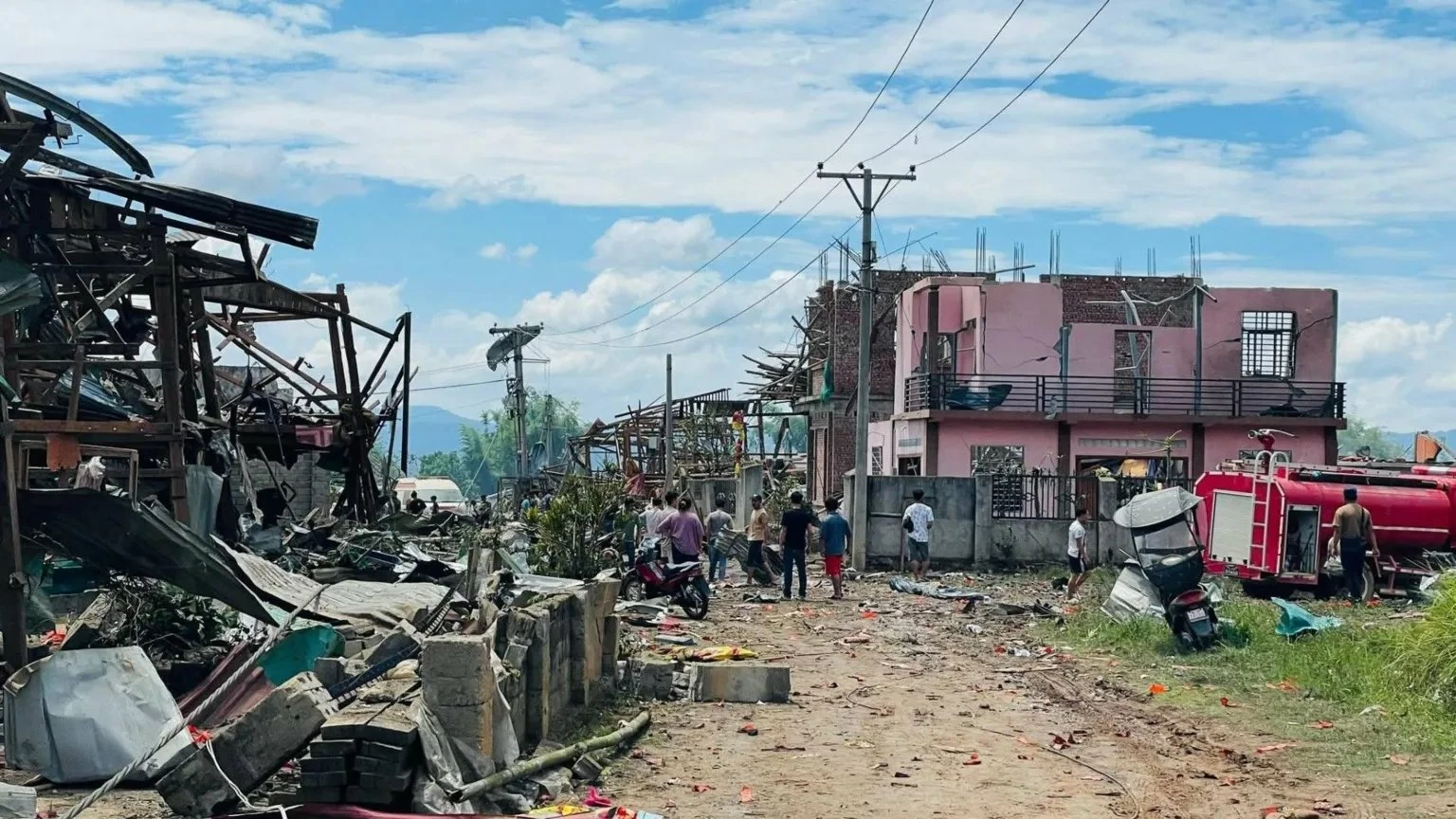
Massive Explosion in Myanmar Kills Dozens, Destroys Entire Village Near Chinese Border
A catastrophic explosion near the China-Myanmar border on May 31, 2026, has leveled an entire village, killing at least 120 people and injuring hundreds more. The blast—likely caused by an illicit explosives depot used for illegal mining—has triggered a humanitarian crisis while exposing the porous Sino-Burmese frontier as a hub for unregulated cross-border trade. The event forces a reckoning: How does Myanmar’s instability ripple through global supply chains, and which firms are already positioning to exploit—or mitigate—the fallout?
The Humanitarian Crisis and Its Geopolitical Fault Lines
By 18:46 local time on May 31, 2026, the shockwave from the explosion had already reached Naypyidaw. The official death toll—120 confirmed dead, 200 injured—is almost certainly an undercount. Witnesses described a “fireball” consuming the village of Hpakan, near the Shan State border with Yunnan Province, China. The depot, operated by armed factions linked to the Myanmar National Democratic Alliance Army (MNDAA), was a black-market hub for dynamite smuggled into China for illegal gold and jade mining. The explosion’s epicenter lies just 80 kilometers from Muse, a key trade hub where China’s Belt and Road Initiative (BRI) funnels billions into Myanmar’s crumbling infrastructure.
“This isn’t just a local disaster—it’s a systemic failure of the China-Myanmar Economic Corridor. The BRI’s reliance on unstable partners like the MNDAA means every explosion here is a warning shot for Beijing’s global ambitions.”
The blast’s timing is no coincidence. Myanmar’s junta, led by Senior General Min Aung Hlaing, has been tightening its grip on Shan State ahead of a June 2026 UN Security Council vote on extending sanctions. The explosion—if linked to ethnic armed organizations (EAOs) like the MNDAA—could become a propaganda tool for the junta to justify further militarization of the region. Meanwhile, China’s silence is deafening. Beijing has not issued a formal statement, but sources in Kunming confirm that Chinese security forces are already securing the border to prevent cross-contamination of the crisis into Yunnan’s restive ethnic minority regions.
How the Explosion Shatters Global Supply Chains
The real story isn’t the death toll—it’s the supply chain domino effect. Myanmar’s Shan State is a critical node in the China-Myanmar Economic Corridor (CMEC), a $7.3 billion BRI project that routes rare earth minerals, gemstones, and opium-derived pharmaceutical precursors into China. The explosion has:
- Disrupted jade and ruby exports: Myanmar supplies 90% of the world’s jade; the blast may force miners to reroute through Thailand or Laos, adding 30-50% to logistics costs.
- Escalated opium trafficking risks: Shan State produces 70% of Myanmar’s opium; the explosion could push cartels deeper into China’s Yunnan province, where methamphetamine labs are already proliferating.
- Triggered insurance market volatility: Lloyd’s of London has already seen a 40% spike in premiums for shipments passing through Muse since March 2026, as reports confirm.
For multinational corporations, the question isn’t *if* this will affect their supply chains—it’s *when*. Firms relying on Myanmar’s minerals or pharmaceutical intermediates are already consulting with supply chain resilience consultants to map alternative routes through Vietnam or Cambodia. Meanwhile, Chinese state-owned enterprises (SOEs) like China Railway Group—which operates key CMEC infrastructure—are likely accelerating security audits of their Burmese assets.
The Security Vacuum: Who Fills It?
Myanmar’s government is incapable of responding. The military junta’s forces are stretched thin between fighting the Arakan Army in Rakhine State and the Three Brotherhood Alliance in Shan. The explosion has created a power vacuum that three factions are poised to exploit:
- The MNDAA and other EAOs: These groups control the black-market explosives trade. Their survival depends on keeping the border porous.
- China’s People’s Armed Police (PAP): Already deployed in Yunnan, the PAP is quietly negotiating with local warlords to “stabilize” the region—on Beijing’s terms.
- ASEAN’s quiet diplomacy: Indonesia and Thailand are pushing for a UN-backed humanitarian corridor, but their leverage is limited without junta cooperation.
The explosion also exposes a critical flaw in the China-Myanmar Free Trade Agreement (CMFTA), signed in 2008. The treaty’s Chapter 7 on “Border Security” includes no provisions for cross-border disasters, leaving both governments legally exposed. Multinational firms with operations in the region are now scrambling to update their cross-border legal compliance frameworks to account for this gap.
“This event is a stress test for the CMFTA. If China doesn’t step in to secure the corridor, the entire BRI’s credibility in Southeast Asia will take a hit. The question is whether Xi Jinping is willing to risk that for a few tons of jade.”
Economic Fallout: The Numbers Behind the Chaos
| Metric | 2025 Baseline | Projected 2026 Impact | Key Affected Sectors |
|---|---|---|---|
| Jade Export Volume (tons/year) | 12,000 | 8,000 (-33%) | Luxury goods, Chinese manufacturing |
| Opium Production (metric tons) | 600 | 800 (+33%) | Pharmaceutical intermediates, illicit finance |
| Insurance Premiums (Muse Route) | $1.2M/container | $1.8M (+50%) | Mining, logistics |
| Chinese FDI in Myanmar ($B) | $3.2B | $2.5B (-22%) | Infrastructure, energy |
The data is clear: this explosion isn’t just a humanitarian tragedy—it’s a geoeconomic shock. The World Bank’s latest Myanmar report warns that if Shan State’s instability persists, GDP growth could drop from 3.1% to 1.2% by 2027. For firms operating in the region, the message is unequivocal: Geopolitical risk modeling is no longer optional—it’s a survival tool.
The Long Game: Who Wins When the Dust Settles?
Three outcomes are now likely:

- China consolidates control: Beijing will use the crisis to push for deeper military cooperation with the junta, potentially stationing PAP units in Shan State under the guise of “disaster response.”
- EAOs fragment further: The MNDAA’s survival depends on smuggling routes. If China cracks down, these groups may ally with Thai or Vietnamese cartels, diversifying their operations.
- ASEAN’s influence wanes: Without a unified response, Indonesia and Malaysia will struggle to counter China’s narrative that Myanmar’s chaos is a “Western plot.”
The explosion also accelerates Myanmar’s transition into a failed state proxy. The junta’s collapse is no longer a matter of *if*, but *when*—and China is already positioning itself to inherit the pieces. For global firms, the question is no longer about Myanmar itself, but about the contagion effect. If Shan State’s instability spreads to Sagaing or Magway, the entire Indo-China trade corridor could be at risk.
The Corporate Playbook: How to Adapt
Firms operating in or sourcing from Myanmar must act now. The World Today News Directory has identified three critical moves:
- Diversify sourcing: Companies reliant on Myanmar’s jade or gemstones should engage strategic sourcing consultants to identify alternative suppliers in Madagascar or Zambia.
- Harden supply chains: Logistics firms are already integrating cyber-physical security protocols to protect against both physical and digital disruptions in the region.
- Prepare for sanctions arbitrage: With the UNSC vote looming, firms must consult sanctions compliance experts to navigate the legal gray zones of trading with Myanmar’s shadow economy.
The explosion in Hpakan isn’t just a local tragedy—it’s a harbinger of the new normal in Southeast Asia: instability as a feature, not a bug. The firms that thrive in this environment will be those that treat geopolitical risk not as an abstract concept, but as a tactical advantage. The clock is ticking.