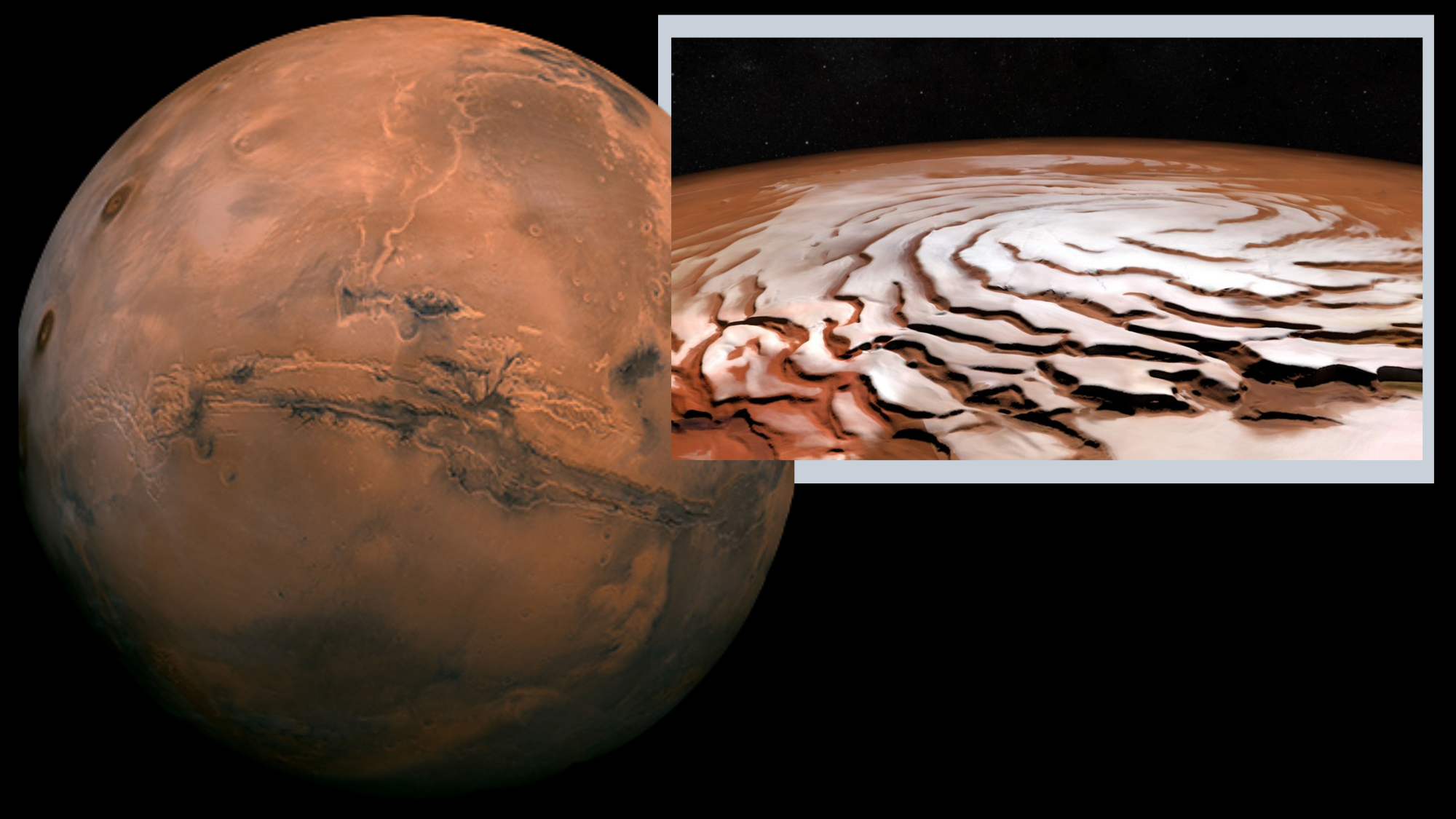
Mars North Polar Ice Is Cleaner Than Thought, Research Finds
Martian North Polar Ice Contains Only Three Percent Dust by Mass
Water ice at Mars’s north pole contains just 3% dust by mass, a finding that upends previous planetary science models which estimated dust levels as high as 25%, according to research published September 8 in npj Space Exploration.
The Tech TL;DR:
- The Shift: North polar Martian ice is far cleaner than previously modeled, scaling back assumed dust mass concentrations from 25% down to 3%.
- The Mechanism: Cleaner ice has a higher albedo, reflecting more solar radiation back into space and reducing thermal sublimation rates across the polar cap.
- The Implication: Lower dust concentration alters historical climate models of the Red Planet, reshaping how scientists evaluate past planetary habitability and liquid water accumulation.
Contrasting Calculation Models For Martian Ice
Previous estimates of Martian polar composition relied heavily on thermal and optical properties modeled after lunar regolith. When Khuller tested those conventional lunar formulas on Earth’s own snow and ice deposits, the framework failed to produce accurate benchmarks. Recognizing that lunar soil mechanics did not map cleanly onto terrestrial ice dynamics, the researchers adapted alternative methodologies long utilized for analyzing polar snow on Earth. This methodological pivot corrected longstanding scientific disagreements regarding the true surface composition of the polar regions.
Landing hardware directly on Martian poles remains exceptionally difficult, pointing to historical milestones like the loss of NASA’s Mars Polar Lander in 1999 and the successful 2008 Phoenix mission, which became the first to directly sample ice near the northern pole. Data from the Phoenix mission, combined with orbital datasets from spacecraft, allowed researchers to analyze six specific north polar locations where water ice is exposed at the surface.

Thermal Impact of Low Albedo Versus High Albedo Ice
Dust acts as a direct thermal insulator on the Martian surface. Dark, dusty ice absorbs solar radiation much like a dark t-shirt in the sunlight, accelerating local warming and vaporizing ice into the atmosphere more rapidly. Because the newly revised measurements show the upper residual cap is significantly cleaner than expected, the ice retains less heat. Instead, it increases the overall albedo of the region, reflecting incoming sunlight and helping preserve the cold Martian environment.
Mars lacks the stabilizing gravitational anchor of a massive moon, causing the planet to oscillate wildly over astronomical timescales compared to Earth’s relatively steady axial tilt. Superimposed on these axial shifts are seasonal cycles where carbon dioxide frost covers the north pole during winter. When that carbon dioxide sublimates away in the Martian summer, it exposes the underlying water-ice matrix.
Spacecraft Map Seasonal Brightness Changes in Polar Caps
Observations from orbiting spacecraft, including Europe’s Mars Express and NASA’s Mars Reconnaissance Orbiter, mapped seasonal brightness changes across the polar caps. Khuller described the northern deposits structurally as an “ice-cream sandwich,” featuring alternating strata of clean ice and dirty, dust-laden layers. Winter frost deposits tend to carry higher dust concentrations, which vanish in summer to reveal older, cleaner ice underneath.
These historical layer exposures have direct implications for astrobiology. When past dustier layers melted at their bases from solar absorption, they created shallow pools of nutrient-rich meltwater. On Earth, similar environments host microbial life that survives freeze-thaw cycles by going dormant during winter. While no life has yet been discovered on Mars, understanding these pristine versus dusty stratifications provides researchers with a clearer baseline for examining why Earth developed biology while its neighbor remained barren.