
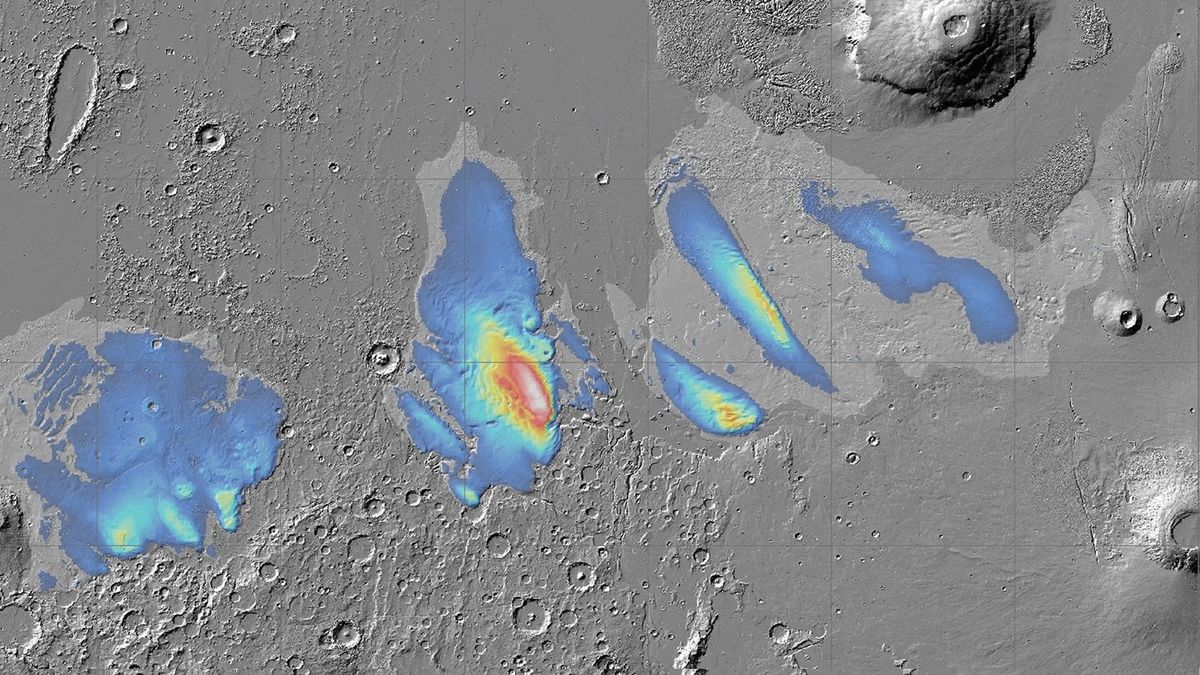
Mars Express orbiter uncovers massive equatorial water-ice deposit on Mars
The Medusae Fossae Formation, stretching 5,000 kilometers along Mars’s highland-lowland divide, has puzzled scientists for years. Initially regarded as a source of dust storms, it is now understood to contain enough frozen water to rival the planet’s polar ice caps. This finding alters the planning for crewed missions, as equatorial water could serve as a vital resource for fuel, oxygen, and human survival. However, the persistence of ice in this region raises questions about Mars’s climate history and the practical challenges of accessing this buried reservoir.
The Radar That Saw Through Dust
The Mars Express orbiter, which has been operational for over a decade, first directed its MARSIS radar instrument toward the Medusae Fossae Formation in recent years. Initial observations indicated the presence of extensive buried deposits, though the data was inconclusive. The material appeared low-density and nearly transparent to radar, characteristics that could suggest either fine dust or ice. For years, the ambiguity remained unresolved.
Recent radar data, processed with improved techniques, has provided clearer insights. Researchers found that the deposits are thicker than previously estimated, reaching depths of up to 3.7 kilometers. Their radar signature closely resembles that of Mars’s polar ice caps, where water ice is known to be abundant. Thomas Watters of the Smithsonian Institution, who led the analysis, noted that the signals align with expectations for layered ice, reinforcing the conclusion that the formation contains significant water reserves.
The physical properties of the deposits help exclude dust as the primary component. A deep accumulation of fine particles would compress under its own weight, resulting in a denser profile than what the radar detects. Ice, however, maintains its low-density characteristics even at depth, supporting the interpretation that the Medusae Fossae Formation holds substantial quantities of water ice.
A Climate Puzzle Buried in Ice
The existence of such a large ice reservoir near Mars’s equator challenges existing models of the planet’s climate. Under current conditions, surface ice at these latitudes would typically sublimate into the thin Martian atmosphere over time. Yet the ice in the Medusae Fossae Formation has remained intact, protected by layers of volcanic ash and sediment. This suggests either that the ice was deposited during a period when Mars’s climate was markedly different or that unknown processes have sustained it over time.
The origins of the formation continue to be debated. Some hypotheses propose that it consists of ancient lava flows buried beneath ash, while others suggest it was formed during a wetter phase in Mars’s history. The radar data confirms that the ice is layered, indicating a complex depositional history. If the ice was deposited during a past climate epoch, it could preserve a record of Mars’s environmental changes, offering insights that future missions might uncover.
The scale of the water ice is considerable. The volume of water contained within the Medusae Fossae Formation could create a global ocean with a depth of 1.5 to 2.7 meters. While the polar ice caps remain the planet’s largest known water reservoirs, the equatorial deposit presents a more accessible option for human missions, which could prove critical for long-term exploration.
The Mission-Planning Revolution
Planning for crewed missions to Mars has long been constrained by the challenges of landing near the poles, where water ice is abundant but conditions are harsh. The planet’s thin atmosphere complicates aerobraking, and polar regions experience extreme cold, limited sunlight, and extended periods of darkness. The equator, in contrast, offers milder temperatures, consistent solar energy, and a more manageable landing environment.
The identification of a substantial water-ice reservoir in the Medusae Fossae Formation shifts the mission calculus. Water is essential not only for drinking but also for producing oxygen and rocket fuel. Transporting these resources from Earth would be costly and logistically demanding, significantly increasing mission payloads. Local sourcing, however, could make sustained human presence on Mars more feasible.
Extracting the ice presents its own set of challenges. The reservoir lies beneath hundreds of meters of overburden, including volcanic ash and sediment, which would need to be excavated or drilled through. The ice may also contain impurities, requiring processing before it can be used. While the equator offers a more hospitable landing zone, the Medusae Fossae Formation is known for its dust storms, which could pose risks to equipment and operations.
Despite these hurdles, the strategic benefits are clear. A crewed mission landing near the equator could access this ice deposit, reducing reliance on pre-positioned supplies and lowering overall mission risk. The discovery also paves the way for robotic missions to test extraction methods and assess ice purity before human arrival.
What We Still Don’t Know
While the presence of ice in the Medusae Fossae Formation is confirmed, many details remain uncertain. The exact composition of the ice—whether it is pure water or mixed with dust and other materials—has yet to be determined. The depth and distribution of the ice layers are not uniformly mapped, meaning some areas may hold more ice than others, complicating extraction efforts.
Equally important is understanding how the ice has persisted at these latitudes. If it was deposited during a past climate epoch, what conditions allowed its formation, and how has it survived for billions of years? If it is being replenished, what mechanisms are involved? Answers to these questions could transform our understanding of Mars’s climate history and its potential to support life.
The European Space Agency has not yet announced specific plans for follow-up observations, but the discovery is expected to inspire new research proposals. Future missions might deploy advanced radar instruments or landers equipped to drill into the formation. For now, the Medusae Fossae Formation remains a compelling target, bridging scientific inquiry with the practical needs of human exploration.
The implications of this discovery extend beyond Mars. If ice can exist near the equator of a planet as arid and cold as Mars, similar deposits might be found elsewhere in the solar system. The Moon, for example, is known to have water ice in permanently shadowed polar craters, but the Medusae Fossae finding suggests that equatorial ice could also be present, hidden beneath layers of regolith.
For the time being, attention remains on Mars. The discovery of this ice reservoir does not ensure that human missions will reach the planet sooner, but it addresses one of the key challenges to long-term exploration. The equator, once overlooked as a barren landscape, may now hold the key to Mars’s future as a destination for human exploration.