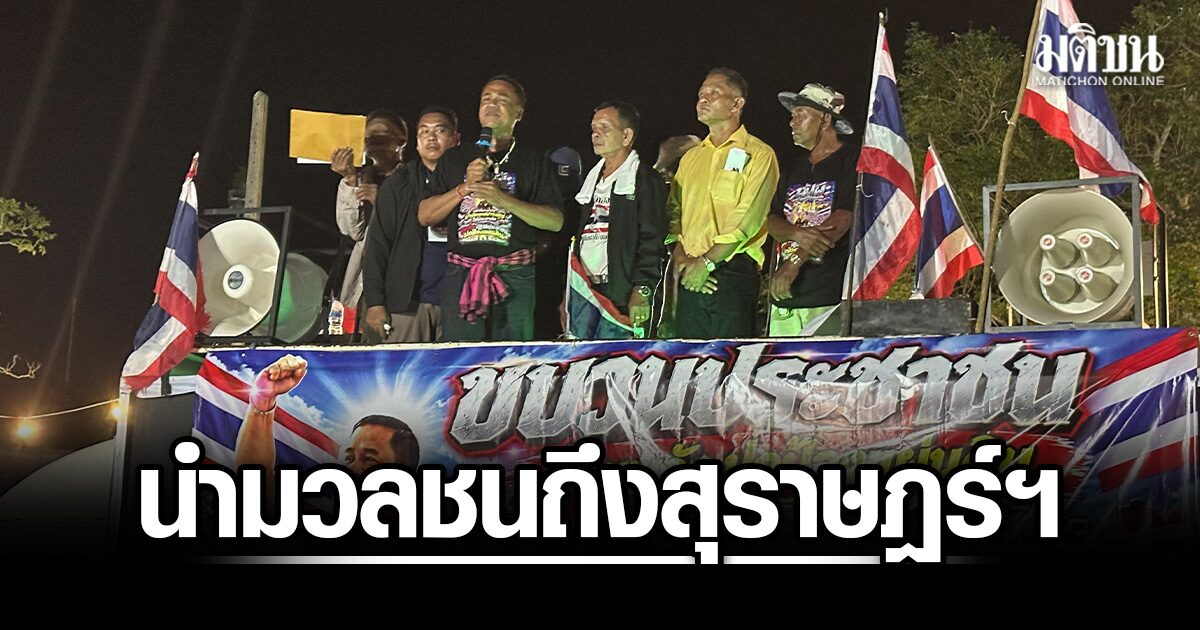
Mano Chukaew leads protest convoy to Surat Thani
Mano Chukaew, a sub-district headman from Krabi, led a caravan of approximately 500 protesters and 100 vehicles to a stop at the Cooperative of Surat Thani on November 5, 2026. The group, identifying as the People’s Power to Protect the Land, is marching toward Government House in Bangkok to demand a 10-baht per liter reduction in diesel prices and more aggressive state action against illicit drugs.
The convoy, which originated in Nakhon Si Thammarat, arrived at the Surat Thani site around 5:30 p.m. Supporters including Pongsa Choonam, head of the Green Party, and local human rights activist Sathaporn Klomcharoen joined the group to declare their alignment with the movement. The caravan is scheduled to resume its journey at 7:00 a.m. on November 6.
Security arrangements in Surat Thani
Pol. Maj. Gen. Suwat Suksri, Commander of Surat Thani Provincial Police, met with Mano Chukaew for approximately 10 minutes upon the group’s arrival. The discussion focused on security protocols and the designated boundaries for the protest activities. Provincial police have since deployed officers to secure the overnight resting area at the Cooperative of Surat Thani, located along Highway 41 in Phunphin District.
Mano addressed the crowd from a modified six-wheel truck equipped with a sound system at 7:00 p.m. He emphasized that the protest is a non-partisan effort driven by the economic hardships faced by citizens nationwide. The organizers have been documenting donations, reporting approximately 1,010,000 baht collected before departing Nakhon Si Thammarat, and plan to disclose total figures via a live social media broadcast to ensure transparency.

Protesters demand fuel price cuts and drug suppression
The protesters are demanding an immediate 10-baht reduction in diesel prices, citing the fuel’s role as a primary cost driver for agricultural goods and household expenses. The group is calling for the government to classify drug suppression as a national priority. Organizers have stated they intend to park their vehicles at the entrance of Government House if their demands are not met.
Prime Minister Anutin Charnvirakul addressed the movement during a press briefing at Government House on November 5. He stated that the protest is a right of the people under the constitution, provided it remains peaceful and lawful. “It is a right,” Anutin said, emphasizing that the government is operating in the interest of the country and its citizens.
The movement has also drawn attention from opposition figures. Chai Chana Dechdecho, a list-MP for the Democrat Party, addressed allegations that he was supporting the group, stating, “Today the country is in crisis; the people cannot take it anymore.” Chai Chana maintained that the protesters are acting of their own volition and that the government should focus on resolving the economic distress rather than questioning the movement’s origins.

Historical context of public demonstrations
While the current movement seeks to exert pressure on the administration, historical precedents suggest that government responses to such protests vary significantly. Large-scale demonstrations have occurred frequently in Thai politics, yet successful policy shifts—such as the resignation of a government—are rare and often linked to broader systemic crises or the involvement of national institutions. The current situation remains in a state of flux as the caravan prepares to continue its journey toward the capital.
The movement aims to reach Bangkok by November 8, targeting Gate 4 of Government House. As the caravan expands, the involvement of additional groups from the northern and northeastern regions remains a reported possibility, potentially increasing the pressure on the administration to address the rising cost of living.
“If the government cannot meet the proposal, the fuel will run out at Government House,” Chai Chana stated regarding the potential for an extended standoff.