Manchhar Lake Faces Existential Crisis as Pakistan’s Indus River Flows Dry Up
Deprived of consistent Indus River flows and burdened by stagnant wastewater, the region’s fishing communities are now facing mass migration.
The Shrinking Basin and the Failure of Drainage Infrastructure
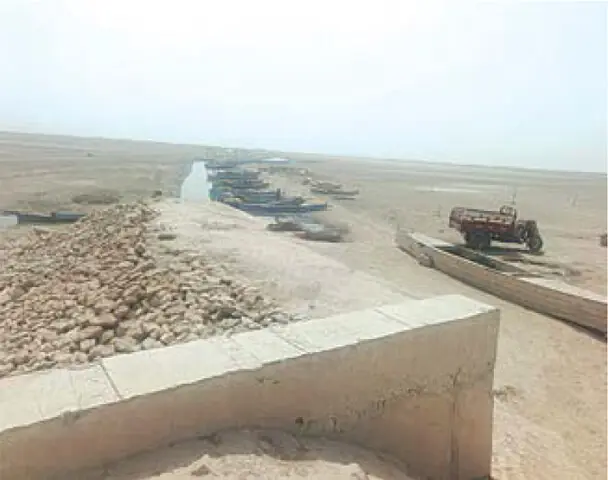
The state of Manchhar Lake is currently defined by a severe lack of natural replenishment. According to local reports from the lake’s embankment, the water has receded to the point where wooden fishing boats sit grounded on exposed mudflats. While official estimates from the irrigation department place the water level at 108.4 feet, local stakeholders—including the activist group “Manchhar Bachao Ittehad”—contend the actual level is closer to 105 feet. This discrepancy highlights a growing tension between bureaucratic data and the reality on the ground.
The lake’s traditional water sources, including natural waterways from the Khirthar range and seasonal Indus River flows, have been largely severed. The primary current inflow consists of wastewater from the Main Nara Valley Drain (MNVD), now designated as the Right Bank Outfall Drain-I (RBOD-I). However, even this supply is inconsistent; upstream rice transplantation in the Larkana and Qambar-Shahdadkot districts has diverted the flow, leaving the lake starved of even its low-quality, effluent-heavy water sources.
Families who have relied on the lake’s biodiversity for generations are moving toward Sindh and Balochistan to find work, as the local catch now consists of low-value fish yielding minimal subsistence income.
Two Decades of Stalled Engineering and Financial Disarray
The environmental degradation of the lake is inextricably linked to the incomplete RBOD-II project. Designed by the Water and Power Development Authority (Wapda) in the early 2000s, the project was intended to bypass Manchhar Lake and carry hazardous effluent directly to a creek in Thatta. Twenty years later, the project remains an unfinished liability.
Originally budgeted at Rs14bn in 2001, the project’s cost has ballooned through successive revisions. Following a 2015 work stoppage, current estimates suggest that restarting the project could push total costs toward 1 trillion rupees. Public Accounts Committee (PAC) briefings reveal that billions of rupees of a revised cost have already been spent, yet the infrastructure remains non-functional.
The impasse persists due to a breakdown in inter-agency cooperation. Wapda has sought to transfer the responsibility of the RBOD-I/MNVD systems to the Sindh government, while Sindh officials have rejected the current form of the RBOD-II project, citing concerns over its alignment and the massive fiscal mismanagement that has already triggered criminal proceedings against irrigation officials.
Legal Interventions and the Future of the Nai Gaj Dam
While the RBOD projects remain in limbo, legal and engineering efforts are shifting toward the Nai Gaj Dam. On July 13, 2026, a Federal Constitutional Court (FCC) bench overturned previous Sindh High Court orders, directing the completion of the dam in accordance with the original 2021 memorandum of understanding. This project is intended to store water from the Gaj Nai stream and includes a 52-kilometer pipeline designed to deliver 50 cusecs of freshwater to Manchhar Lake.
Despite these court-ordered mandates, the timeline remains precarious. Originally initiated in 2012, the dam has missed multiple completion deadlines, the most recent being June 2025. Whether the intervention will provide the necessary ecological relief for the lake remains a subject of intense debate among hydrologists and local community leaders.
As these legal and bureaucratic processes grind forward, the immediate survival of the lake’s remaining ecosystem hangs in the balance. The ongoing dialogue between the Sindh Irrigation Ministry and Wapda leadership—most recently held in Lahore on July 16—reflects the urgency of the crisis, yet concrete outcomes for the displaced fishing communities remain elusive.
Navigating the Crisis: A Call for Professional Oversight
The situation at Manchhar Lake underscores the critical need for independent assessment and environmental management in regions where large-scale infrastructure projects have failed to meet their design objectives. For landowners, agricultural stakeholders, and community groups impacted by these shifting water policies, the complexities of navigating government bureaucracy and water rights litigation are immense.
The drying of Manchhar Lake is a stark reminder of what happens when engineering projects are decoupled from ecological stewardship. As the region waits for the next phase of the Nai Gaj project, the true cost is being paid by the communities left on the receding banks, waiting for water that may not arrive in time to save their way of life.