Man Sees Cat’s Eyes on Human Faces After Brain Surgery, Case Study Reports
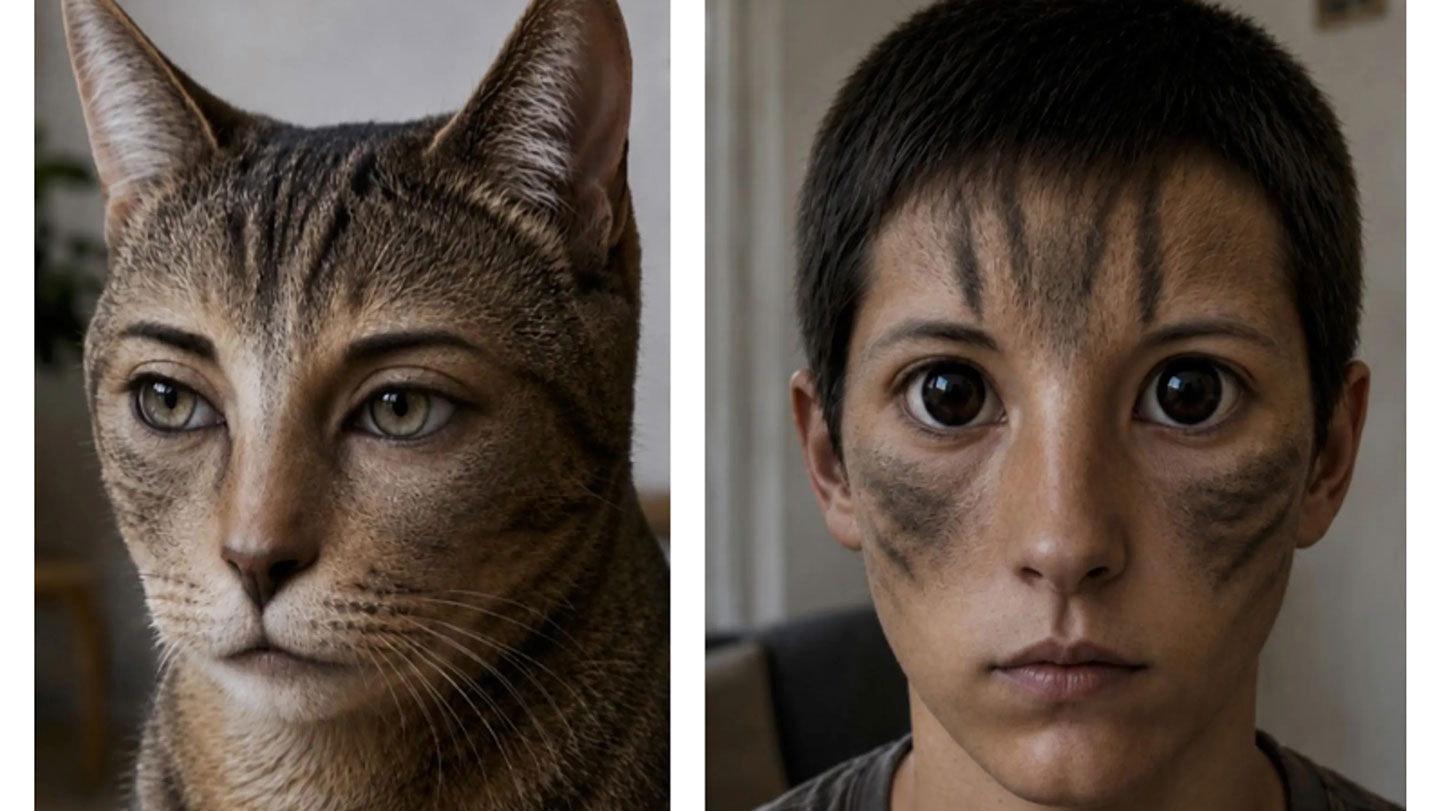
After brain surgery to remove tangled blood vessels, a 28-year-old man in the northeastern United States started seeing his cat’s almond-shaped eye sockets, enlarged pupils, and stripes plastered onto human faces, Science News reported.
- Karl’s rare condition mixes prosopometamorphopsia with palinopsia, causing visual memory echoes to paste themselves onto new perceptions.
- Surgeons removed tissue from his right temporal lobe in 2024 to correct an arteriovenous malformation.
- Researchers published his case in the December 2026 issue of the journal Cortex.
Surgical Removal Alters Face Perception
The patient, who asked to go by the pseudonym Karl, discovered the strange visual filter right after returning home from the hospital following his 2024 procedure. “Right when I got home from the hospitals, I was seeing my cat in my mother and my sister,” Karl told Science News. His gray tabby cat, Luna, is frequently the first face he encounters in the morning, which triggers the feature swaps.
“That was one of the first things that I noticed,” Karl said.
If Karl spots a human face first thing in the day, that person’s features might appear on Luna instead. The perceptual shifts can last for several hours or persist across an entire day. Alongside human-to-cat and cat-to-human swaps, he has experienced human-to-human feature transfers.
Doctors removed tissue from Karl’s right temporal lobe to treat an arteriovenous malformation, which involves tangled blood vessels between arteries and veins that carry a risk of fatal brain bleeds if left untreated. Because this brain region is critical for recognizing faces, the partial removal disrupted his visual processing.
Karl Retains Facial Shapes While Features Replaced by Memories
Researchers say Karl experiences a combination of prosopometamorphopsia, commonly called PMO or demon face syndrome, and palinopsia, where previously viewed images persist in new contexts. Unlike typical PMO cases where entire faces warp, Karl retains normal overall facial shapes while specific features like eyes and shading are replaced by stored memories.
“This case of Karl seeing his cat’s features in human faces and vice versa demonstrates that individual features can be pulled from memory and influence our ongoing perception,” Brad Duchaine, a professor of psychological and brain sciences and principal investigator of the Social Perception Lab at Dartmouth, said in a statement.
To study these distortions, Duchaine’s team collaborated with Karl using artificial intelligence. Duchaine created an initial sketch, fed it into a large language model to generate realistic images, and refined the visuals over several months based on Karl’s direct feedback.
“AI provides researchers like us with the ability to generate more accurate visualizations of what people are experiencing when they’re having distorted visual perceptions,” Duchaine explained, according to Yahoo News. Duchaine said that his lab has heard from more than 250 individuals experiencing face distortions, some of whom were incorrectly diagnosed with psychiatric conditions and prescribed antipsychotics.

Surgery Removes Face-Recognition Tissue
During the 2024 operation to correct an arteriovenous malformation, surgeons removed tissue from Karl’s right posterior temporal area, a region known to be involved in face recognition. Source 1 reports that this removal gave researchers “a rough idea of the brain areas making this possible.”
Historical Precedents in Medical Literature
The new report draws comparisons to a documented 1986 case in the same journal involving a woman who saw a poodle on a bus and subsequently saw the dog’s face on every passenger. While that woman’s full-face substitutions lasted roughly 30 minutes following a stroke, Karl’s feature-specific transfers have remained consistent for two years.
Karl also experiences environmental echoes, occasionally seeing visual repetitions of potholes from old roads onto newly traveled asphalt or square hallway shapes appearing in unfamiliar stairwells. Clinical psychiatrist Jan Dirk Blom of Leiden University and Parnassia Psychiatric Institute in the Netherlands, who was not involved in the research, called the methodology innovative.
“In my line of work, clinical psychiatry, we know that everything stands and falls with the descriptions that our patients give us,” Blom told Science News, describing the patient collaboration as participation at its best.
The case study appears in the December 2026 issue of Cortex, a monthly peer-reviewed journal published by Elsevier since 1964 that covers the psychology, neuroscience, cognitive science, neuropsychology, and neurology of the cerebral cortex. The journal’s 2022 impact factor stands at 3.6.
Researchers plan to continue working with Karl to monitor whether his perceptual symptoms shift over time.
Worth a look
- Microsoft Issues “Code Red” After 24-Hour Outage Cripples Services
- Wedzicha Urges Simple Objective Measures for COPD Exacerbations in Community
- Jessie J Returns to Instagram After Breast Reconstruction Surgery (newsdirectory3.com)
- Chinese Official Ma Sentenced to Death for Espionage, State Media Reports (time.news)