
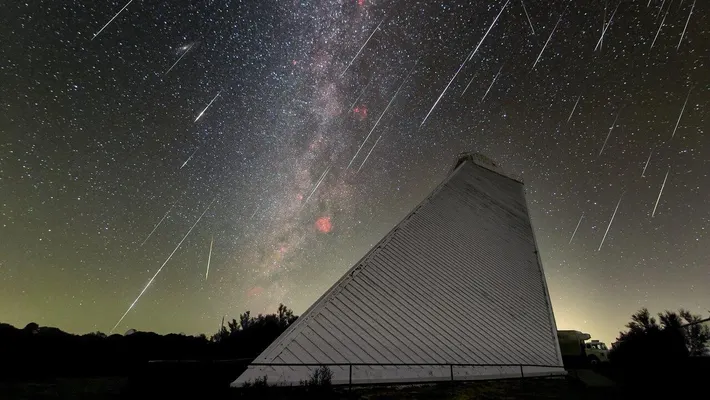
Lyrid Meteor Shower 2026: Date, Time & How to See in Indonesia
Lyrid Meteor Shower to Peak April 22, 2026, Offering Potential Celestial Display
The Lyrid meteor shower, an annual celestial event originating from the debris of Comet Thatcher, is expected to peak in the early morning hours of April 22, 2026. Under ideal conditions, observers could see up to 10 meteors per hour, though occasional outbursts have produced rates as high as 100 per hour.
The shower will be visible from both the Northern and Southern Hemispheres, with better viewing conditions generally found in the Northern Hemisphere due to the higher elevation of the radiant point – the area of the sky from which the meteors appear to originate – in that region. Observers in the Southern Hemisphere can still enjoy the display, particularly by seeking out dark locations away from light pollution.
The peak is predicted for 19:15 UTC on April 22, 2026, according to EarthSky.org. A waxing crescent moon, approximately 33% illuminated, will be present in the sky, but is not expected to significantly interfere with viewing, especially if observers shield their eyes from the moon’s glare.
The Lyrids are among the oldest recorded meteor showers, with observations dating back 2,700 years to 687 BC, as documented by Chinese astronomers. The meteors are composed of dust particles shed by Comet Thatcher (C/1861 G1), a long-period comet discovered by A.E. Thatcher in 1861, and independently by Carl Wilhelm Baeker.
Comet Thatcher takes approximately 415.5 years to orbit the sun, with its last perihelion – closest approach to the sun – occurring in 1861. Its next predicted perihelion is around 2283. The comet is the source of the dust that creates the annual Lyrid meteor shower. According to NASA, the Lyrids are created as Earth passes through these debris trails, causing the dust particles to burn up in the atmosphere.
The name “Lyrids” comes from the constellation Lyra, as the meteors appear to radiate from that area of the sky. Even as the meteors can appear anywhere in the sky, tracing their paths back will point towards Lyra. Lyrids are known for sometimes leaving persistent trains, glowing trails that linger for a few seconds after the meteor streaks across the sky.
For optimal viewing, observers are advised to find a dark location away from city lights, allow their eyes to adjust to the darkness for 20-30 minutes, and look towards the southern sky. No special equipment, such as telescopes or binoculars, is needed; the wide field of view offered by the naked eye is best for spotting meteors.
The year 2026 promises other astronomical events, including the Pink Moon in April, the Eta Aquariids in May, a Blue Moon in May, the Perseids in August, and the Harvest Moon in September.