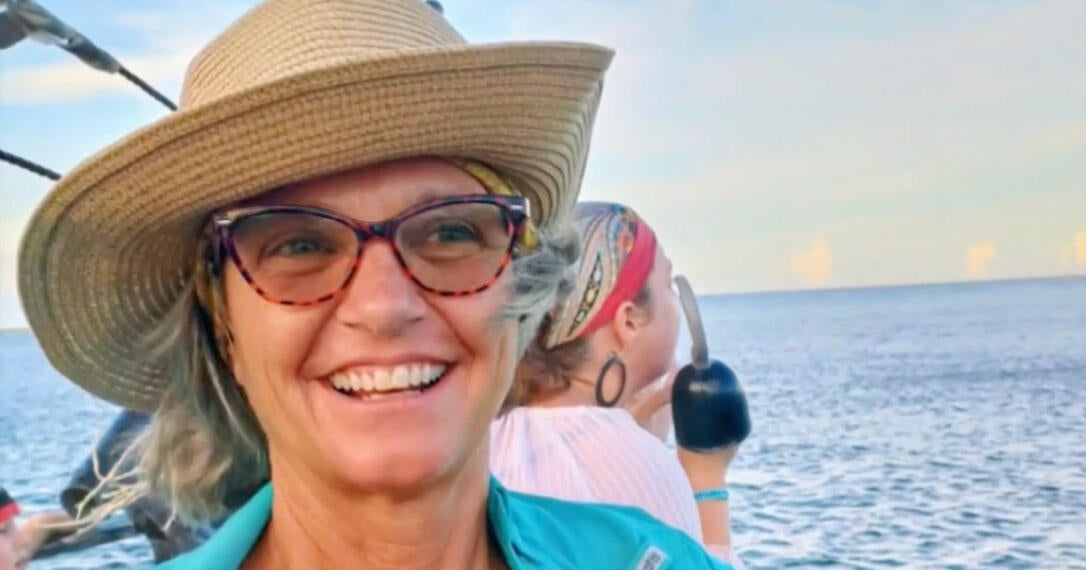
Lynette Hooker’s Troubled Marriage Before Her Disappearance
Lynette Hooker, 55, vanished during a nighttime boat ride in the Bahamas on April 4. Her husband, Brian Hooker, reported her missing on April 5, claiming she was swept overboard after their dinghy lost power. Leaked 2024 messages reveal a volatile relationship, with Lynette previously stating she could not be at sea with him.
The dream of a nomadic life on the water often masks a claustrophobic reality. For Lynette Hooker, the transition from a structured life in Michigan—complete with an “awesome career” and a home—to the isolation of the Bahamas was not a seamless escape. It was, by her own admission in private messages, a catalyst for a relational collapse.
The distance between a romanticized voyage and a domestic nightmare is often measured in feet, not miles, when those feet are the confines of a boat.
The Digital Paper Trail of a Breaking Marriage
Messages obtained by CBS News paint a stark picture of a marriage under extreme pressure. In January 2024, Lynette reached out to Marnee Stevenson, a fellow boater, to disclose a temporary split from Brian. The language she used was not that of a typical marital spat; it was an expression of fundamental incompatibility with the cruising lifestyle.
“We were married 21 years. Our marriage lasted 6 weeks cruising.”
This distinction is critical. It suggests that while the couple could function in a traditional society, the “too much closeness” of life at sea acted as a pressure cooker. Lynette’s decision to quit her career and sell her assets in Michigan to pursue this life represents a total commitment that, according to her texts, quickly became unsustainable.
By late January 2024, the situation had escalated to the point where Lynette fled to her mother’s home in Florida. When questioned about the possibility of reconciliation, her response was blunt: “It was real bad. I can’t be out there with him.”
When domestic disputes migrate to international waters, the legal protections typically afforded to spouses in their home jurisdictions often vanish. Families facing similar crises often find that standard domestic advice is insufficient, requiring the expertise of international family law specialists to navigate the complexities of separation across borders.
The Bahamas Incident: A Timeline of Disappearance
The trajectory of the relationship took a sudden turn in late February 2024. Despite her previous assertions that she would not return, messages indicate that Lynette and Brian reconciled. A social media exchange with Marnee Stevenson, featuring heart emojis and a thumbs-up, suggested that things were “on the up and up.”
This reconciliation set the stage for the events of April. While sailing in the Bahamas, the couple embarked on a nighttime boat ride. On Sunday, April 5, Brian Hooker reported his wife missing. His account focused on a mechanical failure: a dinghy that lost power the previous night, which he claimed hampered his ability to seek immediate facilitate after Lynette was swept away.
The sequence of events—a nighttime ride, a power failure, and a sudden disappearance—immediately drew the attention of Bahamian authorities. Brian Hooker was detained and questioned by police regarding the circumstances of his wife’s vanishing.
Though he was later released, the intersection of the “real bad” history revealed in the 2024 texts and the suspicious nature of the disappearance creates a complex investigative landscape. In cases where a spouse vanishes in a foreign jurisdiction, the initial police report is rarely the finish of the story. Many families now turn to private maritime investigators to conduct independent searches and verify the technical claims regarding vessel failure.
The High Cost of the Cruising Dream
Lynette Hooker’s story is a cautionary tale about the erasure of identity. To enter the cruising life, she didn’t just move; she dismantled her previous existence. She sold her house, gave away her possessions, and walked away from a professional career she described as “awesome.”
This level of sacrifice creates a dangerous power imbalance. When a partner gives up their entire support system—financial, professional, and residential—to join another person in a remote environment, the cost of leaving becomes prohibitively high. The “closeness” Lynette cited as a problem was likely not just physical, but a total dependency on her husband for safety and survival in a foreign territory.
The psychological toll of such a transition often requires specialized support. For those trapped in volatile relationships while living abroad, securing remote domestic violence advocacy is often the only lifeline available when physical escape is blocked by the ocean.
Jurisdictional Hurdles and Legal Limbo
The fact that Brian Hooker was detained and then released highlights the difficulty of prosecuting or investigating crimes that occur on the water in international or foreign territories. The Bahamas operates under its own legal framework, and the burden of proof for a “man overboard” incident is notoriously difficult to meet without eyewitnesses or forensic evidence from the vessel.
The reliance on a “power failure” as an explanation for a delayed report is a common trope in maritime disappearances. Whether this was a genuine mechanical tragedy or a convenient narrative remains the central question of the investigation.
The contrast between the heart emojis of February and the disappearance of April serves as a grim reminder that reconciliation does not always equal resolution. The underlying volatility that led Lynette to say “I can’t be out there with him” apparently remained, even if it was temporarily masked by a desire to make the dream work.
As this case continues to unfold, it underscores the necessity of maintaining independent ties—financial and social—even when pursuing a life of adventure. The tragedy of Lynette Hooker is not just her disappearance, but the systemic vulnerability created when one person holds all the keys to the vessel. For those navigating the aftermath of such disappearances, finding vetted criminal defense and maritime attorneys is the only way to ensure that the truth isn’t lost to the currents of a foreign sea.