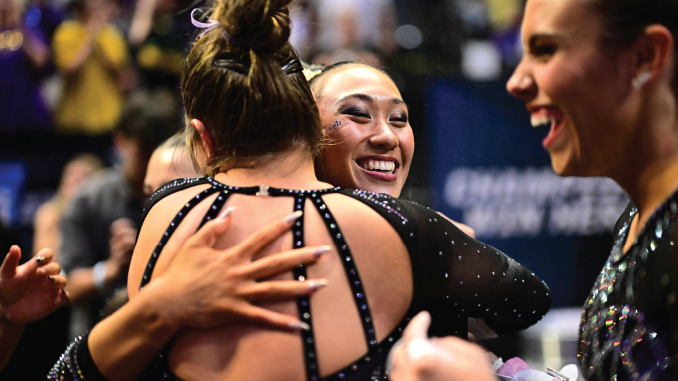
LSU Gymnastics Returns to Fort Worth as No. 2 Seed
No. 2 seed LSU gymnastics advanced to the 2026 NCAA National Championships in Fort Worth after winning the Baton Rouge Regional on April 4. With a final score of 197.825 and two perfect 10s, the Tigers secured the top spot over Stanford, Michigan, and Clemson to reach the Elite 8.
Securing a regional title is a physical and psychological grind, but for LSU, the victory in Baton Rouge came with a significant tactical cost. Even as the Tigers dominated the field to earn their ticket to Dickies Arena, the loss of a key performer during a critical rotation introduces a volatile variable into their championship aspirations. The transition from regional dominance to the National Semifinals on April 16 requires more than just high scores. it demands a depth of roster that can withstand high-impact attrition.
The Scoring Matrix: Precision and Peak Performance
LSU’s final score of 197.825 was not a product of chance but of surgical execution across four disciplines. The distribution of points reveals where the team found its edge and where the vulnerabilities lie. The floor exercise was the powerhouse of the evening, posting a team total of 49.650. This was anchored by Kaliya Lincoln, who achieved a perfect 10, marking the first such milestone of her career.
The vault followed closely with a 49.450, bolstered by Kailin Chio’s perfect 10. These “perfect” scores are the gold standard of the sport, providing a psychological buffer and forcing opponents to chase an unattainable ceiling. The balance beam contributed 49.425, maintaining a consistent high-floor performance that prevented any significant scoring dips.
The uneven bars, however, told a different story. With a score of 49.300, this was LSU’s lowest event total of the night. This dip is directly attributable to a catastrophic failure in routine completion, which shifted the team’s tactical trajectory in real-time. In a sport where tenths of a point determine the difference between a podium finish and an early exit, the bars rotation became the primary point of friction.
“LSU SCORES Vault – 49.450 Bars – 49.300 Beam – 49.425 Floor – 49.650 Final Score – 197.825”
Maintaining this level of output requires a rigorous approach to periodization and load management, especially as the season reaches its crescendo. For athletes operating at this ceiling, the margin between a perfect 10 and a season-ending injury is razor-thin. While collegiate stars have access to university facilities, aspiring athletes in the region must often seek out elite youth gymnastics programs to build the foundational strength necessary to survive the rigors of the NCAA circuit.
The McClain Variable: Tactical Void and Recovery
The most pressing concern for head coach Jay Clark is the status of Konnor McClain. During the second rotation on the uneven bars, McClain suffered an injury that left her unable to complete her routine. This is a critical blow to the Tigers’ depth. McClain’s absence doesn’t just remove a high-scoring potential; it disrupts the lineup’s rhythm and forces a redistribution of pressure onto the remaining gymnasts.
From a sports medicine perspective, an inability to complete a routine often suggests an acute musculoskeletal failure or a joint instability that requires immediate diagnostic imaging. The window between April 5 and the semifinals on April 16 is narrow. The recovery protocol will likely involve aggressive inflammation management and functional rehabilitation to determine if she can return to competition form in Fort Worth.
The stakes are high for any athlete facing a sudden injury in the postseason. While the pros have dedicated surgical teams, local high school and collegiate athletes facing similar ligament or tendon tears must immediately secure vetted local orthopedic specialists and rehab centers to salvage their competitive hopes and ensure long-term joint integrity.
Fort Worth Logistics and the Economic Ripple
The shift of the competition to Fort Worth, Texas, transforms the event from a regional athletic meet into a significant economic driver for the host city. The NCAA Championship Semifinals at Dickies Arena will draw thousands of fans, creating a localized surge in demand for luxury hospitality and short-term rentals. The Tigers will compete in either the 3:30 p.m. Or 8 p.m. Session, a timing detail that will dictate the flow of fan traffic and spending across the city.
This influx of high-net-worth boosters and traveling supporters creates a massive logistical vacuum. Local businesses must scale rapidly to meet the needs of these delegations. The franchise and the university are already navigating the complexities of travel and security, often sourcing regional event security and premium hospitality vendors to manage the overflow of personnel and ensure the safety of the athletes.
Competitive Outlook: The Stanford Threat
LSU does not travel to Texas alone. Stanford as well qualified from the Baton Rouge Regional with a score of 197.225. While LSU held the top spot, the gap of 0.600 is negligible in a championship environment. Stanford’s ability to advance alongside the No. 2 seed indicates a high level of stability in their own rotations.
The road to the National Championship on April 18 will be defined by who can minimize errors. LSU has proven they can hit the ceiling with perfect 10s, but the injury to McClain exposes a vulnerability in their floor. If the Tigers cannot find a way to stabilize the bars rotation, their statistical advantage over teams like Stanford may evaporate.
Coach Jay Clark has now led the Tigers to qualify for the championships for four consecutive years, establishing a culture of consistency. However, the 2026 campaign will be judged on whether the program can pivot from a regional victory to a national title while navigating a depleted roster. The trajectory of the team now depends on the medical reports coming out of the training room and the ability of the remaining squad to absorb the workload.
As LSU prepares for the final push in Fort Worth, the intersection of elite performance and medical recovery will be the deciding factor. Whether it is securing the right legal counsel for NIL contracts or finding the best sports therapists for injury recovery, the infrastructure surrounding the athlete is as essential as the training itself. To find the vetted professionals necessary to support an athletic career at this level, the World Today News Directory remains the primary resource for medical, legal, and local business services.
Disclaimer: The insights provided in this article are for informational and entertainment purposes only and do not constitute medical advice or sports betting recommendations.