
Low Energy Floquet States in Magnetic Vortices Bridge Electronics and Quantum Tech
Floquet States in Magnetic Vortices: A Low-Energy Bridge or Physics Lab Curiosity?
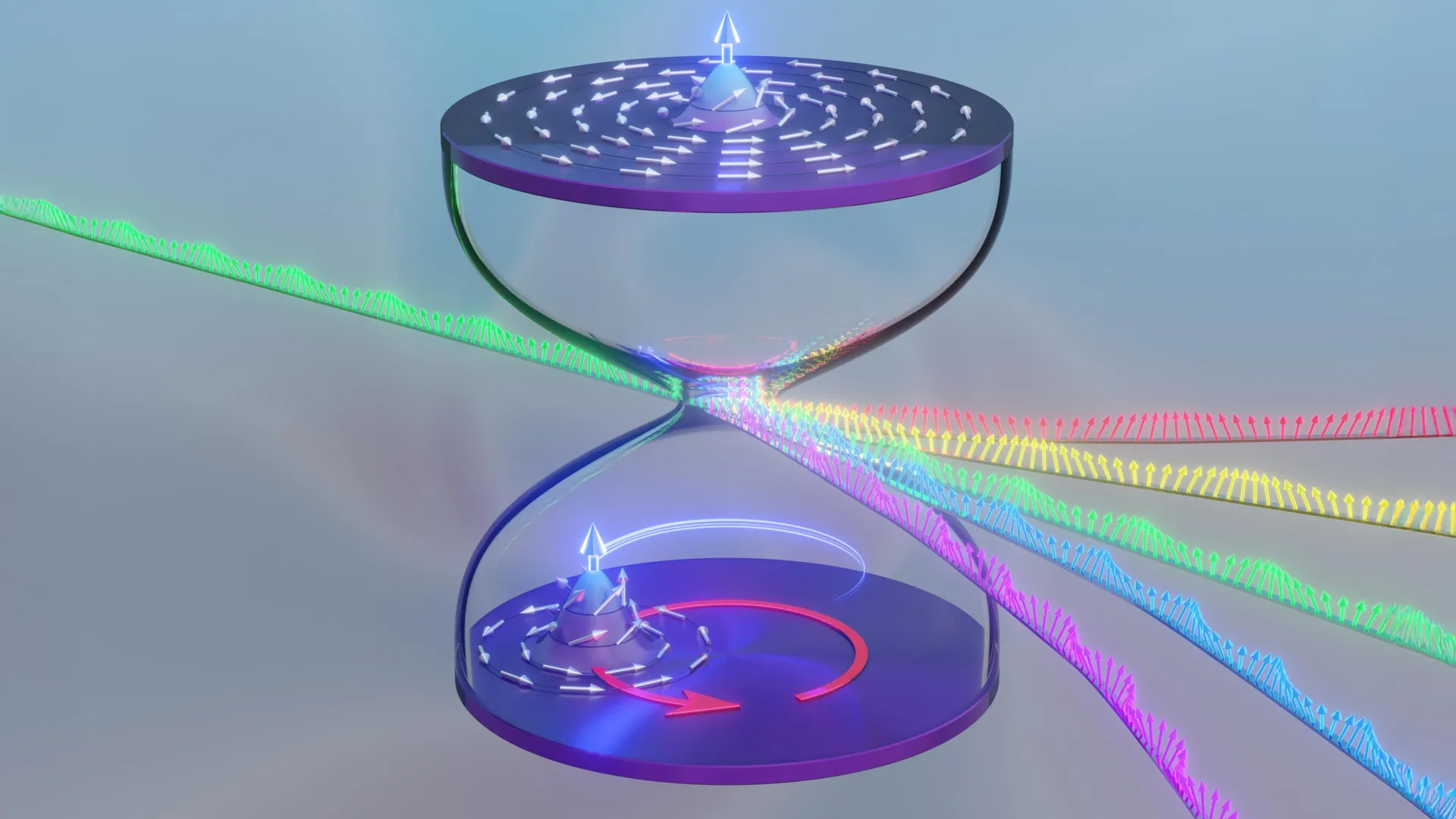
The Helmholtz-Zentrum Dresden-Rossendorf (HZDR) claims to have cracked the energy efficiency bottleneck in spintronics. Their latest publication in Science details the observation of Floquet states within magnetic vortices using microwatt-level magnetic waves rather than high-energy laser pulses. For the enterprise architecture team, this signals a potential shift in how we handle signal synchronization between classical CMOS logic and emerging quantum processors. However, before we rewrite the data center power budget, we need to scrutinize the deployment reality of magnon-based frequency combs.
The Tech TL;DR:
- Energy Efficiency: New method reduces excitation energy from laser-grade watts to microwatts, compatible with standby smartphone power levels.
- Interoperability: Frequency combs act as a universal adapter, potentially bridging terahertz spintronic signals with gigahertz electronic circuits.
- Deployment Horizon: While the physics are verified, integration into existing semiconductor fab lines requires significant hardware engineering overhaul.
The core issue facing modern high-performance computing isn’t just raw throughput; it’s the thermal wall hit by charge-based transport. Moving electrons generates heat. Moving spin waves (magnons) does not, at least not to the same degree. The Dresden team’s breakthrough lies in shrinking magnetic disks to the nanometer scale and observing how the vortex core behaves under periodic forcing. This isn’t just about smaller magnets; it’s about stabilizing oscillation states that can carry information without the resistive losses inherent in copper interconnects.
Traditionally, inducing Floquet states required intense laser pulses, creating a high barrier to entry for integrated circuit design. The new approach utilizes gentle magnetic wave stimulation. This shifts the power profile dramatically. In a production environment, dropping excitation energy to microwatts means these components could theoretically operate within the thermal design power (TDP) constraints of current mobile SoCs. Yet, the latency implications remain the critical variable for systems architects.
Architectural Breakdown: Laser vs. Magnetic Wave Excitation
To understand the viability of this technology for enterprise integration, we must compare the operational parameters of the legacy laser-induced method against this new magnetic wave approach. The following table breaks down the speculative specifications based on the published data and current spintronic benchmarks.
| Parameter | Legacy Laser-Induced Floquet | HZDR Magnetic Wave Method | Standard CMOS Interconnect |
|---|---|---|---|
| Energy Consumption | High (Watts range) | Ultra-Low (Microwatts) | Moderate (Milliwatts) |
| Signal Frequency | Terahertz (THz) | GHz to THz Range | GHz Range |
| Heat Dissipation | Requires Active Cooling | Passive Cooling Sufficient | Active Cooling Required |
| Integration Complexity | High (Optical Alignment) | Medium (Magnetic Layering) | Low (Standard Fab) |
The reduction in heat dissipation is the standout metric here. For data centers operating at peak capacity, moving signal transport from charge-based to spin-based mechanisms could theoretically reduce cooling overhead by significant margins. However, the “Integration Complexity” row highlights the bottleneck. While the energy cost is low, the manufacturing process requires precise control over magnetic vortex cores in nickel-iron disks. This isn’t a drop-in replacement for existing PCB layouts. Organizations looking to pilot spintronic components will need to engage specialized quantum computing consultants to assess compatibility with current infrastructure.
Industry reaction remains cautiously optimistic but grounded in fabrication realities. Dr. Elena Rostova, Lead Researcher at the Institute for Spintronic Interfaces, notes the significance of the frequency comb stability.
“The ability to generate a frequency comb without high-energy optical pumping changes the power equation for spintronic logic gates. However, the signal-to-noise ratio at room temperature remains the primary hurdle for commercial adoption.”
This skepticism is warranted. Lab environments often control for variables that enterprise server rooms cannot.
Implementation Mandate: Simulating Magnon Dynamics
For developers interested in modeling how these magnetic states might interface with logical operations, the underlying physics can be approximated using Python-based simulation libraries. While the HZDR team used their proprietary Labmule program, open-source alternatives allow us to test the frequency comb spacing logic. Below is a snippet demonstrating how to calculate the Floquet frequency spacing based on vortex core velocity.
import numpy as np def calculate_floquet_comb(omega_drive, core_velocity, radius): """ Simulates the frequency comb spacing generated by a rotating magnetic vortex core. Based on Floquet theory applied to magnon dynamics. """ # Angular frequency of the driving field omega_d = omega_drive # Core rotation frequency approximation omega_core = core_velocity / radius # Floquet sidebands occur at integer multiples of the driving frequency # n = order of the sideband sidebands = [] for n in range(-3, 4): freq_n = omega_d + (n * omega_core) sidebands.append(freq_n) return np.array(sidebands) # Example parameters (SI units) drive_freq = 2.4e9 # 2.4 GHz velocity = 100.0 # m/s disk_radius = 150e-9 # 150 nm comb_spectrum = calculate_floquet_comb(drive_freq, velocity, disk_radius) print(f"Frequency Comb Centers: {comb_spectrum / 1e9} GHz") This script highlights the deterministic nature of the frequency combs. For a cybersecurity auditor, the deterministic nature of these signals is crucial. If these states are used for hardware security modules (HSM), the predictability of the frequency comb could be a vector for side-channel attacks if not properly randomized. The transition from physical discovery to secure implementation requires rigorous validation.
The Interoperability Challenge
The claim that this technology acts as a “universal adapter” between electronics, spintronics, and quantum technologies is ambitious. In practice, bridging the impedance mismatch between a terahertz magnon signal and a gigahertz CPU clock requires sophisticated modulation. The HZDR paper suggests the frequency comb provides the necessary harmonics to lock these disparate systems. You can review the foundational physics in the original Science journal publication. Further technical specifications on magnon propagation can be found in IEEE magnetics society archives.
Developers working on low-level hardware abstraction layers should monitor the spintronics topic on GitHub for emerging drivers. Currently, no standard API exists for manipulating magnetic vortices, meaning any integration will be proprietary. This fragmentation poses a risk for long-term maintainability. Enterprise IT departments should avoid committing to single-vendor spintronic solutions until a standardization body like the JEDEC Solid State Technology Association weighs in.
The path forward involves validating these microwatt claims in noisy, real-world environments. While the Labmule program used by HZDR offers automation, scaling this to mass production requires a supply chain capable of nanometer-precision magnetic deposition. Until then, this remains a promising layer in the hardware stack, not a replacement for the foundation.
As we move toward 2027, the convergence of quantum and classical systems will demand exactly this kind of low-energy bridge. But for now, preserve your CMOS stacks running and treat Floquet magnons as a high-potential R&D track rather than a Q4 procurement item. The physics works; the fab process is the remaining variable.
Disclaimer: The technical analyses and security protocols detailed in this article are for informational purposes only. Always consult with certified IT and cybersecurity professionals before altering enterprise networks or handling sensitive data.