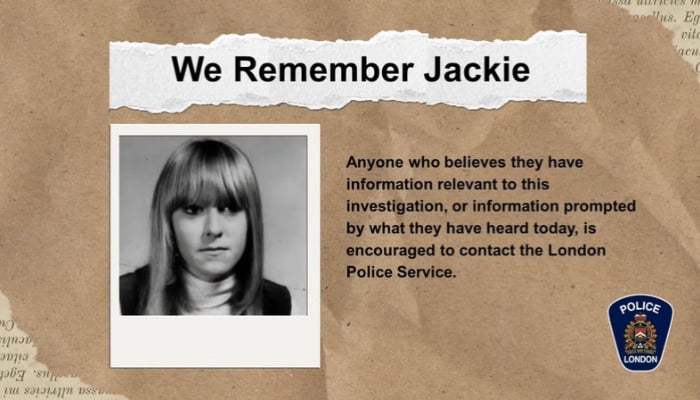
London Police Solve 1968 Cold Case Murder of Teen Jacqueline Dunleavy Using DNA Genealogy
London police identified Michael Joseph Moore as the person responsible for the 1968 murder of 16-year-old Jacqueline “Jackie” Dunleavy on Monday.
Investigators used modern forensic DNA technology and genetic genealogy to solve the nearly 59-year-old cold case. Moore, who was 25 years old at the time of the killing, died on March 3, 2018, meaning no criminal charges can be laid.
- Moore was a former London firefighter who retired with the rank of captain.
- Dunleavy was found strangled on the grounds of Katherine Harley School on Jan. 9, 1968.
- The breakthrough involved DNA testing through forensic laboratory Othram.
“This outcome reflects the extraordinary dedication and persistence of the investigators who worked on Jackie’s case, both past and present,” London police Chief Thai Truong said.
DNA evidence identifies suspect
The investigation involved analyzing preserved biological material and using genetic genealogy to construct family trees. Investigators worked with the Toronto Police Service, the Ontario Provincial Police, and the Centre of Forensic Sciences to narrow the focus to Moore.
Police said the evidence established a level of certainty that would have supported criminal charges. “Had Moore been alive today, he would have been arrested and charged in relation to Jackie’s murder,” Det. Mike Budzyn said.

The identification followed a comprehensive review by the Major Crime Section. While Moore’s name appeared during a joint task force investigation between 1997 and 2001, he was not named as a suspect at that time.
The 1968 investigation
Dunleavy, a Grade 10 student at Westminster Secondary School, was last seen walking away from the Stanley Variety Store at approximately 6:30 p.m. on Jan. 9, 1968. Three youths discovered her body at about 8 p.m. that evening on the grounds of Katherine Harley School.
Although Dunleavy had suffered a head injury, investigators determined the cause of death was strangulation. Witnesses at the time recalled seeing a girl matching Dunleavy’s description enter a white vehicle at a bus stop on Beaconsfield Avenue.
Moore had emigrated from Ireland to Canada in January 1967 and lived in an apartment on Springbank Drive at the time of the murder. He was described as being approximately 6 feet tall with dark hair.
Police detail how genetic genealogy narrowed the suspect
Police said the case had been reviewed by generations of investigators, but modern genetic genealogy made it possible to “construct family trees and narrow the investigation toward a potential suspect,” according to a news release. Det.

Moore immigrated to Canada in 1967
He was born in Ireland in 1942 and immigrated to Canada in January 1967, moving into an apartment on Springbank Drive in May of that year. Police said there is no evidence that Moore and Dunleavy knew each other.
Dunleavy was the daughter of a London police officer, a connection Chief Thai Truong noted carried particular significance for the service. Her younger brother and his wife attended Monday’s announcement but declined interviews. Police released Moore’s identity to provide an accurate historical record and urged anyone with information about him to come forward.
Police seek historical information
Authorities released the identity of Moore to provide an accurate historical record and offer answers to the victim’s family and the community. “Hearing the name Michael Joseph Moore, or learning information about him today, may bring back memories for people who knew him, had contact with him, or were familiar with him during that time,” police said.
“Information that may not have seemed significant at the time could have meaning today,” police said in a statement.