Locust Brain Detects Bacterial Biofilms From Free-Floating Cells At MSU
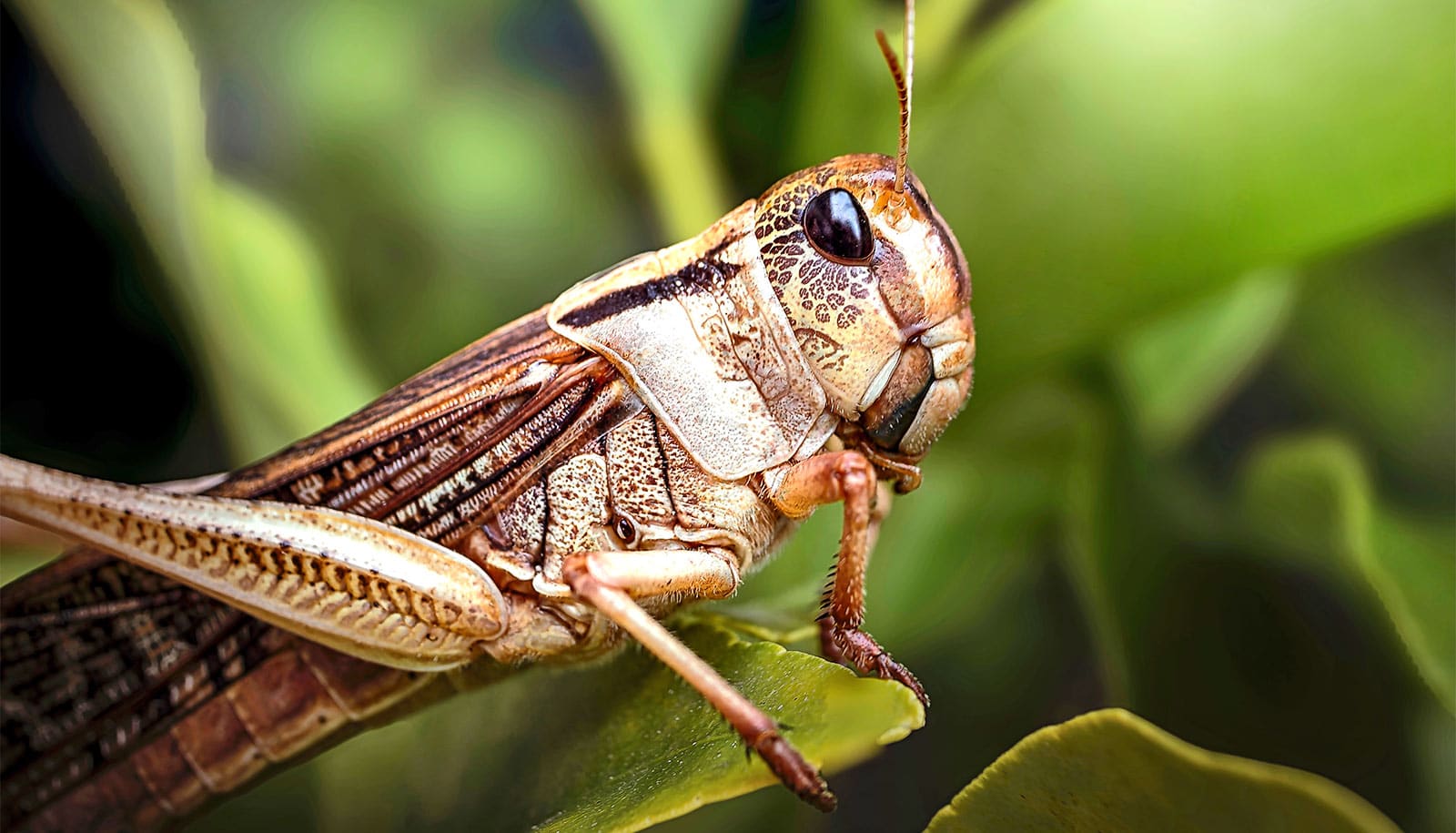
Electrodes in a locust brain picked out the smell of bacterial biofilms from free-floating cells in under five seconds, a Michigan State University team demonstrated in a study published Sept. 22 in Communications Biology.
Biofilms — slimy, surface-attached bacterial communities protected by an extracellular matrix — can make bacteria up to 1,000 times more resistant to antibiotics than free-floating, or planktonic, cells, the study authors wrote, citing earlier research. They account for roughly 80% of human bacterial infections, affecting wounds, implants and lungs, yet no clinical test can distinguish a biofilm infection from a planktonic one without directly culturing a sample, a process that takes days.
Rather than training locusts to behave in response to odors, the researchers implanted electrodes in the antennal lobe — the primary olfactory center — of six living insects and recorded the firing patterns of 32 neurons as air from bacterial cultures passed over the antennae. Each odor was delivered for four seconds and repeated five times.
“The insect brain performs the complex odor processing, while our electronics and algorithms translate that neural activity into an identifiable signal,” said Debajit Saha, a senior author of the study.
A computer classifier matched 22 of 25 trials to the correct culture flask — 88% accuracy across five odor classes including two species ( Pseudomonas aeruginosa and Staphylococcus aureus) each grown as biofilms and planktonic cultures, plus a sterile broth control. Both biofilms were identified in every trial. When the task was narrowed to distinguishing biofilm from planktonic growth within each species, accuracy reached 96%, MSU reported.
“What we did not know was whether the odor produced by bacteria would contain enough information to reveal something as specific as their growth state — whether the bacteria were organized on a biofilm surface or growing planktonically,” Saha said. “Seeing such a high level of discrimination was therefore quite surprising.”
Highly discriminatory neural responses appeared within the first couple of seconds of odor exposure; the team needed less than five seconds of data per sample. The clearest signal emerged about one second after odor onset, Earth.com noted.
The study tested only two bacterial species in controlled flask cultures. Human breath contains thousands of volatile compounds shaped by diet, medications and environment, and whether biofilm signatures can be separated from that background remains untested.
Michigan State University, classified among “R1: Doctoral Universities – Very high research activity,” demonstrated its leadership in interdisciplinary research by publishing a biology/neuroscience study in Communications Biology on Sept. The university’s team, led by Debajit Saha from the College of Engineering, achieved 88% accuracy in distinguishing bacterial biofilm odors using locust neural recordings, showcasing its expertise in bioengineering and neuroscience.
Additionally, MSU houses the Facility for Rare Isotope Beams, a major national research hub, underscoring its established role in cutting-edge scientific investigation.
Saha’s longer-term goal is a portable device that couples a living locust’s olfactory system with miniaturized electronics and machine-learning algorithms — a “cyborg” sensor that harnesses biological odor processing rather than replicating it artificially.
“What makes this direction particularly exciting is the possibility of bringing together biology and engineering,” Saha said.
“Instead of trying to reproduce the enormous complexity of an insect’s olfactory system entirely with artificial sensors, we can potentially harness the biological system itself and connect it to modern electronics and machine learning.”
The work was supported by the National Science Foundation.