Local Email Search Speed: Notmuch vs IMAP
How to Let Claude Search Your Email Without Letting It Send or Delete
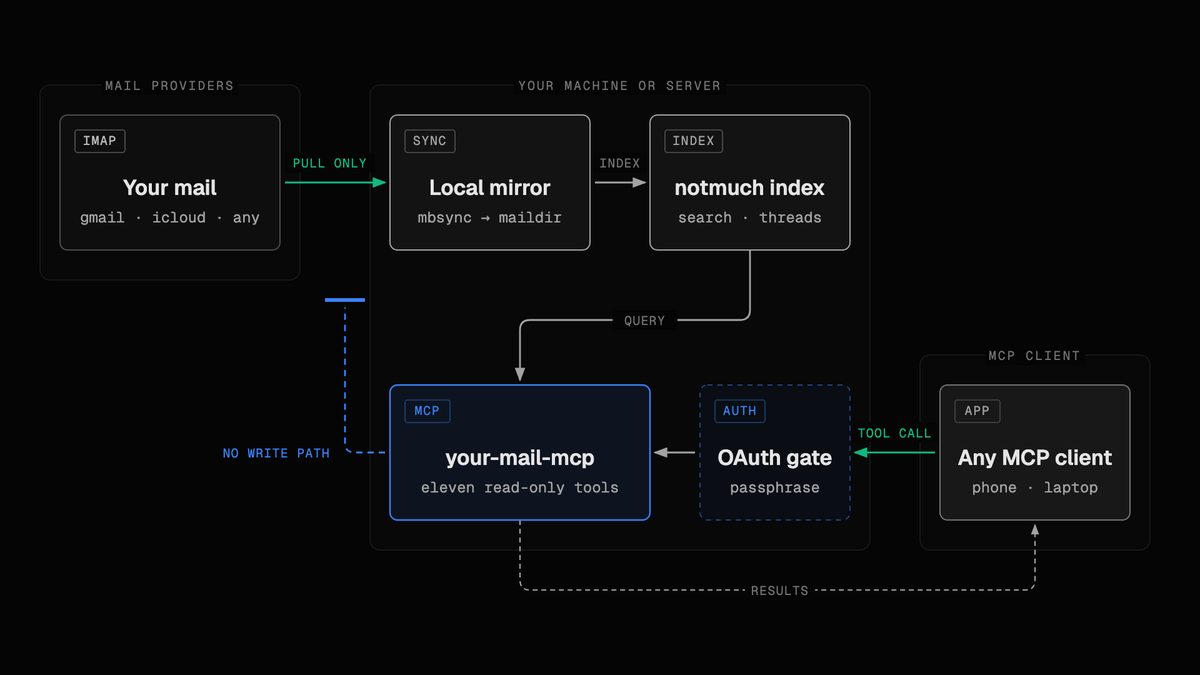
As enterprise adoption scales and individual workflows demand deeper automation, integrating large language models with local data stores has become standard practice. According to technical discussions on platforms like Hacker News, a primary friction point for developers running local semantic searches across tens of thousands of messages—such as a 36,000-message iCloud archive spanning 14 directories—is balancing speed against security. While a local notmuch database indexes that corpus in milliseconds, querying cloud-tethered assistants via IMAP or API introduces severe threat vectors. Configuring an LLM like Anthropic’s Claude to read correspondence without granting write, send, or delete permissions requires strict API scoping, read-only authentication tokens, and containerized sandboxing.
The Tech TL;DR:
- Read-Only Scoping: Restrict LLM tool access exclusively to GET and search endpoints, stripping OAuth scopes for SMTP send operations and message deletion.
- Local vs. Protocol Latency: Local indexing engines like notmuch return search queries in milliseconds, whereas IMAP wrappers add network latency and parsing overhead.
- Enterprise Containment: Deploy middleware proxies to intercept API calls, ensuring strict SOC 2 compliance and preventing data exfiltration during retrieval-augmented generation (RAG) queries.
Architectural Isolation: Enforcing Read-Only API Boundaries
Giving an AI assistant conversational access to a personal or enterprise inbox creates an immediate attack surface. Per the official Anthropic Developer Documentation, tool use implementation relies on explicit JSON schemas defining what functions an LLM can invoke. To prevent unauthorized actions, developers must decouple search capabilities from transactional mail protocols. When writing custom MCP (Model Context Protocol) servers to bridge Claude with an email client, engineers must explicitly omit functions mapped to `message.send` or `message.delete`.
According to repository guidelines maintained by the open-source community on GitHub, a secure integration depends on OAuth 2.0 token scopes restricted strictly to `https://www.googleapis.com/auth/gmail.readonly` or equivalent IMAP read-only flags. If an LLM attempts to hallucinate a tool call or execute a prompt injection payload designed to purge a directory, the missing write scope causes the API gateway to reject the request outright at the transport layer.
{
  "tools": [
    {
      "name": "search_emails",
      "description": "Search local email headers and body text using read-only queries.",
      "input_schema": {
        "type": "object",
        "properties": {
          "query": { "type": "string", "description": "Search term or regex pattern" }
        },
        "required": ["query"]
      }
    }
  ]
}
Latency Benchmarks: Local Indexing Versus IMAP Scraping
Processing large message volumes exposes acute performance bottlenecks. Searching a local store of 36,000 messages across 14 distinct folders via a native utility like notmuch takes milliseconds on modern multi-core x86 and ARM silicon. By contrast, streaming the same query over IMAP can introduce multi-second latency spikes depending on network bandwidth and server-side throttling. Engineering teams configuring retrieval-augmented generation pipelines often rely on vetted software development agencies such as [Relevant Tech Firm/Service] to build local caching layers that prevent API rate-limit exhaustion.
According to database performance benchmarks published on Stack Overflow, offloading the search index to a local SQLite or vector database dramatically reduces token consumption and cost. Instead of piping raw mailboxes directly into an LLM context window—which risks hitting token limits and leaking sensitive PII—the local search script retrieves only the matching snippets required for the prompt.
Securing Enterprise Deployments and Preventing Data Leaks
For organizations scaling AI integrations across corporate infrastructure, unvetted access to communications archives violates core compliance frameworks. Enterprises cannot risk prompt injection vulnerabilities tricking an assistant into exfiltrating confidential correspondence. Organizations are urgently deploying vetted cybersecurity auditors and penetration testers via [Relevant Tech Firm/Service] to review custom tool schemas and API gateways before production deployment.
Containerization provides an additional layer of defense. Running the integration bridge inside an isolated Docker container with zero outbound network access—except for the designated LLM API endpoint—ensures that even if an injection attack succeeds, data cannot be routed to an unauthorized external server. For comprehensive system hardening, consulting firms like [Relevant Tech Firm/Service] assist engineering leads in establishing continuous integration testing to audit tool permissions on every code push.
Editorial Kicker
As autonomous assistants transition from novelties to core workflow components, the architectural line between utility and risk will be drawn at the API boundary. Developers who enforce strict permission scoping today will avoid catastrophic data loss tomorrow, proving that security and seamless AI integration can coexist if engineered from the metal up.

*Disclaimer: The technical analyses and security protocols detailed in this article are for informational purposes only. Always consult with certified IT and cybersecurity professionals before altering enterprise networks or handling sensitive data.*