ListeList Reports Lake Karachay in Russia Has Radioactive Contamination
Lakes once considered tranquil landscapes now present lethal risks ranging from radioactive contamination to sudden gas releases, according to a report by ListeList.
While many bodies of water remain safe for recreation, specific geological and human-made conditions have rendered some of the world’s most notable lakes hazardous.
- Lake Karachay in Russia was used as a nuclear waste dump, receiving 4.44 exabecquerels of radioactivity.
- A 1986 limnic eruption at Lake Nyos in Cameroon killed 1,746 people and 3,500 livestock.
- Lake Lugano, situated between Switzerland and Italy, holds the highest concentration of floating plastic particles among 38 sampled global sites.
Radioactive Legacy of Lake Karachay
Lake Karachay in Russia’s southern Ural Mountains was utilized by the Soviet Union starting in 1951 to store high-level radioactive waste from the Mayak nuclear plant. The facility disposed of waste directly into the water because it was too volatile for standard storage tanks, ListeList reported.
The lake accumulated cesium-137 and strontium-90, with cesium levels estimated at roughly 40 times the amount released during the Chernobyl disaster.
A drought in 1968 exposed the lakebed, allowing radioactive dust to spread across the region and irradiate approximately half a million people. By 1990, the site remained so toxic that standing near the discharge point for one hour resulted in a lethal dose of radiation. The lake was converted into a permanent dry waste store through backfilling with concrete and soil between 2015 and 2016.
Limnic Eruptions at Nyos and Kivu
Lake Nyos in Cameroon is the site of a rare geological phenomenon known as a limnic eruption. On August 21, 1986, the lake released a massive cloud of carbon dioxide that had accumulated in its deep waters. Because the gas is heavier than air, it descended into nearby valleys and smothered 1,746 people and 3,500 livestock while they slept. Since 2001, authorities have used pipes to vent gas from the lake bottom to prevent a recurrence.
Lake Kivu, located on the border between Rwanda and the Democratic Republic of the Congo, presents a similar but larger threat. Scientists have identified 256 cubic km of dissolved carbon dioxide and 65 cubic km of methane within its depths. While projects like KivuWatt began extracting methane for electricity in the 2010s, the long-term stability of the lake remains uncertain.
Lake Karachay, a small lake covering just 0.15 km² by 1993, served as a dumping site for high-level radioactive waste from 1951 onward. The lake accumulated 4.44 exabecquerels (EBq) of radioactivity, including 3.6 EBq of cesium-137 and 0.74 EBq of strontium-90, with cesium levels roughly 40 times the amount released during the Chernobyl disaster. By 1990, radiation near the discharge point reached 600 röntgens per hour (approximately 6 Sv/h), a lethal dose within an hour.
Chemical and Environmental Hazards
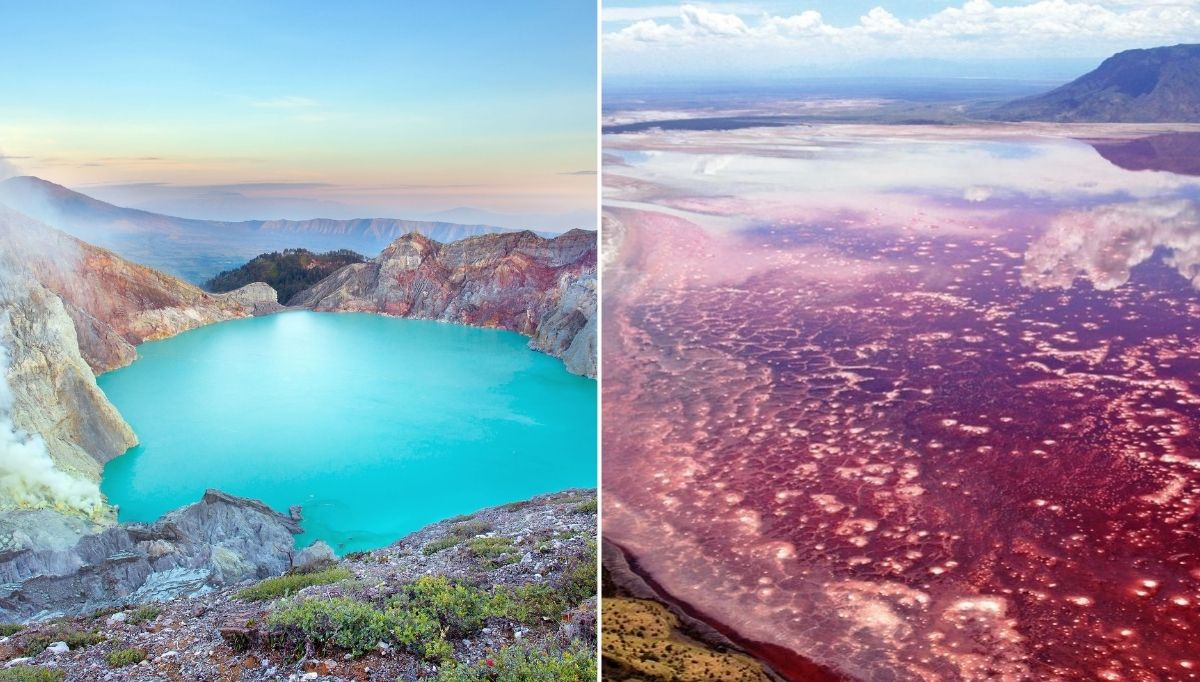
Other lakes pose risks through extreme chemistry or environmental pollutants. Lake Natron in Tanzania features a pH level exceeding 12 due to sodium carbonate deposits, creating a caustic brine that calcifies animals that die in the water. Conversely, Kawah Ijen in Indonesia contains the world’s largest highly acidic crater lake, with a pH as low as 0.13.
Lake Lugano was identified in a [2023 study published in Nature] as having the highest concentration of floating plastic particles among 38 studied lakes and reservoirs. Meanwhile, Lake Victoria in East Africa remains dangerous due to weather, with fishers drowning annually when storms swamp small boats.