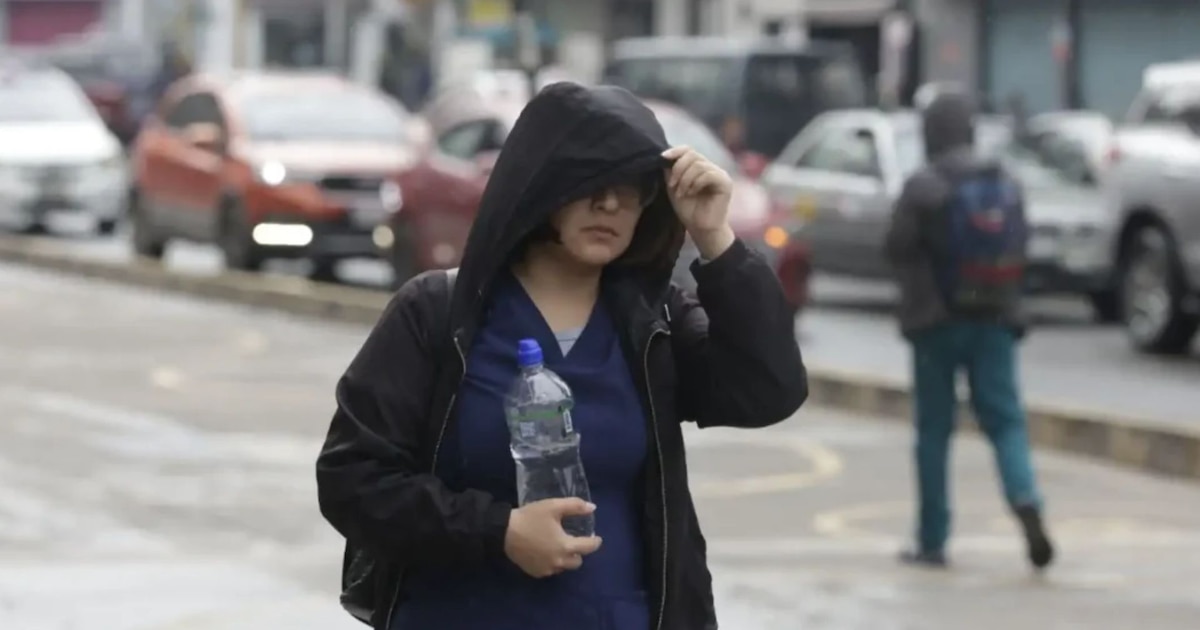
Lima districts recorded 3.5 millimeters of drizzle in a single morning
Lima districts recorded 3.5 millimeters of drizzle in a single morning, equal to 3.5 liters per square meter, as the El Niño event pushes coastal temperatures up to six degrees above normal.
The National Meteorology and Hydrology Service (Senamhi) said the warming ocean and high atmospheric moisture will keep drizzle falling over the central and southern coast through Thursday, with accumulations of 0.5 to 0.8 millimeters per day in central coastal areas including southeast Lima, Agencia Andina reported. Senamhi added that cloud cover, fog and mist will also persist near the shoreline, mainly during the night, early morning and first hours of the day.
For the southern coast, accumulations of 0.5 to 2.5 millimeters per day are expected in Arequipa provinces Camaná, Caravelí, Castilla, Caylloma, Condesuyos and Islay; in Moquegua provinces Mariscal Nieto and Ilo; and in Tacna provinces Jorge Basadre and Tacna, with amounts near 0.5 millimeters per day elsewhere on the southern coast, Agencia Andina reported. Ica province Nasca is another department that could be affected, Agencia Andina reported.
“We are entering the highest peak of this Extraordinary El Niño phenomenon,” said Grinia Ávalos, head of Senamhi, warning that December, January and February will be the most critical months for both heat and intense rainfall on the western slope, Federación de Periodistas del Perú reported.
She warned that Lima will reach 30 degrees and some areas in the north of the country could reach 34 degrees, Federación de Periodistas del Perú reported.

Senamhi’s climate surveillance deputy director, Yury Escajadillo, said the current event shows ocean-atmosphere coupling comparable to the 1982-83 and 1997-98 episodes, AP Noticias reported.
Northern rivers surge as capital bakes
In the north, the Tumbes River briefly exceeded the danger threshold of 1,000 cubic meters per second over the past 48 hours before receding, tvperu.gob.pe reported. Piura accumulated 134 liters of water per square meter in the last 24 hours, with another critical day expected Thursday, Federación de Periodistas del Perú reported.
🌊#OLEAJE: El nivel del mar aumentó e inundó una parte del balneario de #Paracas y el Rancherío de Laguna Grande. 🇵🇪#ElNiño #perú #ica pic.twitter.com/1MkW8WnfcD
Lima’s temperature anomalies have been sharp. La Molina station reached 32.6 °C against a 23.2 °C average, while Campo de Marte in Jesús María hit 31.8 °C versus a 21.3 °C norm, Canal N and Willax reported.
Carabayllo registered 30.7 °C, La Molina 30.5 °C and Ate 29.6 °C, Canal N reported. According to Senamhi, in San Juan de Lurigancho and Villa María del Triunfo drizzle with high humidity is being recorded, Federación de Periodistas del Perú reported.
Senamhi forecast maximums will gradually ease toward 27-28 °C in coming days, but high humidity will lift the heat index by one to two degrees, Altavoz reported. Northern districts could reach 31 °C, eastern districts 32 °C, and the Tumbes-to-Piura corridor up to 34 °C, Federación de Periodistas del Perú reported.
For the next few days, maximums will descend toward ranges of 27 °C to 28 °C, but high humidity will raise the thermal sensation between 1 and 2 degrees due to marine warming and an extraordinary Coastal El Niño until February, Federación de Periodistas del Perú reported.

Incoming mayors drilled on emergency powers
Defense Minister Rafael Belaunde led a two-day seminar in Piura for more than 60 newly elected provincial and district mayors, covering the disaster risk management system, the BAE housing rental bonus, machinery requests and the budget program for risk reduction, El Peruano reported. During the two days, the future authorities and their technical teams will learn the meteorological outlook for the region, the functioning of the National Disaster Risk Management System and its preparation, response and rehabilitation processes, El Peruano reported.
They will also receive guidance on mechanisms to attend emergencies, such as access to the Emergency Housing Rental Bonus (BAE) and the request for machinery, El Peruano reported. Likewise, they will learn the functioning of Budget Program 0068, an instrument that allows identifying and prioritizing interventions for risk reduction and disaster attention, El Peruano reported.
The sessions feature specialists from Indeci, Senamhi and other Defense sector entities, as well as the Ministries of Transport and Communications and of Women and Vulnerable Populations, El Peruano reported.
“The new municipal authorities will lead the local response during the peak of the rainy season in Piura and must take office prepared and with the necessary knowledge to face the El Niño phenomenon,” Belaunde said, El Peruano reported, according to El Comercio Perú.
The minister highlighted the work the Armed Forces perform in emergency attention in the country and assured they have personnel and means prepared to provide immediate support to the population by land, sea and air, El Peruano reported.
#Radar ¡ATENCIÓN TUMBES Y PIURA! Lluvias con descargas eléctricas en Cañaveral (18.2 mm), Rica Playa (5.1 mm) y El Tigre (1.2 mm). Se prevé su disminución. Tumbes: Zarumilla y Contralmirante Villar. Piura: Sullana, Piura y Ayabaca (1 a 5 mm). https://t.co/HivsuHrC6n pic.twitter.com/PvZM5tGByR
Prime Minister Luis Galarreta, Agriculture Minister Marco Vinelli and the Northern Operational Command chief, Division General EP Carlos Rabanal, attended the sessions organized by Indeci with the Technological University of Peru, El Peruano reported. Also present were Senator Karla Schaefer and Deputies Henry Albañil, César Revilla, Carmela Paucara and Eduardo Castillo, El Peruano reported.
Indeci urged local authorities to verify evacuation routes are clear and signposted, confirm health centers, fire companies and police stations are operational, and coordinate early-warning systems using whistles, bells, alarms, sirens or loudspeakers, Agencia Andina reported.
Indeci also recommended the population protect and reinforce the roofs of their homes, disconnect and stay away from electrical appliances, and drive with caution since rain reduces visibility and increases braking time, Agencia Andina reported. Likewise, establish an early warning system using whistles, bells, alarms, sirens or loudspeakers, in coordination with local authorities; in addition, prepare and apply their Family Emergency Plan, Agencia Andina reported.
Senamhi, the specialised technical body attached to the Ministry of Environment, operates Peru’s national network of more than 900 meteorological and hydrological stations and issues the official weather, climate and hydrological forecasts that feed the National Disaster Risk Management System (SINAGERD).
Its Climate Surveillance Deputy Directorate and Hydrology Directorate produce the seasonal outlooks, El Niño monitoring and river-level bulletins — such as the Tumbes River danger-threshold alerts — that Indeci and regional authorities use to trigger evacuations and early-warning sirens.

Senamhi’s Nelson Quispe said Lima’s drizzle could intensify next week, with accumulations potentially surpassing 80-90 millimeters. The capital’s historical daily rainfall record is 17 millimeters set in 1970; recent events have reached 11.7 millimeters, tvperu.gob.pe reported.
One of the most affected points was Villa María del Triunfo, where at the beginning of the month 11.7 millimeters of precipitation were reported, a record that caused waterlogging in low areas of the district and complications in vehicular circulation, tvperu.gob.pe reported. Senamhi issued a short-term warning for the possible activation of ravines and mudslides between November 14 and 15, with a validity of 24 hours, Canal N reported.