
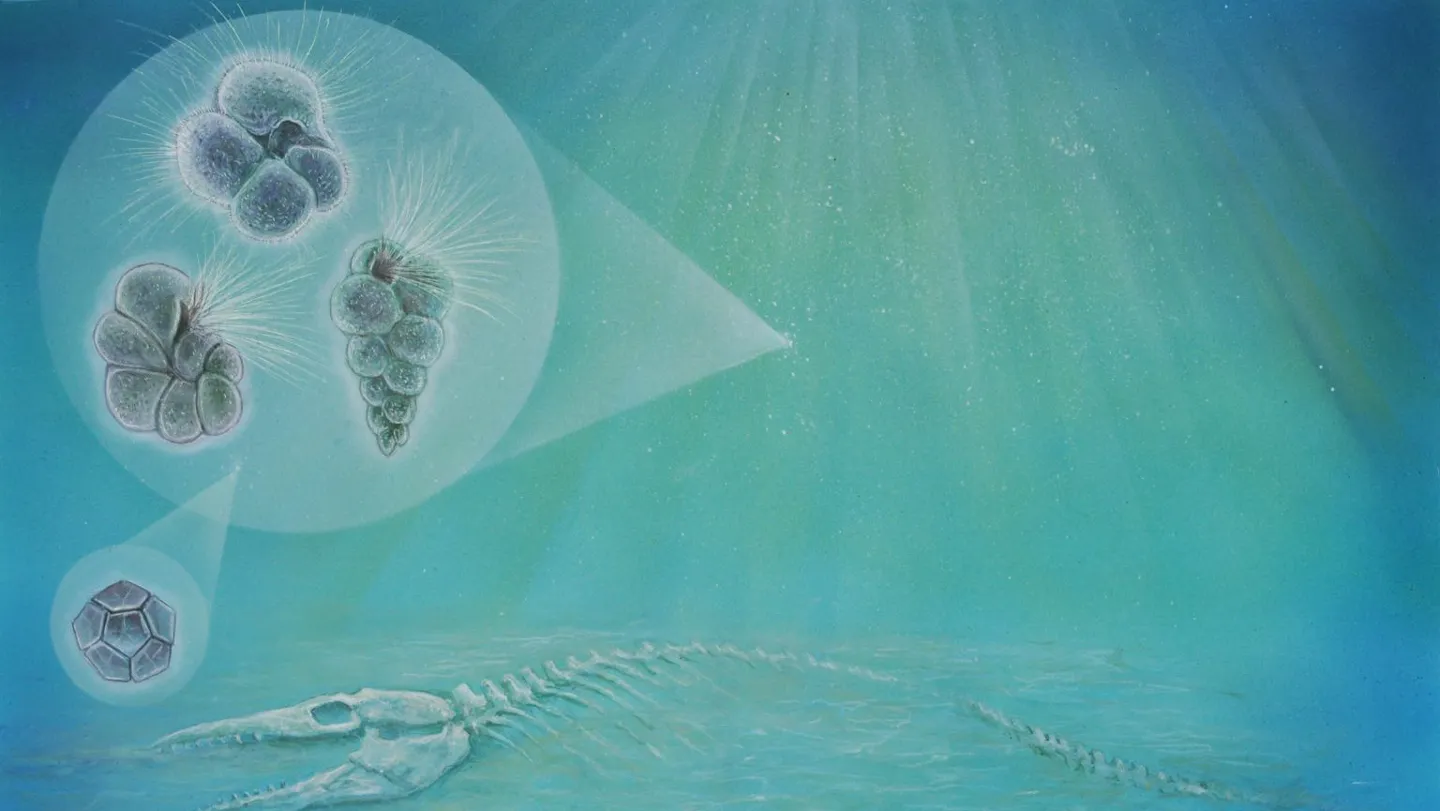
The recovery of life on Earth after the asteroid impact that wiped out the dinosaurs happened far more rapidly than previously believed, with new species emerging within decades, and certainly within a few thousand years of the event, according to research published this week in Geology.
For decades, scientists estimated that it took approximately 30,000 years for complex ecosystems to begin rebuilding after the Chicxulub impact 66 million years ago. This estimate was based on the thickness of sediment layers and average sedimentation rates. But, a re-examination of data, incorporating measurements of helium-3 – a rare isotope deposited on Earth by interplanetary dust – suggests a significantly accelerated timeline.
The research, led by Christopher Lowery, a paleoceanographer at the University of Texas at Austin, focused on marine fossils known as planktonic foraminifera, microscopic organisms with mineral shells. The first appearance of a specific species, Parvularugoglobigerina eugubina, has long been used as a marker for the beginning of ecological recovery. Lowery and his team found that this species appeared roughly 6,400 years after the impact, based on analysis of sediment cores from the Chicxulub crater and five other sites around the world – including locations in Italy, Spain, and Tunisia.
“This really helps us understand how quickly species can evolve,” Lowery said. “It provides a rare opportunity in the geological past to understand how ecosystems can recover from these quick, severe changes.”
The team’s findings challenge previous assumptions about the pace of post-extinction recovery. The helium-3 data revealed that sediments accumulated much faster in the immediate aftermath of the impact than previously thought, compressing the timeline for the emergence of new life.
Further research, published last year by Brian Huber of the Smithsonian’s National Museum of Natural History, suggests the recovery may have been even faster. Huber and his colleagues used temperature signals within foraminifera shells and climate models to propose that new plankton species began to appear within decades of the impact. Their work indicates that a brief period of darkness caused by atmospheric dust and soot was followed by a rapid clearing of the skies and a surge in global warming, potentially accelerating evolutionary change.
Although the exact timing remains a subject of ongoing research, the emerging consensus points to a remarkably swift response by life on Earth. Vivi Vajda, a paleobiologist at the Swedish Museum of Natural History, who was not involved in the study, emphasized the significance of the findings. “Life really starts to rebound as soon as there is any possibility,” she said.
The Chicxulub crater, located off the Yucatán Peninsula in Mexico, is estimated to be 180-200 kilometers (110-120 miles) in diameter and 20-30 kilometers (12-19 miles) deep, formed by an asteroid approximately 10-15 kilometers (6.2-9.3 miles) wide. The impact is widely believed to have caused a mass extinction event that eliminated roughly 75% of plant and animal life on Earth.
Despite the speed of initial recovery, Lowery cautions that it took millions of years for ecosystems to fully stabilize, and the world never regained its pre-impact biodiversity. Evolution, he notes, is capable of rapid innovation, but not instant restoration.
