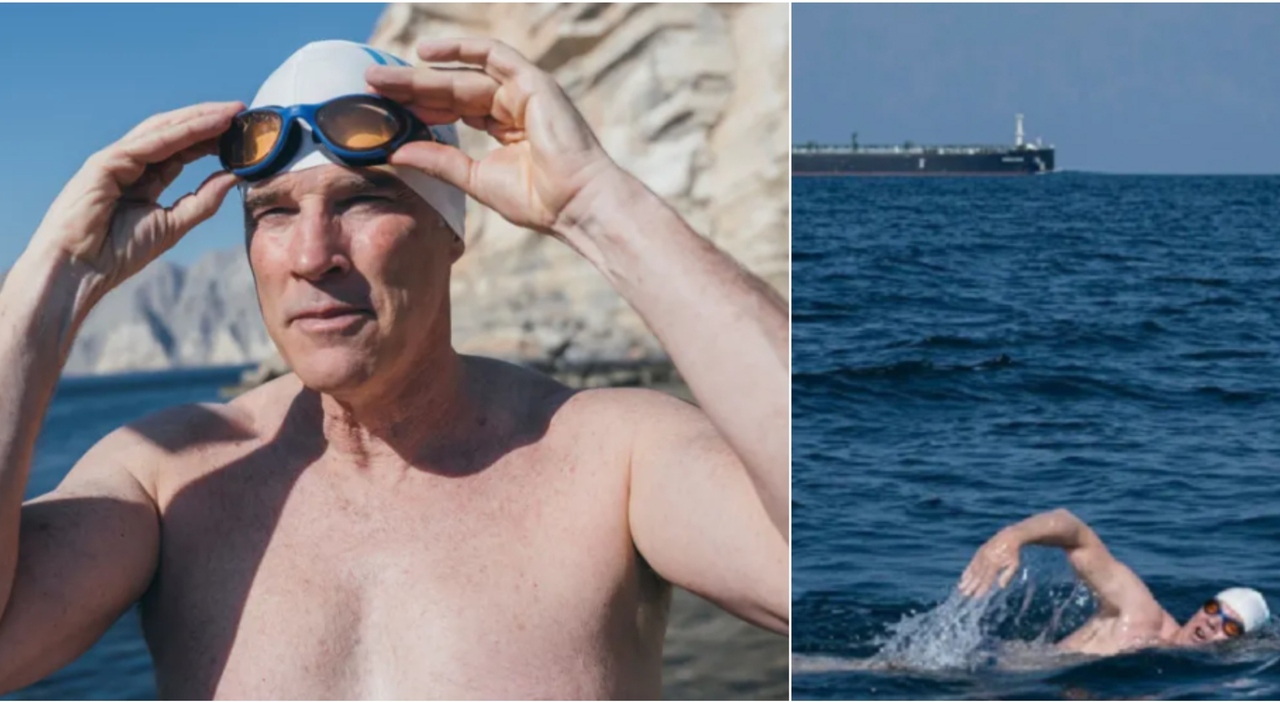
Lewis Pugh Swims Hormuz to Highlight Environmental Destruction
Lewis Pugh, a 56-year-old British endurance swimmer and United Nations Patron of the Oceans, completed a 15-kilometer swim along Oman’s Musandam Peninsula on November 21 to highlight the environmental destruction caused by conflict in the Strait of Hormuz.
The three-day expedition involved six and a half hours of swimming in stages, according to the Lewis Pugh Foundation. Pugh entered the water near Musandam Island and concluded his swim at Cape Hormuz, the northernmost tip of the peninsula. He swam in a swimsuit, cap, and goggles, covering the distance in stages rather than in a single continuous crossing, the Associated Press reported.
Tanker explosion near swimmer on day one
The proximity of the conflict to the swimmer was immediate. Thirty minutes into his first day, a projectile struck a tanker approximately four kilometers away, Pugh told the Associated Press. “I felt the explosions, on the other side I was surrounded by ospreys and dolphins. I will never forget the contrast between these two images,” he told Agence France-Presse. On the second day, Pugh passed the burning liquefied petroleum gas carrier Tara Gas.
“The flames were enormous. These ships carry highly flammable gas and an attack on one of them can have catastrophic consequences, not only for the crew, but also for the surrounding marine environment,” Pugh told Il Messaggero. “My first thought went to the seafarers on board,” Pugh told Il Messaggero.
In the following days, he said he witnessed further attacks on commercial vessels and saw ships burning, according to his account published on his website. The Strait of Hormuz is also home to dugongs, sea turtles, and whale sharks, Pugh told Il Messaggero, according to la Repubblica.
A corridor in crisis
The Strait of Hormuz is a critical global artery, handling roughly one-fifth of the world’s traded oil. Since conflict began on February 28, Iran has increased attacks on vessels it claims use unauthorized routes. Security in the region remains volatile. Data from the Joint Maritime Information Centre, a U.S.-led body based in Dubai, shows a sharp drop in activity.
Between November 19 and 21, the center assisted 114 transits—averaging 28 per day—which represents a 65 percent drop from pre-war levels, Notizie Geopolitiche reported. 227 vessels were waiting at anchor east of the strait, Notizie Geopolitiche reported.
Iran’s regular army commander-in-chief, General Amir Hatami, ordered the Navy days earlier: “As long as the Islamic Republic’s seven conditions are not met, not only will the Strait of Hormuz not be reopened, but it must be closed further day by day,” according to Iranian state media.
I have just completed a three-day swim through the Strait of Hormuz to draw attention to the devastating environmental consequences of war. Just 30 minutes after I began swimming, an oil tanker was struck a few kilometres away. The explosions rocked the sea around me. Over the… pic.twitter.com/ruMxBHyQFN
Iran claims tankers struck mines; JMIC disputes cause
Iran’s Revolutionary Guards said that two tankers on an unauthorized route in the southern Strait of Hormuz hit naval mines, causing violent explosions and fires, according to a statement carried by state television. The Guards identified one of the vessels as a supertanker carrying over two million barrels of crude that sank in the southern Persian Gulf.
The Joint Maritime Information Centre, the U.S.-led body in Dubai that logs Gulf incidents, considers the mine claims unconfirmed. Its reports list “unidentified projectiles” rather than mines in the water, according to its assessment cited by Notizie Geopolitiche.

UKMTO confirms tanker incident with military
UK Maritime Trade Operations announced Sunday evening that a tanker was involved in an incident with military forces in the Gulf of Oman, east of the Strait of Hormuz near the southern Iranian city of Chabahar, according to Euronews. The maritime agency specified the event occurred 17 nautical miles east of Khasab, Oman.
Iran’s Navy separately announced that two tankers struck mines north of Ghanam Island and east of the Strait of Hormuz, according to the semi-official Fars news agency cited by ANSA.
Lewis Pugh has a history of utilizing endurance swims to advocate for marine conservation. In 2018, he swam the full length of the English Channel to call for 30% of the world’s oceans to be protected by 2030. His previous expeditions include a 2010 swim across a glacial lake on Mount Everest to highlight melting glaciers in the Himalayas, and a 2007 swim across the North Pole to draw attention to melting Arctic sea ice.
The cost to the seabed
The physical scale of the damage is extensive. Greenpeace disaster expert Nina Noelle told Internazionale that at least 133 attacks on tankers have occurred since February. Documented losses cover approximately 20,000 square kilometers, an area nearly the size of Wales. “Mangroves and coral reefs can take decades to recover, especially if oil remains in the sediments,” Noelle said. In 2023, he swam the entire 315 miles of the Hudson River in the United States to promote the protection of waterways. His foundation reports these campaigns helped secure protection for more than 3.5 million square kilometers of ocean, Corriere della Sera reported.
“The war causes immense human suffering… but there is another victim that receives far too little attention: nature itself,” Pugh said in a statement posted to X on November 21. “The environmental consequences will last for decades. My message is simple: Stop the fighting. Open the Strait. Clean up the pollution.” “The human cost of war must not overshadow the risks to the sea,” Pugh told Diariodelweb.it.
“We must stop the war, reopen the strait and clean up the pollution.” “Sport opens doors, creates opportunities for dialogue and allows people to start reflecting on important issues,” Pugh said, adding his final message to governments and the international community: “We must stop the war, reopen the strait and clean up the pollution.”
More on Strait of Hormuz
Thank you! 💚🤍❤️ https://t.co/ttgflT9I2k
I have just completed a three-day swim through the Strait of Hormuz. I went there to bring attention to the devastating environmental cost of war. Associated Press has published the first account of the swim. Please read it, and help share it.https://t.co/zWm3DAm9eB Photos:… pic.twitter.com/ghMzMXU3JF
British endurance swimmer Lewis Pugh spent three days swimming parts of the Strait of Hormuz to highlight how the war with Iran threatens the area's habitat and wildlife. https://t.co/rtx5H1NErr
British endurance athlete describes what it was like swimming through the Strait of Hormuz and the moment they had to abort a swim due to an oil tanker being hit. Lewis Pugh wants to highlight the environmental damage the war is having on the wildlife in the Strait of Hormuz. pic.twitter.com/TwsbEKDrpE
British endurance swimmer Lewis Pugh has completed a 15-km swim through the Strait of Hormuz, navigating waters where oil tankers have been attacked and set ablaze, to highlight the environmental threat posed by the ongoing war with Iran. Know more 🔗 https://t.co/UpOrwbub00… pic.twitter.com/l4BDSFwcbG