Lee Chang-dong’s “Possible Love” Reviews Class, Filmmaking Ethics at TIFF
Lee Chang-dong’s latest film, Possible Love, premiered at the Toronto International Film Festival, offering a critical examination of class disparities and the ethics of documentary filmmaking. The 165-minute drama, which marks the director’s first feature in eight years, explores the tension between a wealthy couple and a struggling working-class family.
Class and Culpability
The film follows Ho-seok, a worker recently laid off after a strike, and his wife Mi-ok, who works in a mask factory. Their lives intersect with Lee Ye-ji, a documentary filmmaker, and her husband Sang-woo.
Ye-ji attempts to document the plight of laborers, but her efforts raise questions about whether the wealthy are merely exploiting the suffering of the working class for their own artistic pursuits, according to the review published by cinemafromthespectrum.com. The film opens by quoting the tenth commandment: “Thou shalt not covet.”
Lee Chang-dong uses this narrative to hold both the artists and their audiences accountable, questioning the efficacy of such films in improving the lives of their subjects.
“It’s very possible that Ye-ji could have the best intentions with making a documentary about how laid-off workers have suffered, except that her desire to make them into her film’s “main characters” could risk having their individual struggles supposedly represent the entire South Korean working class,” noted cinemafromthespectrum.com. The filmmaker also explores the imbalance of class relations after the characters meet at the funeral of one of Ho-seok’s former coworkers.
Ye-ji’s interest in the project began after she accompanied her husband on a trip from Qatar.
Sul Kyung-Gu and Jeon Do-Yeon Deliver Standout Performances
The film features performances from Sul Kyung-gu as Ho-seok and Jeon Do-yeon as Mi-ok. Critics highlighted their work as a standout element of the production, with film-forward.com describing Jeon’s portrayal of a woman carrying her family’s burdens as “some of the most remarkable acting this year.” The film’s 165-minute runtime is well justified, according to film-forward.com, especially in a festival season where many features exceed 150 minutes.
The narrative utilizes a non-linear structure, moving back and forth in time to piece together the complexities of the couples’ relationships. The documentary-within-a-film serves as a focal point for the characters’ clashing worldviews.
As the characters interact, the distinction between the subjects’ reality and the filmmaker’s perspective becomes increasingly blurred, as noted by letterboxd.com. “The camera is supposed to show the insides and outs of humanity and to show the ability of love itself,” letterboxd.com observed.
Lee Chang-dong’s filmography is defined by a rigorous moral scrutiny of South Korean society, employing non-linear structures and a novelist’s attention to the inner lives of the marginalized to interrogate collective trauma and systemic inequality.
From the reverse chronology of Peppermint Candy (1999) unpacking two decades of national history to the enigmatic class rage of Burning (2018), his work consistently blurs the line between personal culpability and structural violence. Possible Love extends this eight-year hiatus since Burning by turning that lens onto the ethics of representation itself, staging a documentary-within-a-film that exposes how artistic extraction mirrors the economic exploitation of the working-class subjects on screen.

Production Dynamics
The film features a silent observer in Cheol, the 10-year-old son of the working-class couple. Ye-ji, who film-forward.com describes as a “dilettante filmmaker,” plays a less strident character than her role in Parasite. She attended high school with Sang-woo, where the girls nicknamed him “Dream Lover” because his handsomeness intimidated her; the two later reconnected while studying in the United States. Ye-ji’s documentary aims to cover the labor situation in South Korea, though she relies on her husband’s wealth for backing while applying for grants.
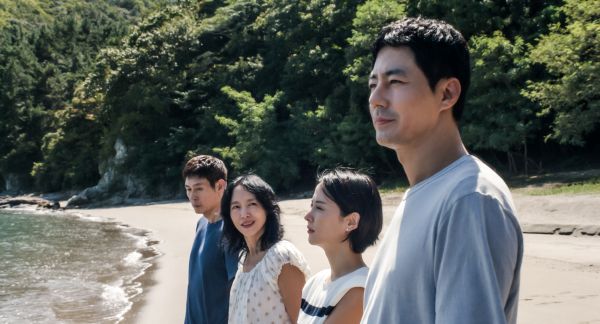
As a filmmaker, she believes she must “love” her subjects, an approach that leads her to invite them to her coastal estate. Dong’s framing of the couple’s ability to document Ho-seok’s internal struggle is described as “very critical, painful, and sprawling,” according to letterboxd.com.
The question of whether art can genuinely alleviate the hardships of the laborers it depicts remains unanswered by the conclusion of the film.