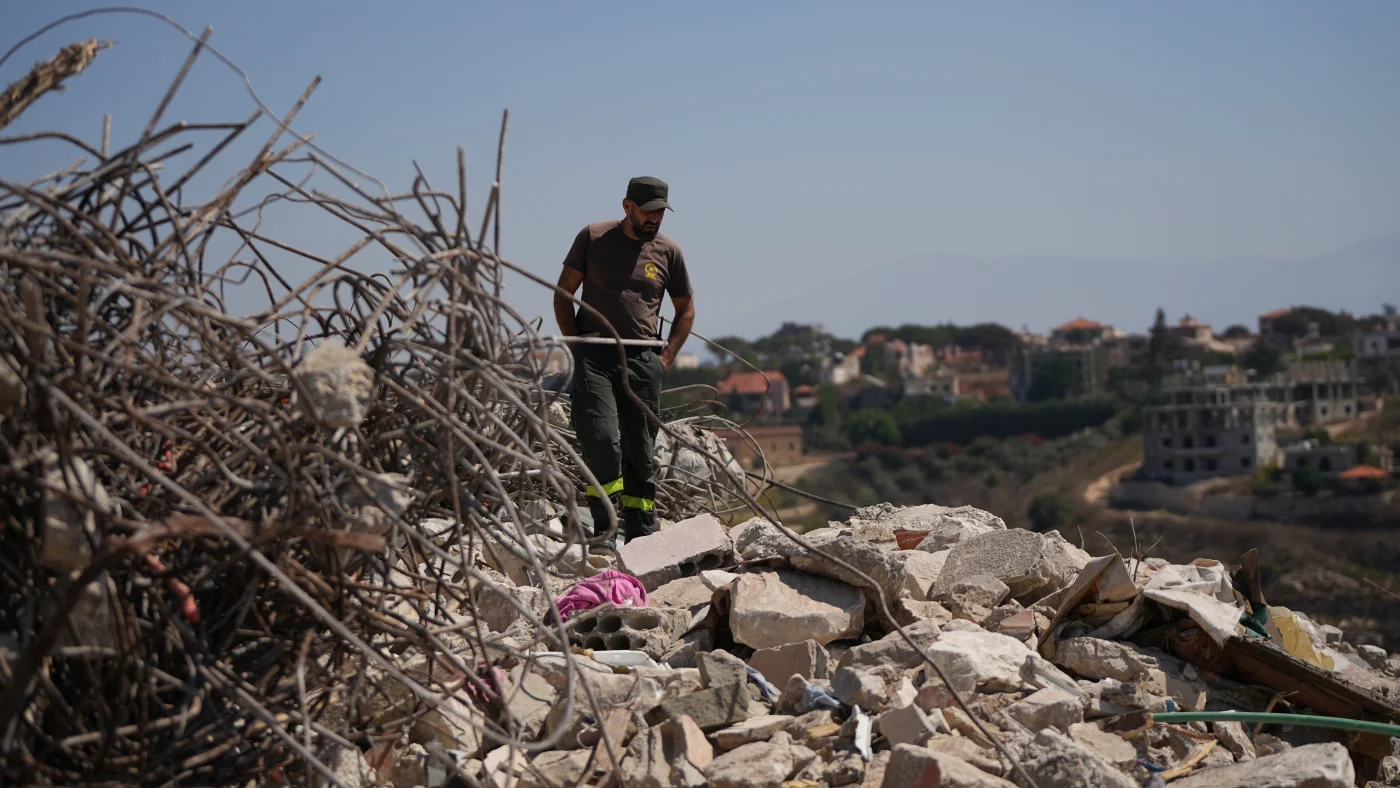
Lebanese Villagers Return to Destroyed Homes as Israeli Army Withdraws from Village
Returning villagers in southern Lebanon faced widespread destruction as the Israeli army withdrew from Zawtar al-Gharbiyah following a U.S.-brokered ceasefire, marking a test for a plan to hand security to the Lebanese army.
- Atef Kadouh and Soumaya Yaghi returned to the village to find their home of 40 years occupied, burned, and heavily damaged.
- Lebanon’s Health Ministry reported that Israel has killed more than 135 first responders and medical staff over the past two years.
- Israel’s defense minister acknowledged destroying more than 20,000 homes across the border in a self-declared security zone.
Returning Home to Ruins
Atef Kadouh and his wife, Soumaya Yaghi, spent decades working in Saudi Arabia to build their family home in Zawtar al-Gharbiyah, where they raised five children.
When they came back to the village in July, it served as a test case of a U.S.-brokered plan for Israeli forces to withdraw and hand security over to the Lebanese army, NPR reported. The plan aims to keep Iran-backed Hezbollah out of the area after cross-border rocket fire began in October 2023.
The couple, who had lived in the house for 40 years, found that their home and two other properties belonging to extended family had been demolished. Upstairs hallway walls featured a work roster written in blue marker in Hebrew, detailing the first names of Israeli soldiers, according to NPR. Kitchen appliances had bullet holes, and furniture had been pushed over the second-floor balcony.
“We were not expecting that. Everything that could be broken they broke,” Kadouh told NPR.

The Israeli military did not reply to queries about why the house was damaged or set on fire, stating only that its policy bars burning homes or leaving explosives.
Evidence of Military Presence Remains
During their inspection of the scorched property, the family discovered discarded packaging written in Hebrew left behind by occupying soldiers. In one of the rooms, investigators also found the spent engine casing of a missile or drone bearing English markings that read “propulsion unit – tactical.”
Disparity in Military Capabilities
Reflecting on the overwhelming force used during the conflict, Kadouh emphasized the technological imbalance between the opposing sides. He remarked, “This army has a rifle — Israel has an F-35” fighter jet. Despite the scale of the destruction observed in the village, he said that he and his wife would rather endure the current conditions than leave their home, stating, “But we would rather sit in the dirt.”
Infrastructure and Land Destroyed
Beyond the destroyed house, the family’s agricultural land was heavily impacted. Yaghi said the Israeli army used a bulldozer to uproot pine trees, olive trees, avocado trees, and a fig tree brought from Italy, alongside fields of thyme.
“We are back to square one,” Kadouh said to NPR. “Starting from scratch.”
Villagers remain without running water or electricity. Kadouh expressed a deep sense of abandonment, noting, “The Lebanese state never sent a soldier here to protect us.” He explained that this vacuum is why various parties, including Hezbollah, Amal, or earlier Palestinian factions, established a presence in the region over the decades.
Despite the devastation, he insisted, “Our soul, our life is here, I was born here.” While he suggested peace with Israel might be possible someday, he concluded, “But we would rather sit in the dirt,” adding that such peace would not happen in his lifetime, particularly under Israeli Prime Minister Benjamin Netanyahu.
Zawtar al-Gharbiyah, a Shiite-majority municipality in the Nabatieh District paired with Zawtar al-Sharqiyah, traces its recorded history to 1596 Ottoman tax registers listing it as the village of Sarqiyya with 24 Muslim households. Its strategic position near the Litani River and the Israeli border later placed it on the “yellow line,” a unilaterally declared Israeli occupation zone from which civilians were barred, and the Lebanese army withdrew from the surrounding area on 2 March following regional escalation.
Israeli forces subsequently established a permanent ground presence for the first time, destroying over half the town, filling in the well, and cutting electricity and water while maintaining surveillance and artillery fire on adjacent Zawtar al-Sharqiyah just 50 metres away.