
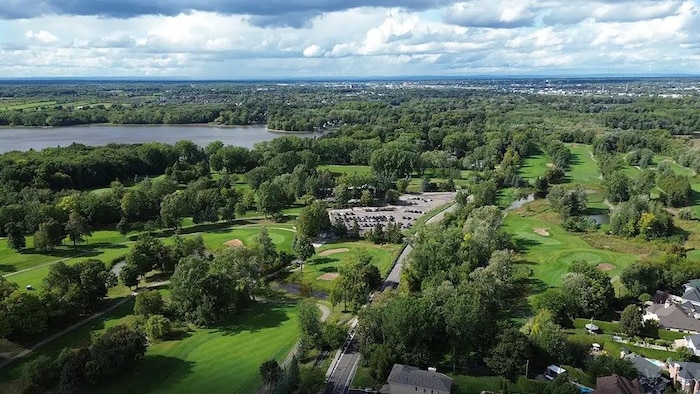
Laval has finalized the acquisition of the Golf Sainte-Rose, a 52-hectare property bordering the Rivière des Mille Îles, for $12.5 million. The purchase, announced February 3, 2026, will transform the golf course into a public park, a move intended to bolster the region’s ecological network and provide recreational space for residents.
The deal, negotiated with Groupe immobilier Van Houtte, was jointly funded by the City of Laval, the Communauté métropolitaine de Montréal (CMM), and the Quebec government through the CMM’s Trame verte et bleue program. Laval contributed $8 million, while the CMM and Quebec each provided $2.25 million, according to a press release from the city.
The land, equivalent to approximately 75 soccer fields, is considered a key component of Laval’s natural environment, situated alongside the Bois de Mattawa and the Rivière des Mille Îles. City officials stated the park will focus on restoring wetlands and creating an ecological corridor, as well as offering outdoor activities.
“The Golf Sainte-Rose is a unique site in Laval, both for its ecological value and its recreational potential,” stated Laval Mayor Stéphane Boyer in a press release. The city plans to hold public consultations to gather input on the park’s design and intended uses.
The acquisition aligns with the CMM’s broader strategy to conserve 30% of its territory and establish a network of metropolitan parks, inspired by green belt concepts found in cities like Toronto, and Ottawa. However, the CMM’s approach to creating this network has drawn scrutiny. Concordia University professor Jochen Jaeger recently published research questioning whether the planned network will function as a true green belt.
Jaeger’s study suggests that current laws and regulations in the Montreal region do not sufficiently limit urban sprawl, citing exceptions granted for construction in agricultural zones. He argues that a genuine green belt requires stricter limitations on development and a shift in zoning practices within the city itself.
The trend of converting golf courses into public parks is not unique to Laval. According to urban planning firm BC2, at least twelve golf courses have ceased operations in the Greater Montreal area since 2010, representing a total of 657 hectares. The CMM’s 2026-2036 Metropolitan Land Use and Development Plan identifies ten underutilized golf courses as potential sites for public natural spaces, with three-quarters of their area slated for protection from development.
While some restrictions on development near golf courses, such as those in Rosemère and Mascouche, are facing legal challenges from private developers, the Laval acquisition has progressed without similar opposition. The city anticipates the Golf Sainte-Rose will remain operational through the 2027 golf season before the transition to a park begins.
The CMM’s plan to create a network of green spaces is intended to address concerns about urban sprawl, which experts say leads to increased infrastructure costs, loss of farmland and natural habitats, and higher housing prices. Urban planning specialists as well point to the negative health impacts of sprawl, including increased greenhouse gas emissions, reduced physical activity, and traffic congestion.
The city has not yet announced a timeline for the public consultations or a detailed plan for the park’s development.
