
Scientists at Northwestern University have achieved a significant breakthrough in spinal cord injury research, creating the most advanced laboratory model to date for studying the complex biological processes that occur after trauma. The research, published February 11 in Nature Biomedical Engineering, details the successful development of human spinal cord organoids – miniature, lab-grown versions of spinal cord tissue – that accurately mimic the effects of injury and respond positively to a novel regenerative therapy.
The team, led by Samuel I. Stupp, Board of Trustees Professor of Materials Science and Engineering, Chemistry, Medicine and Biomedical Engineering at Northwestern, utilized stem cells to construct these organoids, incorporating key cellular components including neurons, astrocytes, and, for the first time in this type of model, microglia – the immune cells of the central nervous system. This inclusion allows for a more realistic replication of the inflammatory response that follows spinal cord injury, a critical factor in hindering recovery.
Researchers subjected the organoids to two common types of spinal cord injury: a clean cut simulating a surgical wound, and a compressive contusion mirroring trauma from accidents. Both injury types resulted in cell death and the formation of glial scars – dense tissue that acts as a physical and chemical barrier to nerve regeneration, a hallmark of spinal cord injuries in humans. “We could distinguish between the astrocytes that are a part of normal tissue and the astrocytes in the glial scar, which are large and very densely packed,” Stupp said. “We similarly detected the production of chondroitin sulfate proteoglycans, which are molecules in the nervous system that respond to injury and disease.”
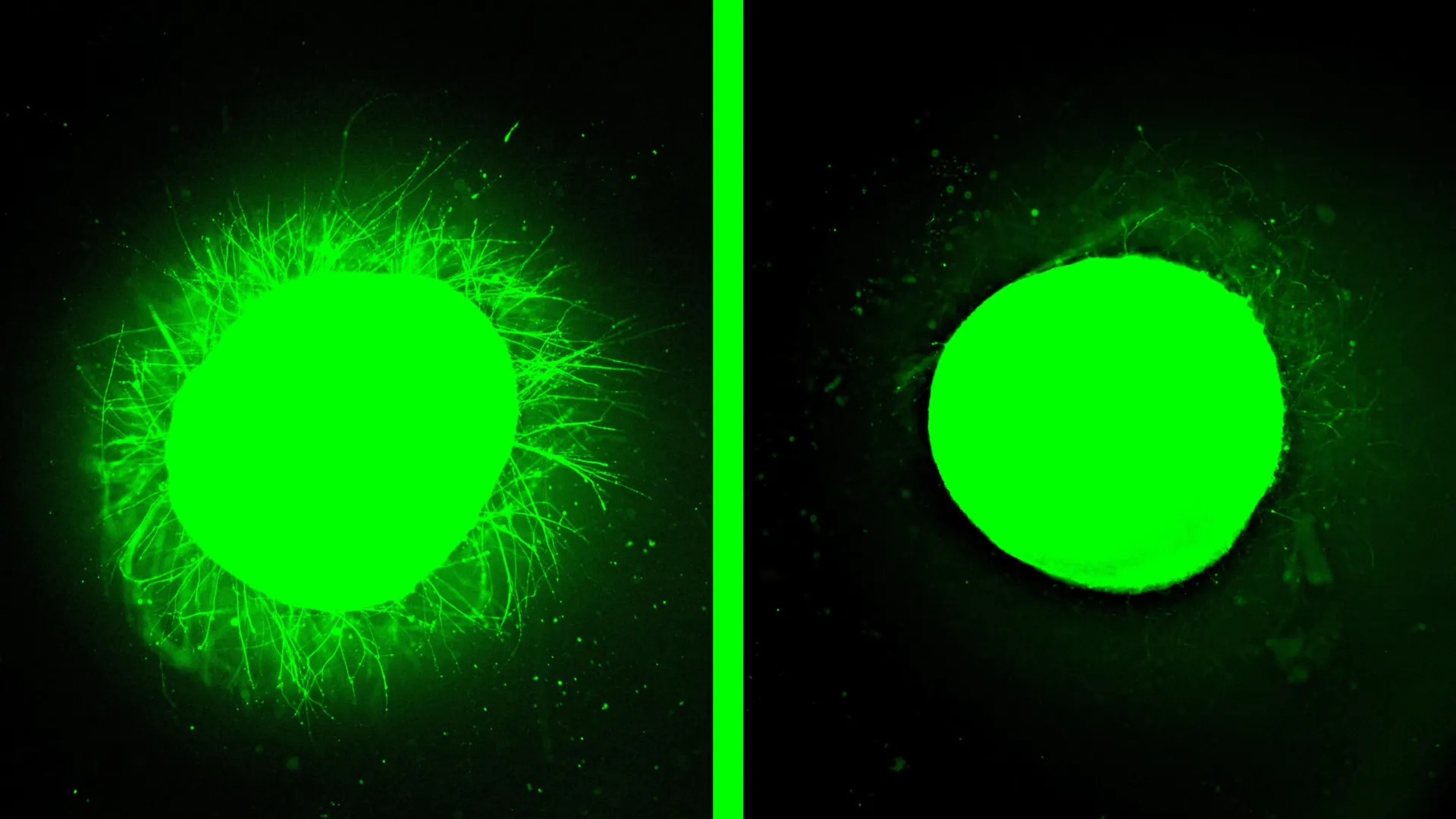
The promising regenerative therapy tested on the organoids involves “dancing molecules” – supramolecular therapeutic peptides (STPs) designed to stimulate nerve regrowth. This therapy previously demonstrated success in restoring movement in mice with severe spinal cord injuries. The organoids treated with these molecules exhibited substantial neurite outgrowth, indicating the re-establishment of connections between neurons. The glial scarring was significantly reduced.
The “dancing molecules” function by forming a nanofiber scaffold after injection, mimicking the natural extracellular matrix of the spinal cord. The key to their effectiveness lies in their dynamic movement, allowing them to interact more frequently with receptors on nerve cells. “Given that cells themselves and their receptors are in constant motion, you can imagine that molecules moving more rapidly would encounter these receptors more often,” Stupp explained in a 2021 statement. “If the molecules are sluggish and not as ‘social,’ they may never come into contact with the cells.”
The research builds on earlier work by Stupp’s team, which in 2021 introduced the IKVAV-PA material for reversing paralysis in animal models. The current study validates the potential of this approach in a human tissue model. The therapy has recently received Orphan Drug Designation from the U.S. Food and Drug Administration (FDA), a status granted to treatments for rare diseases and conditions.
Nozomu Takata, a research assistant professor of medicine at Northwestern’s Feinberg School of Medicine and a member of the Center for Regenerative Nanomedicine (CRN), is the first author of the study. The research was supported by the CRN and a gift from the John Potocsnak Family for spinal cord injury research.
Looking ahead, the Northwestern team plans to refine their organoid models to replicate chronic spinal cord injuries, which are characterized by thicker and more persistent scar tissue. They also envision the potential for personalized medicine, creating implantable tissue from a patient’s own stem cells to minimize the risk of immune rejection.
