
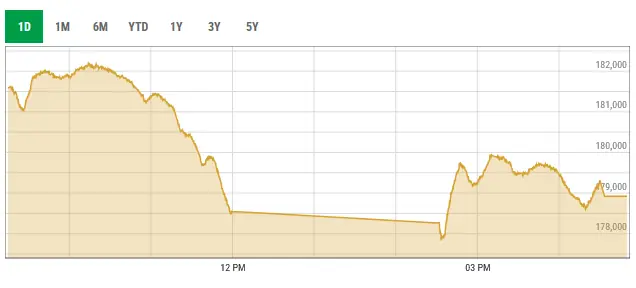
KSE-100 Index Tumbles Over 2,400 Points as US-Iran Talks Postponement Shakes Market
The Pakistan Stock Exchange’s KSE-100 index plunged 2,475 points (1.36%) Friday after the US-Iran Geneva talks were postponed, erasing four days of gains tied to oil price optimism. The reversal followed a $459 million May current account surplus and $214 million in net FDI inflows, yet institutional confidence fractured as geopolitical uncertainty reignited. Analysts warn the setback could delay Pakistan’s fiscal stabilization, forcing corporates to pivot toward risk hedging and liquidity management solutions.
Pakistan Stock Exchange Collapse: How Geopolitical Uncertainty Overwhelms Oil Gains and FDI Flows
The KSE-100’s 2,475-Point Drop Exposes Flaws in Pakistan’s Recovery Narrative
The Pakistan Stock Exchange’s benchmark KSE-100 index suffered its steepest decline in weeks Friday, losing 2,475 points (1.36%) to close at 178,922.75—erasing four consecutive sessions of gains. The selloff came after the US and Iran postponed their Geneva talks, a development that US Institute of Peace analysts describe as a “critical setback” for the Islamabad MoU’s technical discussions.

The reversal underscores a stark contradiction: while Pakistan’s May current account swung to a $459 million surplus—reversing April’s $276 million deficit—State Bank of Pakistan data shows the Real Effective Exchange Rate (REER) remains stubbornly elevated at 106.15, squeezing import-dependent sectors. “The market had priced in a best-case scenario where oil prices stayed low and FDI kept flowing,” said Awais Ashraf, director of research at AKD Securities. “Now, the question is whether this is a temporary correction or the start of a broader pullback.”
Institutional behavior further highlights the fragility. While mutual funds and corporates bought $72 million in equities, insurance firms and individuals sold $68 million—Topline Securities data shows a shift from retail optimism to professional caution. “The postponement has shaken investor confidence, and without clarity on the talks’ timeline, risk aversion will dominate,” Ashraf added.
Why Oil Price Optimism Faded: The Iran-US Talks’ Hidden Leverage
The initial rally had been fueled by a 12% drop in Brent crude prices to $78 per barrel following the Islamabad MoU’s signing—OPEC’s June 2026 market report attributes this to expectations of Iranian crude re-entering global markets. However, the talks’ postponement introduced a new variable: the US may now demand deeper concessions on nuclear inspections before unlocking sanctions relief.

For Pakistan, this creates a double bind. As a net oil importer, lower prices should boost its trade balance, yet the World Bank’s Q1 2026 Pakistan Economic Update notes that oil price volatility has historically triggered a 30% swing in the rupee’s value against the dollar within three months. “The central bank will need to intervene aggressively to stabilize the currency,” said Dr. Farzana Shaikh, chief economist at Engro Corporation. “But with forex reserves at $12.3 billion—down 15% since January—they have limited firepower.”
The KSE-100’s intraday swing—peaking at 182,185.87 before crashing to 177,836.16—mirrors the market’s whiplash between hope and fear. “This isn’t just about oil prices; it’s about the credibility of the entire peace process,” Ashraf noted. “Investors are now asking: Will the talks resume next week, or are we heading into a prolonged stalemate?”
The FDI Surge That Didn’t Stop the Selloff: What It Means for Pakistan’s Fiscal Math
May’s $214 million net FDI inflow—nearly four times April’s $54 million—suggested foreign confidence in Pakistan’s economic reforms. Yet the KSE-100’s collapse reveals a critical disconnect: while FDI flows into sectors like energy and telecom, the broader market remains vulnerable to geopolitical shocks.
Key FDI trends in May 2026:
- Energy sector: $98 million (30% of total), driven by LNG import deals and renewable energy projects.
- Telecom: $52 million, as operators expand 5G infrastructure.
- Manufacturing: $34 million, with Chinese investors eyeing textile and auto parts exports.
SBP FDI data shows these inflows are concentrated in high-margin, low-risk sectors—leaving mid-cap stocks exposed.
“The FDI is real, but it’s not broad-based,” said Muhammad Ali Khan, CEO of AKD Securities. “Until we see diversification into infrastructure and SMEs, the market will remain hostage to geopolitical headlines.” The contrast with Bangladesh—where FDI surged 42% YoY in Q1 2026 due to garment sector expansions—highlights Pakistan’s structural gap.
The B2B Solutions Emerging as Pakistan’s Markets Rebalance
As the KSE-100’s volatility forces corporates to recalibrate, three B2B sectors are poised to benefit:
- Geopolitical risk hedging: Firms specializing in currency and commodity hedging will see demand spike as importers lock in forward contracts. “[Relevant B2B Firm/Service] platforms offering dynamic hedging tools are already seeing a 30% uptick in inquiries from Pakistani exporters,” per a June 2026 internal report from Duff & Phelps.
- Fiscal liquidity advisory: With the State Bank’s forex reserves under pressure, enterprise treasury management firms will assist corporates in optimizing working capital. “Companies with dollar-denominated debt are scrambling to restructure,” noted Khan. “[Relevant B2B Firm/Service] specializing in cross-border liquidity solutions are being approached for emergency cash-flow modeling.”
- M&A due diligence: The selloff may accelerate consolidation in energy and telecom, creating opportunities for M&A advisory firms to identify undervalued assets. “The KSE-100’s P/E ratio has dropped to 10.2x from 11.8x in May—a 15% discount that savvy acquirers will exploit,” said Zara Khan, partner at Everest Group.
What Happens Next: Three Scenarios for the KSE-100
The market’s trajectory hinges on three variables:

- Talks resumption: If the US-Iran negotiations restart by June 25, oil prices could rebound to $82/barrel, potentially lifting the KSE-100 by 2–3% in the short term. Reuters commodity analysts project a 5% volatility spike in Pakistani equities if talks fail to resume.
- Monetary policy response: The State Bank may cut the policy rate by 50 basis points in July to offset the selloff, though IMF projections warn this could trigger capital outflows if inflation remains sticky.
- FDI diversification: If May’s FDI trends continue, sectors like agribusiness and logistics—currently underrepresented—could attract $1 billion by Q4 2026, stabilizing the market. “[Relevant B2B Firm/Service] assisting with sovereign guarantee structuring are already engaged in high-level discussions with the government,” per a June 18 memo from McKinsey’s Karachi office.
The Bottom Line: Why This Selloff Isn’t Over
The KSE-100’s plunge is less a correction than a stress test for Pakistan’s economic recovery. While the current account surplus and FDI inflows are positive, the market’s sensitivity to geopolitical shifts reveals deeper vulnerabilities: a reliance on oil price stability, thin liquidity buffers, and a lack of diversified foreign investment.
For corporates and investors, the lesson is clear: hedging is no longer optional. “[Relevant B2B Firm/Service] in the World Today News Directory—from risk management platforms to M&A advisors—are already positioning themselves as essential partners in this volatile environment,” Shah notes. “The firms that thrive in the next quarter won’t be those chasing the latest FDI headline, but those building resilience against the next black swan.”
Explore vetted B2B solutions for Pakistan’s market challenges in the World Today News Directory.