
Korean Public Institutions Avoid Labor Law Compliance | Union Recognition Issues
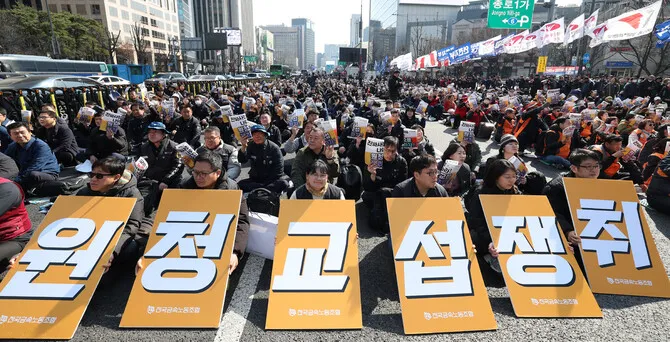
South Korean public institutions are taking steps to distance themselves from labor unions, seeking to avoid collective bargaining obligations under the recently implemented revised Labor Union and Labor Relations Adjustment Act – often referred to as the “Yellow Envelope Law.” Documents obtained by The Hankyoreh reveal that at least nine public organizations have developed plans to minimize their designation as employers, thereby circumventing mandatory negotiations with unions representing subcontracted workers.
The moves approach despite government emphasis on public institutions serving as “model employers.” Internal documents from organizations under the Ministry of Land, Infrastructure and Transport, the Ministry of Climate Change and Energy, the Ministry of Agriculture, Food and Rural Affairs, and the Ministry of Oceans and Fisheries outline strategies to reduce their “user status” – a key determinant of bargaining obligations under the revised law. The law aims to recognize parent companies as joint employers when they exert substantial control over the working conditions of subcontracted laborers.
According to reports from The Hankyoreh and Today’s News, the organizations are pursuing a range of tactics, including revisions to contracts and work order instructions, and adjustments to overall management practices. Some have even reportedly considered strategies to weaken the organizational capacity and bargaining power of subcontracted worker unions.
The Jeju International Free City Development Center (JDC), under the Ministry of Land, Infrastructure and Transport, drafted a “Legal Risk Management Plan” in response to the revised law on March 20th, explicitly addressing strategies to avoid being considered an employer in relation to union negotiations. This document, along with others obtained by lawmakers from the Democratic Party of Korea, highlights the concern within public bodies regarding the potential for increased bargaining demands.
The Ministry of Employment and Labor commissioned a research study to assess the potential impact of the revised law, with some institutions receiving recommendations to actively document labor disputes involving subcontracted workers, according to Maeil Labor News. This suggests a proactive approach to managing potential legal challenges arising from union activity.
The Federation of Korean Trade Unions (FKCTU) has criticized the actions of the public institutions, calling for an immediate halt to efforts to evade their responsibilities under the revised law. The Democratic Federation of Labor, a major labor organization, issued a statement demanding that public institutions engage in negotiations with subcontracted worker unions, accusing them of attempting to undermine the spirit of the legislation.
The revised law, which took effect on March 10th, seeks to clarify the responsibilities of companies that exercise significant control over the working conditions of subcontracted workers. However, the actions of these public institutions suggest a concerted effort to limit the scope of the law’s application, potentially hindering efforts to improve the rights and protections of vulnerable workers. The government has yet to comment on the specific actions of these public institutions, and it remains unclear whether any corrective measures will be taken.