
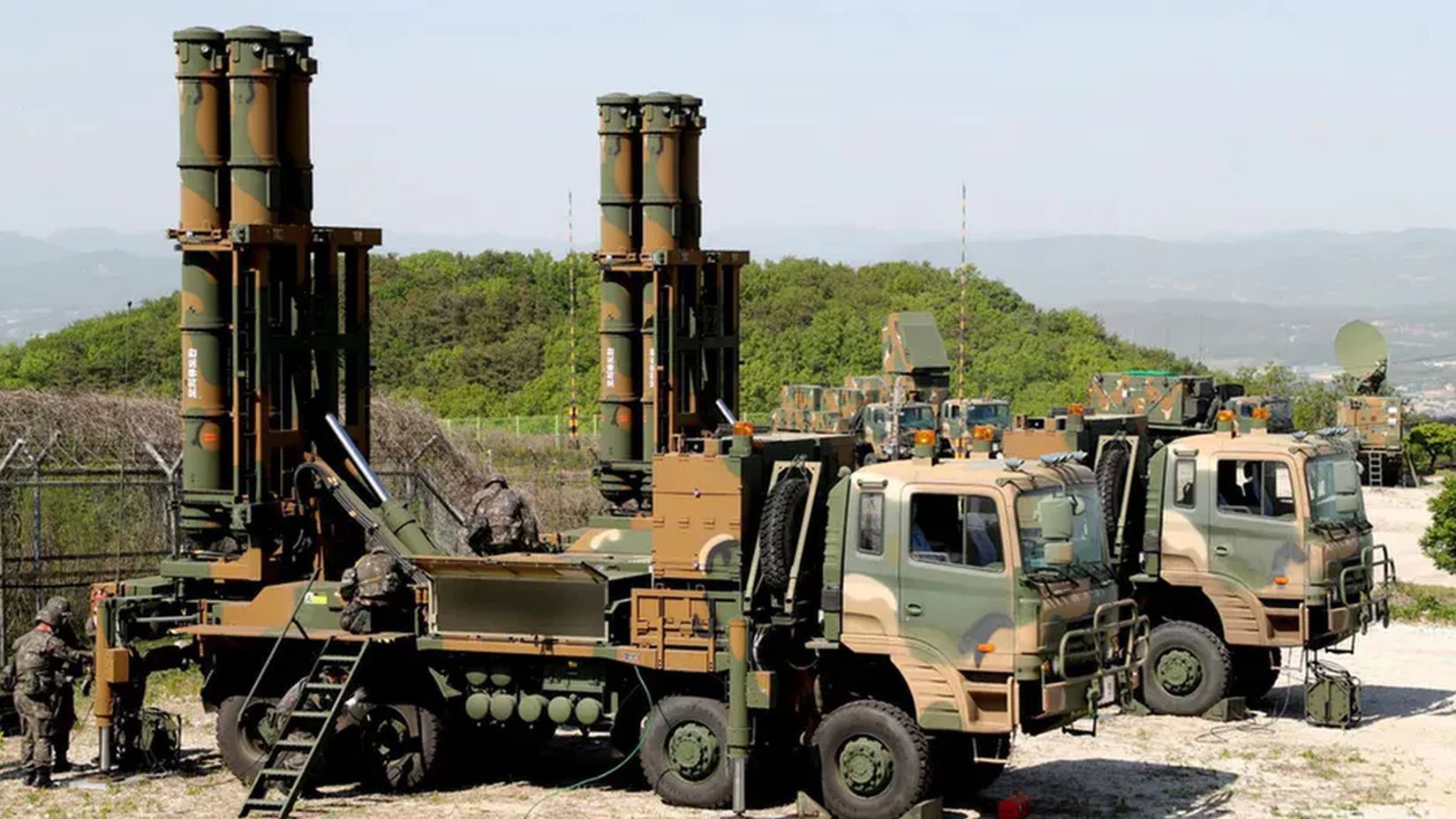
Korean Cheongung-II Missile System: 96% Success Rate Against Iran Attacks & Lower Cost Than PAC-3 MSE
The United Arab Emirates’ air defense systems successfully intercepted multiple Iranian ballistic missiles and drones in recent days, with South Korea’s domestically produced Cheongung-II medium-range surface-to-air missile system playing a key role in the defense, officials confirmed Thursday.
The Cheongung-II, also known as KM-SAM II, was activated to counter Iranian missile strikes launched in retaliation for recent U.S. And Israeli strikes on Iran, marking the first combat deployment and successful interception of hostile projectiles by a South Korean-made air defense weapon system, according to multiple reports. The UAE Ministry of Defence stated Monday that it detected 174 ballistic missiles launched toward the country, of which 161 were destroyed.
Yu Yong-weon, a member of South Korea’s National Defense Committee, stated that the two Cheongung-II batteries deployed in the UAE fired approximately 60 interceptor missiles, achieving a reported 96% success rate. This performance underscores the growing capabilities of South Korea’s defense industry and its expanding arms exports to the Middle East.
The UAE currently operates two Cheongung-II batteries stationed at Al Dhafra Air Base in Abu Dhabi. The deployment is part of a $3.5 billion contract signed in 2022 with South Korean firms LIG Nex1, Hanwha Systems and Hanwha Aerospace for the procurement of ten Cheongung-II batteries, along with associated launchers, radar systems, command vehicles, and interceptor missiles.
The development of the Cheongung-II has roots in a collaborative effort with Russia dating back to the early 2000s. South Korea initially sought to develop a system comparable to the American Patriot missile defense system, and Russian firm Almaz-Antey participated in the early stages of development. The system’s design was reportedly based on Russian 9M96 missiles. This collaboration stemmed from agreements allowing South Korea to acquire Russian military equipment, including T-80U tanks, BMP-3 infantry fighting vehicles, and 9K38 Igla air defense systems, as a means of settling Soviet-era debts.
However, the current Cheongung-II system utilizes entirely domestically produced components, avoiding potential sanctions issues. The system is capable of intercepting ballistic targets at ranges up to 40 kilometers and altitudes up to 15 kilometers with Block I missiles, and up to 50 kilometers and 20 kilometers respectively with the Block II variant, introduced in 2021. The missiles, launched from eight-cell launchers, can reach speeds of Mach 4.5 (1530 m/s) for the B1 version and Mach 5 (1700 m/s) for the B2.
The interceptor missiles employ an advanced guidance system featuring inertial navigation with data link updates and an active radar seeker for precise targeting. They utilize a kinetic kill vehicle, destroying targets through direct impact, similar to the PAC-3 MSE missile. According to Moon Sung-mook, a senior researcher at the Korea Institute for National Security Strategy, Cheongung-II interceptor missiles are significantly less expensive, costing approximately $1.1 million per unit compared to $3.7 million for a PAC-3 MSE missile, according to U.S. Army pricing. Delivery times for Cheongung-II missiles are considerably shorter, avoiding the 4-6 year wait associated with PAC-3 MSE procurement.
U.S. Joint Chiefs of Staff Chairman Dan Caine confirmed Wednesday that air defense batteries from Qatar, UAE, Kuwait, Jordan, and Saudi Arabia participated in countering the Iranian attacks, stating that “years of training, trust, and hard-won integration paid off.”