
Kimwolf Botnet Operator Dort Identified as Jacob Butler Following Swatting Campaign
Kimwolf Botnet Operator “Dort” Identified: A Post-Mortem on Residential Proxy Exploitation
The Kimwolf botnet isn’t just another DDoS tool; it represents a critical failure in residential proxy security architectures. In early January 2026, the exposure of a vulnerability allowing botmasters to infect devices behind residential proxy endpoints shifted the threat landscape. The operator, identified through extensive OSINT pivoting as “Dort,” has escalated from Minecraft cheat development to coordinating SWATting campaigns and distributed denial-of-service attacks against security researchers. This isn’t script kiddie behavior; this is organized cybercrime leveraging supply chain weaknesses in proxy infrastructure.
The Tech TL;DR:
- Attack Vector: Kimwolf exploits weaknesses in residential proxy services to infect internal network devices (IoT, TV boxes) rather than just edge servers.
- Attribution: OSINT analysis links the handle “Dort” to Jacob Butler via email pivots ([email protected]) and historical GitHub activity.
- Enterprise Risk: Organizations relying on residential proxies for traffic routing must immediately audit for lateral movement vulnerabilities.
Understanding the Kimwolf architecture requires looking past the sensationalism of the SWATTing incidents. The core technical achievement here is the bypass of network segmentation typically assumed in residential proxy models. Benjamin Brundage, founder of Synthient, identified that Kimwolf masters were exploiting a little-known weakness in residential proxy services to infect poorly-defended devices plugged into the internal, private networks of proxy endpoints. This suggests a breakdown in network segmentation and endpoint security protocols at the provider level.
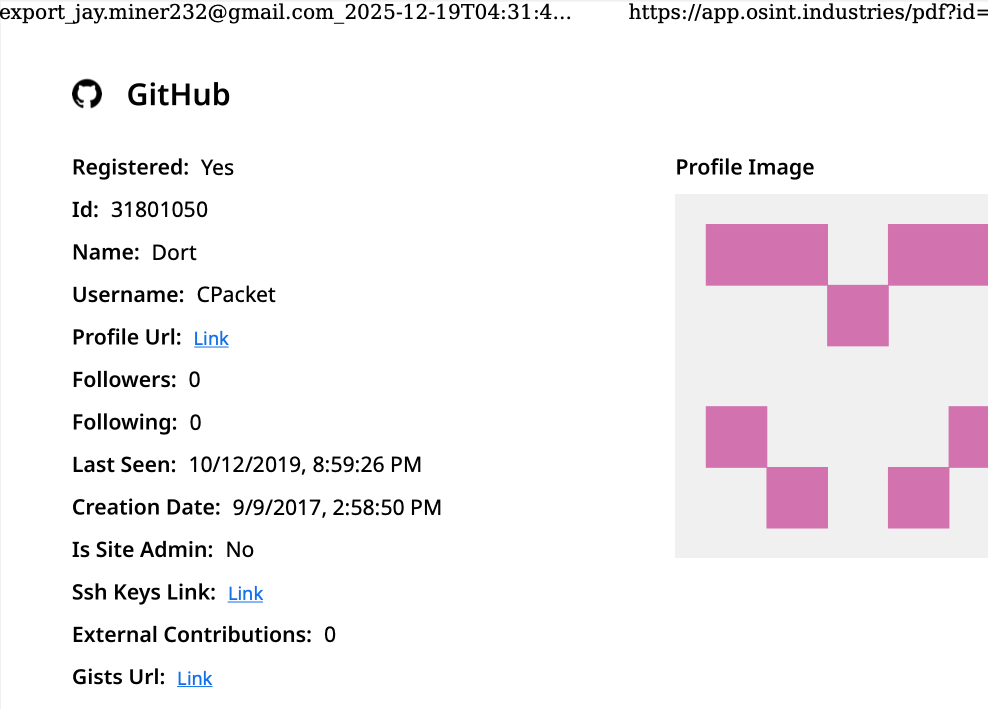
Attribution in cybercrime often relies on digital exhaust. In this case, the trail leads through email pivots and version control history. A public “dox” from 2020 asserted Dort was a teenager from Canada, a claim supported by data from OSINT Industries linking the GitHub account “Dort” to the email [email protected]. Cyber intelligence firm Intel 471 corroborated this, noting the email was used between 2015 and 2019 on cybercrime forums like Nulled and Cracked from a Rogers Canada IP address. This level of persistence indicates a long-term operational security failure by the actor, allowing researchers to map a decade of activity.
“Cybersecurity risk assessment and management services form a structured professional sector in which qualified providers systematically identify vulnerabilities before they are weaponized. The Kimwolf case demonstrates what happens when proxy providers skip this step.” — Security Services Authority, Cybersecurity Risk Assessment and Management Services Provider Guide
The transition from game cheats to botnet command-and-control (C2) is a common trajectory. Dort’s history includes “Dortware,” a Minecraft cheat client and “Dortsolver,” a CAPTCHA bypass service advertised on Telegram channels dedicated to SIM-swapping. This evolution mirrors the commodification of exploit tools seen in the broader malware-as-a-service ecosystem. The technical sophistication lies in the ability to bypass CAPTCHA services designed to prevent automated account abuse, a capability that directly fuels credential stuffing attacks against enterprise login portals.
For enterprise CTOs, the implication is clear: reliance on third-party proxy services introduces supply chain cybersecurity risks. When organizations depend on third-party vendors or software components, they inherit the vendor’s security posture. If a proxy provider allows lateral movement from their exit nodes into customer private networks, the enterprise perimeter is effectively dissolved. Cybersecurity consulting firms are now prioritizing audits of residential proxy vendors to ensure strict isolation between proxy traffic and internal LAN resources.
Technical Mitigation and Detection
Detecting Kimwolf-like activity requires monitoring for anomalous outbound traffic patterns from IoT devices that should remain dormant. Security teams should implement strict egress filtering. Below is a Python snippet utilizing the scapy library to detect unusual outbound connection attempts from known IoT subnets, a basic heuristic for identifying botnet recruitment activity.
from scapy.all import sniff, IP, TCP def detect_botnet_traffic(packet): if IP in packet and TCP in packet: # Check for outbound connections from IoT subnet on non-standard ports if packet[IP].src.startswith("192.168.1.") and packet[TCP].dport not in [80, 443, 53]: print(f"[ALERT] Suspicious outbound traffic detected: {packet[IP].src} -> {packet[IP].dst}") # Start sniffing on eth0 sniff(iface="eth0", prn=detect_botnet_traffic, store=0) Implementing such monitoring is only the first layer. The broader solution involves engaging cybersecurity risk assessment providers to validate the architecture of any third-party network services in use. According to the Security Services Authority, supply chain cybersecurity services address the risks introduced when organizations depend on third-party vendors. This is no longer optional; it is a critical component of SOC 2 compliance and infrastructure hardening.
The human element remains the most volatile variable. Despite Jacob Butler’s denial of current involvement, voice analysis and historical data linkage suggest a strong correlation. Butler claimed someone is impersonating him, yet voice prints from 2022 competitions match recent threats. This discrepancy highlights the difficulty of identity verification in anonymous cybercrime ecosystems. Whether Butler is the active operator or a compromised identity, the threat actor possesses deep knowledge of his digital footprint.
Market demand for security leadership reflects this escalating threat environment. Job postings for roles like Director of Security | Microsoft AI and Visa Sr. Director, AI Security indicate that major enterprises are prioritizing AI-driven security operations to counter automated threats like Kimwolf. The integration of AI into both attack and defense vectors means manual monitoring is insufficient.
The Path Forward
The Kimwolf incident serves as a stark reminder that residential proxy networks are becoming battlefields. The latency issues and IT bottlenecks caused by DDoS attacks are symptomatic of deeper architectural flaws in how we trust intermediate network nodes. Enterprises must move toward zero-trust networking models where no internal device is trusted by default, regardless of its position behind a proxy.
As enterprise adoption of remote work and IoT scales, the attack surface expands. The solution isn’t just patching vulnerabilities; it’s re-architecting trust. Organizations should engage supply chain cybersecurity services to vet every vendor touching their network perimeter. The cost of remediation after a breach far exceeds the investment in proactive penetration testers and auditors.
Dort’s operation may eventually be dismantled, but the tools and techniques will persist. The next iteration of Kimwolf will likely leverage more sophisticated evasion techniques, possibly integrating generative AI to mimic legitimate traffic patterns. Security teams must prepare for an arms race where automation fights automation. The only winning move is rigorous architecture and continuous verification.
*Disclaimer: The technical analyses and security protocols detailed in this article are for informational purposes only. Always consult with certified IT and cybersecurity professionals before altering enterprise networks or handling sensitive data.*