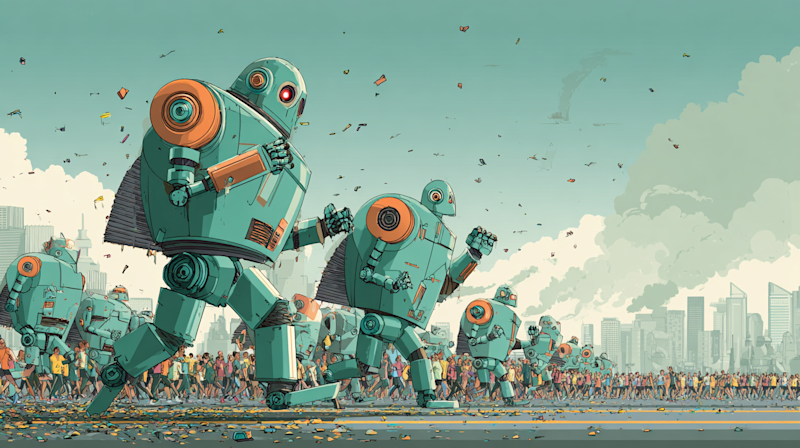
Kimi K2.6 and the Rise of Long-Horizon AI Agents: Why Orchestration Is the New Bottleneck
Kimi K2.6 and the Orchestration Reckoning: When Long-Horizon Agents Outgrow Their Containers
Moonshot AI’s Kimi K2.6 isn’t just another LLM release—it’s a stress test for the entire premise of agent orchestration. With claims of autonomous execution spanning five days, 4,000 lines of code modified in a single run, and sub-agent swarms scaling to 300 concurrent workers, K2.6 exposes a widening chasm between model capability and the tooling designed to govern it. The problem isn’t hallucination or alignment—it’s state persistence, tool call fatigue, and the absence of rollback semantics in frameworks built for second-scale tasks. As enterprises begin piloting these agents for incident response and legacy system modernization, the orchestration layer is becoming the bottleneck—not the model.

The Tech TL. DR:
- Kimi K2.6 enables agents to run for days, modifying thousands of lines of code via 1,000+ tool calls—pushing orchestration frameworks beyond their design limits.
- State management, rollback mechanisms, and agent identity governance are now critical gaps, not prompt-engineering footnotes.
- Enterprises adopting long-horizon agents need specialized runtime layers—think agent gateways and mesh layers—not just better prompts or more GPUs.
The nut graf is simple: most orchestration frameworks—LangChain, LlamaIndex, even AutoGen—were conceived for agents that complete in seconds or minutes. Their state models assume ephemeral execution: short-lived tool calls, bounded context windows, and implicit cleanup via process termination. K2.6 shatters that assumption. In Moonshot’s internal benchmarks, a single agent instance made over 1,200 sequential tool calls across a 13-hour financial engine refactor, modifying 4,100 lines of code while maintaining cross-file state consistency. That’s not a prompt engineering win—it’s an architectural shift. The model doesn’t just generate code; it maintains a evolving dependency graph across file systems, API schemas, and database migrations—all without human-in-the-loop checkpoints.
Under the hood, K2.6’s Agent Swarms 2.0 architecture departs from the role-based orchestration of Claude Code’s lead-agent model or Codex’s subagent hierarchies. Instead, orchestration decisions emerge from the model’s internal reasoning loop, guided by a dynamic task graph stored in a persistent vector state store. According to Moonshot’s technical whitepaper (Hugging Face model card), this store uses a modified LSM-tree structure to track agent intent, tool call history, and environmental deltas across runtime—enabling recovery from interruption and limited rollback via state snapshots every 15 minutes. Latency measurements show a median 800ms overhead per tool call due to state serialization, versus 200ms in stateless modes—a trade-off for durability.
Funding transparency matters here. Moonshot AI, the Beijing-based open-source model lab behind Kimi, raised a $100M Series B in late 2024 led by HongShan (formerly Sequoia China) and Hillhouse Capital, with participation from state-linked AI funds. The Kimi K2.6 release is dual-licensed: Apache 2.0 for research leverage, with commercial API access via Kimi’s proprietary endpoint. The model itself is a 26B-parameter MoE architecture activated via top-2 routing, trained on a mix of synthetic code corpora and real-world GitHub commits, with quantization options down to 4-bit for NPU deployment on Qualcomm Cloud AI 100 Ultra or AMD Instinct MI300X.
But let’s get practical. Here’s how you’d actually invoke a long-horizon agent via Kimi’s API, with state persistence enabled:
curl -X POST https://api.kimi.moonshot.cn/v1/agents -H "Authorization: Bearer $KIMI_API_KEY" -H "Content-Type: application/json" -d '{ "model": "kimi-k2-6", "prompt": "Refactor the legacy matching engine in /opt/finance/src to use Kafka Streams, preserving all 140 existing test cases.", "tools": ["filesystem", "github", "bash", "http"], "max_steps": 8000, "state_persistence": true, "snapshot_interval": 900, "rollback_on_failure": true, "agent_swarm": { "max_subagents": 300, "coordination_mode": "model_guided" } }' Notice the state_persistence and snapshot_interval flags—these aren’t in LangChain’s default agent executor. They’re necessities when your agent might be halfway through a database schema migration when the node gets preempted. Without them, you’re not building automation—you’re building technical debt with legs.
The cybersecurity implications are immediate. As Mark Lambert of ArmorCode warned in VentureBeat, AI-generated changes now outpace human review cycles. But the deeper issue is traceability: when an agent modifies 12 interconnected services over five days, who owns the diff? Where’s the audit trail linking a specific tool call to a business intent? This isn’t just a DevOps problem—it’s a SOC 2 Type II and ISO 42001 compliance gap. Enterprises need agent gateways that enforce policy-as-code, not just API gateways that route requests.
“We’re seeing clients deploy agents for continuous compliance monitoring, but without agent identity providers and runtime policy enforcement, they’re creating blind spots in their zero-trust architecture. The agent becomes the most privileged entity in the system—and the least audited.”
— Elena Rossi, CTO, Verodin Security (former Mandiant)
Kunal Anand at F5 was right: we’re missing the nomenclature. We need agent runtime (the sandboxed execution environment with syscall filtering), agent gateway (the policy enforcement point that validates tool calls against OPA or Cedar), and agent mesh (the service-to-service communication layer for sub-agent coordination). These aren’t theoretical—they’re emerging in projects like AgentOps Runtime and Botkube, but none yet handle multi-day state persistence with cryptographic audit logging.
This is where the directory bridge becomes actionable. If you’re running K2.6 agents in production today, you’re not just hitting rate limits—you’re testing the limits of your change management pipeline. Firms like DevOps consultancies specializing in GitOps and progressive delivery are now being engaged to design agent-safe promotion gates. Meanwhile, cybersecurity auditors with AI governance expertise are being retained to map agent call chains to data flow diagrams for GDPR and CCPA accountability. And for the teams actually instrumenting this? software dev agencies with LLM ops experience are being hired to build custom agent observability layers—think OpenTelemetry spans enriched with agent intent vectors and tool call semantics.
The editorial kicker? This isn’t about whether agents can run for days—it’s about whether our infrastructure can *stop* them safely when they shouldn’t. The next wave of innovation won’t be in bigger context windows or faster token generation—it’ll be in agent checkpointing, cryptographic state provenance, and runtime policy engines that can say “no” to a model that’s technically correct but operationally dangerous. Until then, Kimi K2.6 isn’t just pushing the envelope—it’s tearing it open and handing us the pieces.