KFF Survey: Unpaid Caregivers Face Stress, Health Decline, Financial Strain
About three in ten adults in the United States have provided unpaid care or assistance to a friend or family member over the past year, according to the KFF Survey of Health Access and Caregiving.
- Twenty-nine percent of U.S. adults report providing unpaid care in the past 12 months for reasons related to aging, disability, or chronic illness.
- The median time spent on caregiving tasks is five hours per week, though seven percent of all adults spend more than 15 hours weekly.
- Women and adults aged 50 to 64 report engaging in these duties at higher rates than their demographic counterparts.
Formal paid caregiving such as nursing home and home care remains financially out of reach for many households, as these services are typically expensive and rarely covered by health insurance. This structural gap leaves informal caregivers to shoulder the burden of daily assistance.
The survey data, collected between May 4 and May 26, 2026, by SSRS on the Opinion Panel Mega-Omnibus, reveals that unpaid caregivers skew older and comprise a larger share of women. Fifty-seven percent of caregivers are women, while 42 percent are men. Furthermore, 53 percent of caregivers are aged 50 or older, compared to 44 percent of non-caregivers.

Racial diversity among caregivers roughly mirrors the broader population. Sixty-three percent are White, 15 percent are Hispanic, 12 percent are Black, and 5 percent are Asian or Pacific Islander, as reported by KFF.
| Caregiver Group | Percentage of Demographic | Weekly Hours Exceeding 15 |
|---|---|---|
| All Women (Ages 18+) | 32% | 8% |
| Women (Ages 50–64) | 40% | 11% |
| Black Women | 32% | 10% |
| White Adults | 30% | N/A |
Lower-income adults also dedicate substantially more hours to these tasks. One in ten individuals living in households with incomes below $40,000 spend more than 15 hours weekly on caregiving, compared to just four percent of those with incomes exceeding $100,000.
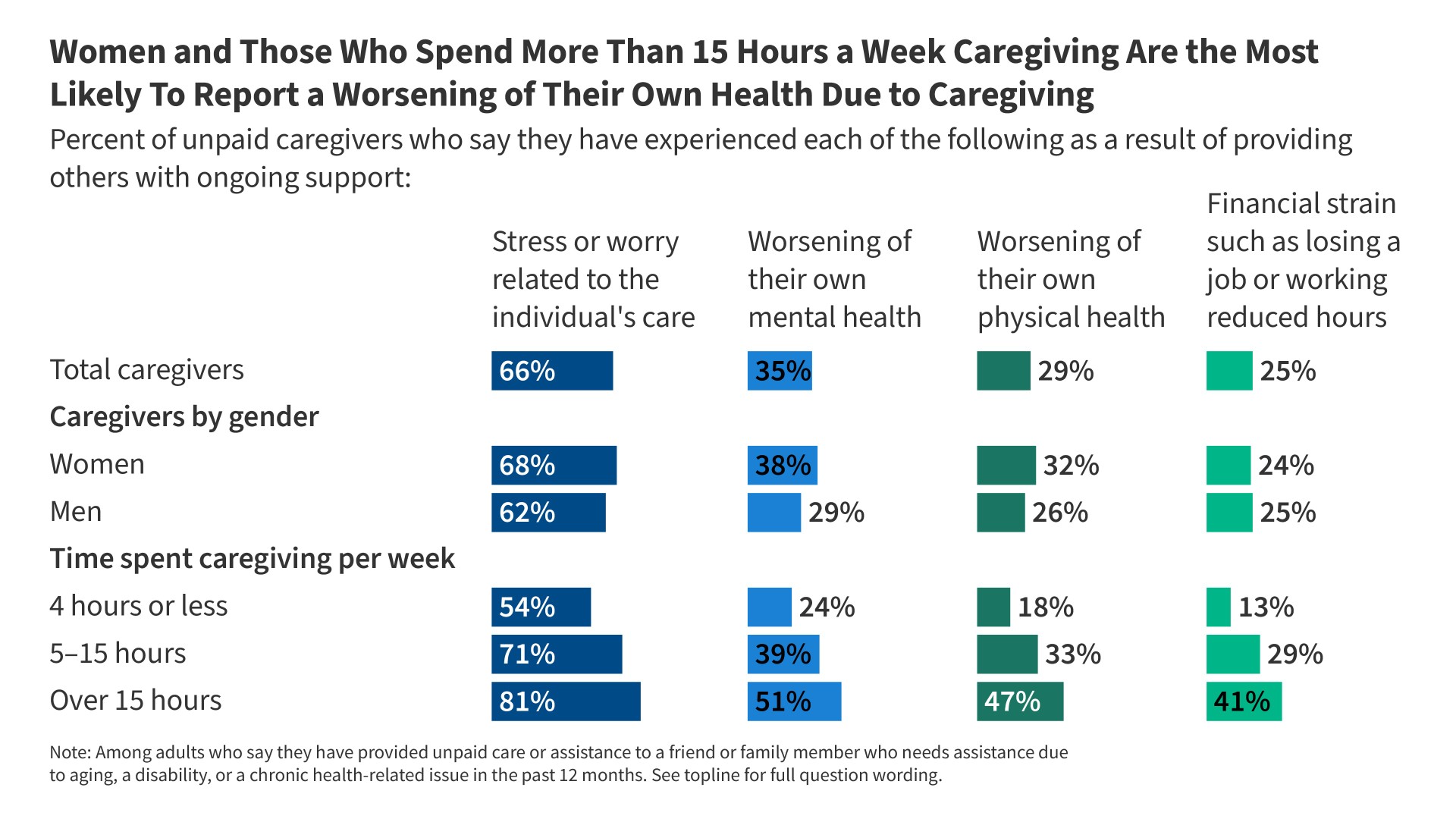
Two-thirds of unpaid caregivers report experiencing stress or worry linked to their responsibilities. At least a quarter note a worsening of their mental or physical health, or face financial strain such as job loss or reduced work hours.
Among individuals managing three or more personal health conditions, 53 percent report that their health deteriorated due to caregiving duties. This includes 41 percent who experienced a decline in mental health and 41 percent who noted worsening physical health.
Housekeeping, grocery shopping, and meal preparation represent the most common tasks, performed by 70 percent of caregivers. Managing medical care accounts for 51 percent of reported activities.
Founded in 1948 by industrialist Henry J. Kaiser in Oakland, California, KFF began as a grant-making foundation with ties to the Kaiser industrial companies. By 1985, it had fully divested its ownership stakes in Kaiser Industries and Kaiser Permanente, becoming an independent nonprofit.
In 1990, CEO Drew Altman redirected the organization from passive grant-making toward active health policy research, polling, and journalism — a shift that established its current role as a primary source for data on health access and caregiving.
Disclaimer: The information provided in this article is for educational and scientific communication purposes only and does not constitute medical advice. Always consult with a qualified healthcare provider regarding any medical condition, diagnosis, or treatment plan.
Worth a look
- 11-Year-Old Genoese Student Writes NASA With Proposals to Save Hubble, Gets Reply
- TOP-REAL Study Evaluates Digital Monitoring for HER2-positive Breast Cancer
- Union Demands AI Negotiation to Protect Mental Health at Work (newsy-today.com)
- Median Net Worth Peaks at 75+ in the Fed's Survey, but the Lead Is Thin (daybreakwire.com)