Karachi’s Water Crisis Escalates: Protests, Grid Failures, and Infrastructure Collapse
Karachi’s water crisis deepened Friday as residents of the Qayyumabad neighborhood clashed with police during a protest over prolonged shortages, while city officials confirmed that up to 14 hours of daily power cuts by K-Electric were exacerbating the humanitarian emergency. The unrest came as the Muttahida Qaumi Movement-Pakistan (MQM-P) renewed its political pressure on the government, accusing the state-owned utility of “criminal negligence” in failing to modernize its transmission network despite collecting billions in consumer bills.
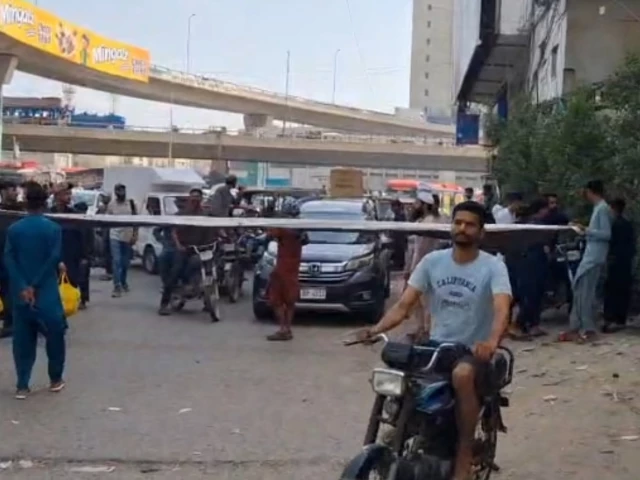
The protest in Qayyumabad erupted after water supply lines were cut off for a second consecutive day, leaving thousands without access to drinking water or sanitation. Witnesses described chaotic scenes as residents blocked a major road, forcing traffic to a standstill. Local authorities deployed paramilitary forces to disperse the crowd, but tensions remained high as temperatures soared past 45°C (113°F), according to the Pakistan Meteorological Department. The Pakistan Army’s National Disaster Management Authority (NDMA) had earlier warned of “catastrophic” conditions in Karachi, citing “continuous grid failures” that had crippled both water pumping stations and emergency medical services.
Meanwhile, K-Electric’s prolonged power disruptions triggered secondary crises across the city. Operations at the “Green Line” electric bus network—Karachi’s flagship public transport initiative—were suspended after a major charging station in the Clifton area experienced a “complete blackout” for over six hours. A spokesperson for the Sindh Mass Transit Authority confirmed that “at least 120 buses” remained stranded, disrupting commutes for over 50,000 daily passengers. The disruption followed a pattern of “unannounced outages” that have plagued the city since April, when K-Electric admitted its “aging transmission infrastructure” could no longer handle peak demand.

The MQM-P’s criticism of K-Electric escalated Friday, with party leader Khalid Maqbool Siddiqui demanding Prime Minister Shehbaz Sharif intervene in a press statement. “The people of Karachi are facing a double tragedy—scorching heat and deliberate power cuts,” Siddiqui said. “While K-Electric collects billions in overbilled tariffs, it has done nothing to upgrade its system. This is not incompetence; it is a calculated assault on the city’s survival.” The party’s accusations align with a broader political narrative, as opposition groups—including Jamaat-e-Islami (JI)—have announced “mass protests” starting Saturday over the water crisis. JI Karachi’s chief, Syed Munawar Hassan, warned that “the government’s failure to act will force citizens to take direct action”, though details of the planned demonstrations remained unclear.
K-Electric did not respond to requests for comment by press time, but internal documents obtained by The Nation reveal that the utility has “repeatedly delayed” modernization projects due to “budget constraints” and “corruption in procurement”. A senior engineer at the utility, speaking on condition of anonymity, acknowledged that “at least three critical substations” in Karachi’s eastern districts were operating at “50% capacity”, directly contributing to the blackouts. The engineer added that “emergency repairs” had been requested but “blocked by higher-ups” due to “political interference”—a claim the utility has not addressed publicly.

As the crisis unfolded, the Sindh government’s silence drew sharp criticism. Provincial Minister for Local Government Syed Murad Ali Shah told reporters that “all necessary steps are being taken”, but provided no specifics. In contrast, the MQM-P’s deputy convener, Farooq Sattar, accused the provincial administration of “complicity” in the utility’s failures. “This is not just a technical problem—it is a political one,” Sattar said. “The government must either fix K-Electric or replace its management entirely.”
The immediate future for Karachi remains uncertain. While the Pakistan Army has deployed “mobile water tankers” to affected neighborhoods, officials admitted these were “temporary measures” and would not resolve the underlying infrastructure collapse. Meanwhile, K-Electric’s CEO, Ahmed Ali Memon, is scheduled to appear before a parliamentary committee Monday to explain the utility’s performance—a hearing the MQM-P has vowed to “turn into a public reckoning”. Until then, residents face another day without reliable power or water, as political blame-shifting overshadows the city’s deepening humanitarian crisis.