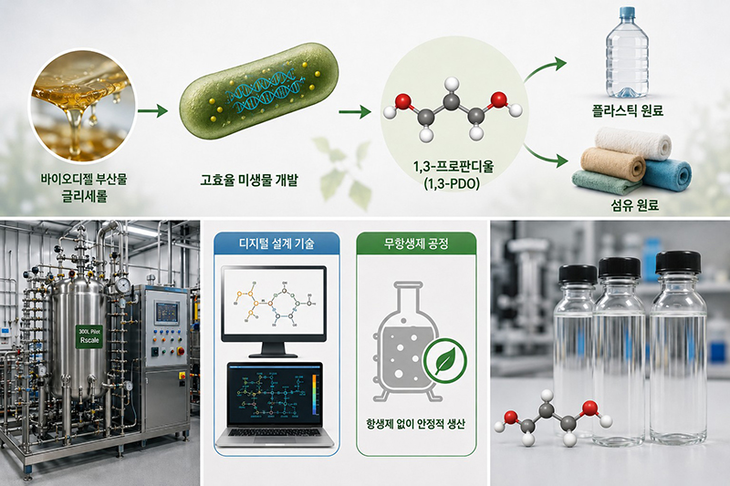
KAIST and Hanwha Solutions Develop Microbial Process for 1,3-Propanediol Production
Decarbonizing the Polymer Pipeline: KAIST’s Microbial 1,3-PDO Synthesis
The chemical industry is facing a long-overdue architectural refactor. Traditional petrochemical synthesis of 1,3-propanediol (1,3-PDO)—a critical monomer for high-performance biopolymers—has historically relied on energy-intensive, carbon-heavy refinement processes. Following a decade of iterative R&D, researchers at KAIST and Hanwha Solutions have reached a milestone in microbial fermentation, effectively pivoting the production of this C3 diol toward a sustainable, bio-based workflow. For CTOs managing supply chain sustainability and material integrity, this represents a shift from legacy petrochemical dependency to a scalable, biologically-driven production stack.
The Tech TL;DR:
- Process Optimization: The breakthrough centers on a microbial fermentation platform that converts crude glycerol—a byproduct of biodiesel—into high-purity 1,3-PDO, bypassing volatile oil-market dependencies.
- Operational Efficiency: By shifting from batch to immobilized fermentation systems, the research highlights a path toward continuous, stable production pipelines, though current productivity metrics require further scaling to match industrial throughput.
- Supply Chain Resilience: This technology enables enterprises to integrate circular-economy metrics into their procurement protocols, reducing the carbon footprint of polymer-based hardware components.
Architectural Breakdown: Fermentation Modes vs. Industrial Throughput
In evaluating the viability of this bio-process, we must look at the underlying fermentation architecture. The transition from batch systems to immobilized cell systems is analogous to moving from monolithic application deployment to containerized, persistent services. While batch fermentation (using nutrient-rich mMRS media) currently yields higher titers—reaching approximately 39.75 g/L—the operational stability provided by immobilized systems is the true “production-ready” goal. The use of fish protein hydrolysate (FPH) as a nitrogen source serves as a low-cost, sustainable substrate, effectively reducing the “cost per unit” in the production lifecycle.
For firms looking to audit their material sourcing, the integration of these bio-monomers requires rigorous validation. Enterprises should engage specialized supply chain auditors to ensure that the transition to bio-based polymers maintains the mechanical specs required for high-stress industrial applications. When legacy hardware components fail due to material inconsistencies, your first line of defense is a forensic evaluation from certified material testing laboratories to prevent downstream catastrophic failures.
The Implementation Mandate: Monitoring Fermentation Variables
To track the efficiency of a microbial production run, engineers must monitor substrate utilization and metabolite formation in real-time. Below is a simplified schema representational of the data collection required to calculate the production yield of 1,3-PDO versus byproducts like lactic acid (LA) and acetic acid (AA).
# Data structure for monitoring batch fermentation performance { "timestamp": "2026-05-19T14:35:00Z", "substrate": "crude_glycerol", "nitrogen_source": "FPH", "metrics": { "titer_1_3_PDO_gL": 31.16, "cell_growth_rate": "stable", "byproduct_LA_gL": 4.2, "byproduct_AA_gL": 1.8 } } Competitive Landscape: The C3 Diol Stack
When comparing this new biological route to traditional chemical synthesis, the primary bottleneck remains the “titer-rate-yield” (TRY) triangle. While petrochemical routes offer high-velocity throughput, they lack the carbon-neutral advantages of the KAIST-Hanwha platform. For organizations evaluating their tech stack, the decision to migrate depends on whether your current infrastructure supports bio-compatible feedstocks. If your internal DevOps team is struggling with the integration of sustainable materials, it may be time to consult with industrial automation consultants who specialize in retrofitting legacy chemical processing plants for bio-fermentation workflows.

The trajectory here is clear: the industry is moving toward “bio-foundries” where microbial engineering is as predictable as compiling code. As these processes move from the lab to the pilot plant, the focus will shift from proof-of-concept to load-balancing and throughput optimization. We are moving away from the era of “black box” chemical sourcing toward a transparent, data-driven supply chain where every gram of 1,3-PDO can be traced back to its biological origin.
Disclaimer: The technical analyses and security protocols detailed in this article are for informational purposes only. Always consult with certified IT and cybersecurity professionals before altering enterprise networks or handling sensitive data.