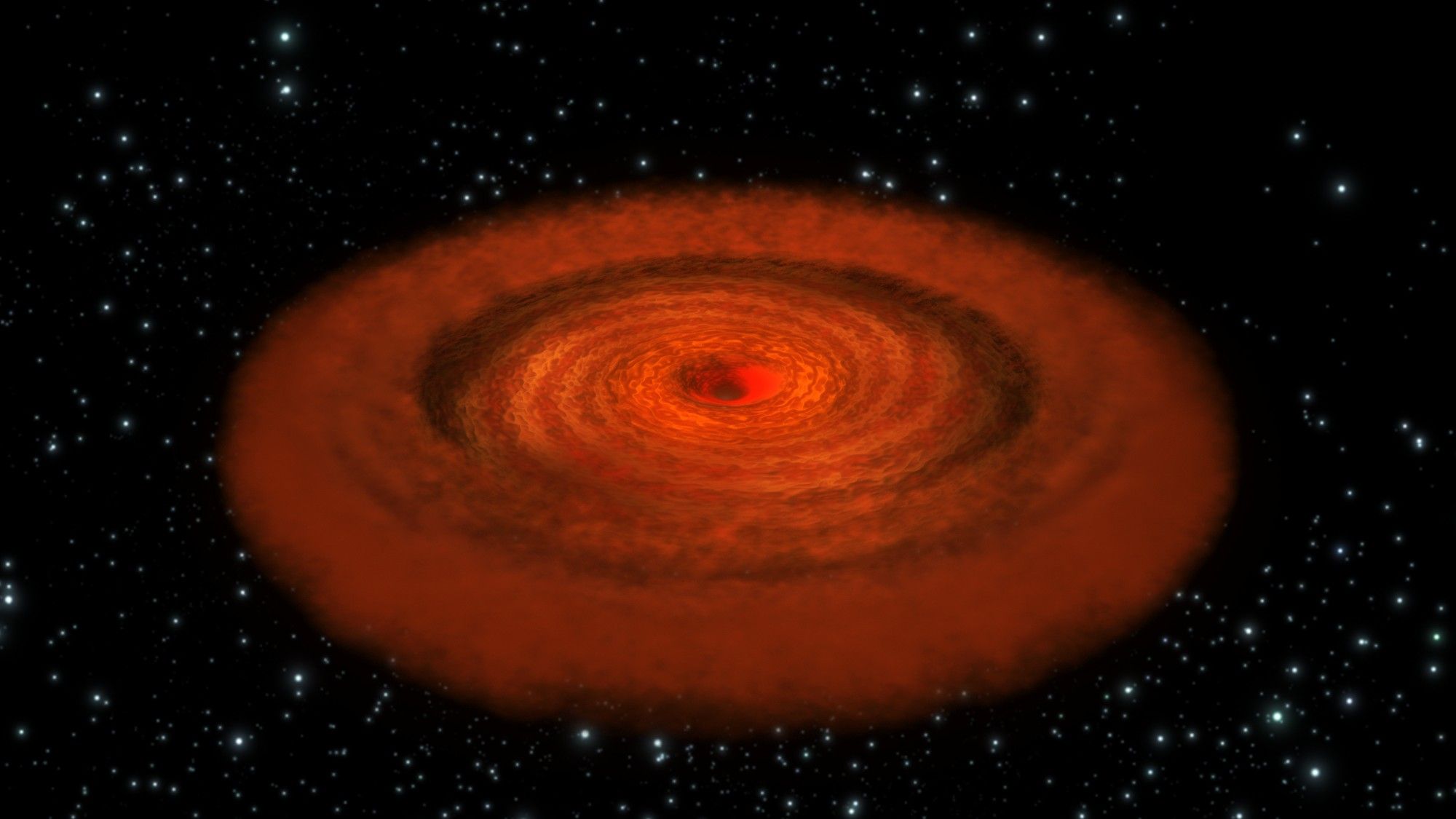
JWST Spots Earliest Little Red Dot Candidate CW-LRD-z10 450 Million Years After Big Bang
Astronomers have identified a potential baby black hole existing just 450 million years after the Big Bang, marking the earliest known example of its kind.
The object, designated CW-LRD-z10, was discovered using the James Webb Space Telescope (JWST) and categorized as a "little red dot," a rare class of cosmic structures believed to be black holes growing within dense gas cocoons.
The findings, published on November 24 in the Astrophysical Journal Letters, suggest this object could provide a new window into the origins of supermassive black holes. "Such an object would be one of the most distant accreting black holes known," said Roberto Maiolino, a professor of experimental astrophysics at the University of Cambridge, who was not involved in the research, in an email to Live Science.

Little red dots were previously difficult to detect because the JWST’s near-infrared camera was limited to a redshift of about 9, or approximately 13.1 billion years ago, according to Live Science. To locate more distant sources, researchers used the telescope’s mid-infrared instrument (MIRI) in 2025. CW-LRD-z10 was the only candidate identified during that search, Takumi Tanaka, a doctoral student at the University of Tokyo, told Live Science.
The research team measured the object’s redshift at 10.36, indicating its light originated when the universe was in its infancy. While the detection of a "Lyman-alpha break" supports this distance, Maiolino said that "at this stage, this should only be considered an LRD candidate" because the spectrum currently lacks the wide hydrogen lines typically associated with these objects.
Some researchers have explored whether the object could be a closer galaxy at a redshift of 3, roughly 11.4 billion light-years away, characterized by a "Balmer break." However, Tanaka told Live Science that the data does not support this theory, as the object’s extreme color is inconsistent with typical stellar populations at that distance.
The presence of potential iron emission lines, often associated with gas near feeding black holes, further supports the active black hole interpretation. "If confirmed, this would support the presence of actively accreting black holes and suggest that gas containing heavy elements was already present in the environment of the possible black hole," Tanaka said to Live Science.
The scientific community expects more clarity in 2027, when the JWST is scheduled to capture a new spectrum of CW-LRD-z10 to distinguish between a genuinely red glow and the effects of strong emission lines.