JWST Finds 13-Billion-Year-old Galaxy LAP1-B, Says Astronomers
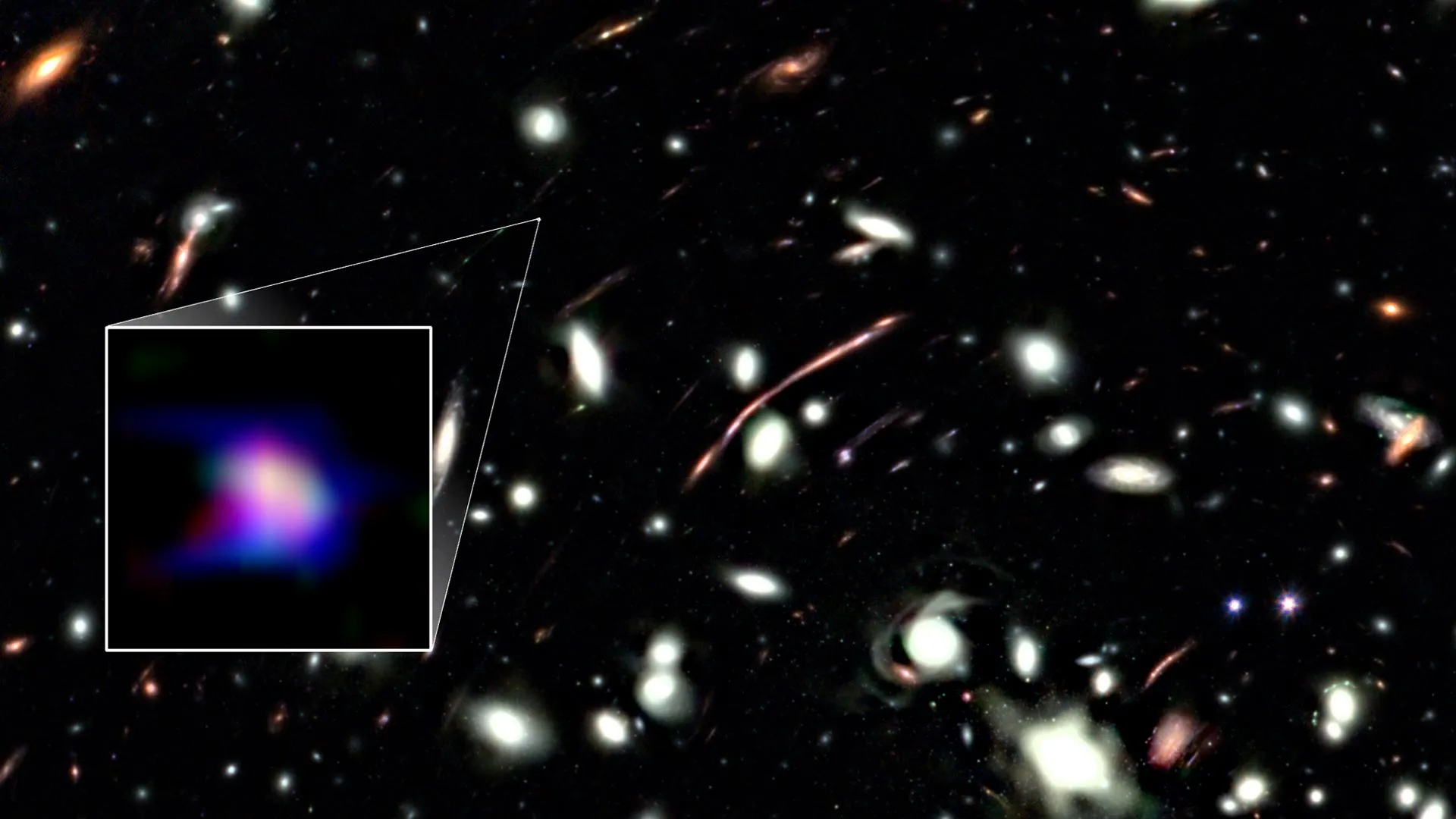
Astronomers using the James Webb Space Telescope have identified LAP1-B, a primitive galaxy from 13 billion years ago that may contain the chemical signatures of the universe’s first stars.
The galaxy existed just 800 million years after the Big Bang. It was observed at a redshift of 6.625 ± 0.001, according to research published in the journal Nature. To capture the ultra-faint object, the team used a massive foreground galaxy cluster as a natural magnifying glass, bringing the distant target into view.
Data from the James Webb Space Telescope revealed that the galaxy has an oxygen abundance of approximately 1/240th that of the Sun, or 0.42% of the solar value, Science Daily reported. This measurement marks LAP1-B as the most chemically primitive star-forming galaxy ever identified.
“I was instantly thrilled by the extreme lack of oxygen revealed in the data,” said Associate Professor Kimihiko Nakajima of Kanazawa University, who led the international research team.
“Finding a galaxy in such a primitive state is astonishing. It’s a chemical signature that clearly indicates a primordial galaxy caught in the moments shortly after its formation,” Nakajima said.
Beyond its low oxygen levels, the galaxy displays a high ratio of carbon to oxygen. Researchers say this signature aligns with theoretical models regarding elements released by the universe’s first-generation stars. These stars formed from pristine gas containing no heavy elements, effectively ending the period known as the Cosmic Dark Ages.
The research also indicates that LAP1-B is dominated by an invisible dark matter halo, as its gravitational mass exceeds the combined mass of its stars and gas. This structural composition suggests the galaxy is a potential ancestor to the ultra-faint dwarf galaxies currently found near the Milky Way.
“It is a profound surprise to find that LAP1-B looks exactly like the ‘ancestor’ we had only imagined in theories,” said Professor Masami Ouchi of the University of Tokyo and the National Astronomical Observatory of Japan.
“This helps us solve the mystery of why these cosmic fossils have survived in their current form to the present day,” Ouchi said.
While previous studies relied on analyzing ancient stars within our local neighborhood to infer the past, the James Webb Space Telescope allows for the direct examination of gas from the early universe. The team intends to continue using the telescope to search for even more primitive objects to further reconstruct the development of the cosmos.
“We hope this discovery marks a historic step in understanding how the elements that make up our own bodies were first born and accumulated across the Universe,” Nakajima said.