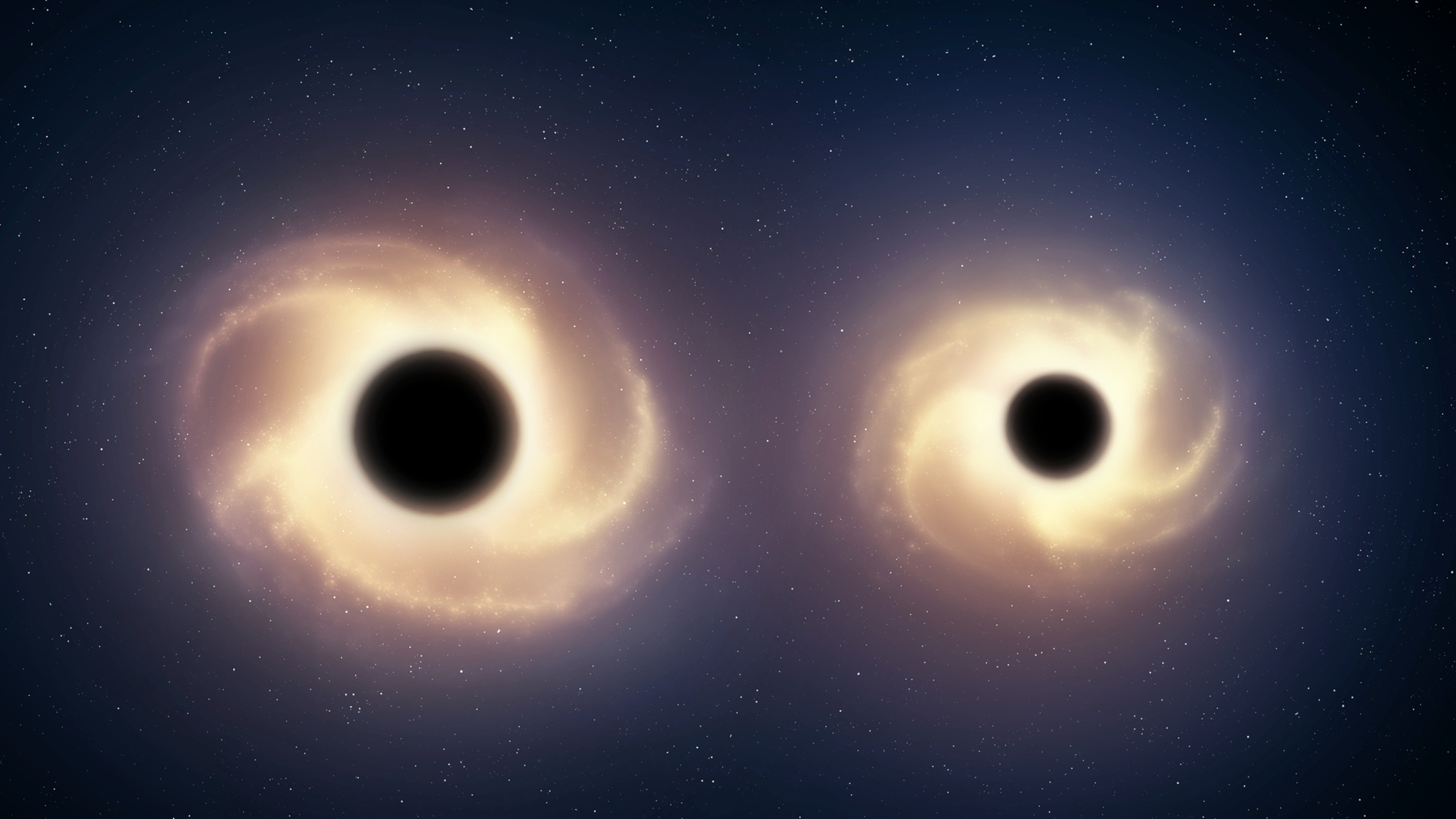
JWST Discovers Closest Pair of Supermassive Black Holes in the Early Universe
<>
Astronomers utilizing the James Webb Space Telescope (JWST) and the Atacama Large Millimeter/submillimeter Array (ALMA) have discovered the closest pair of actively feeding supermassive black holes ever confirmed in the early universe. Designated collectively as LID-1166, the system exists as it was just 1.3 billion years after the Big Bang, offering researchers an unprecedented look at the critical growth phases of cosmic structures through data published in a study accepted by Nature Astronomy and uploaded to the arXiv preprint server on July 21.
- Milestone Observation: The JWST and ALMA detected two actively feeding supermassive black holes separated by only 4,900 light-years within a merging galaxy 1.3 billion years post-Big Bang.
- Technological Precision: Using the Near-Infrared Spectrograph (NIRSpec) instrument, researchers overcame atmospheric limitations to resolve distinct dual active galactic nuclei buried in dense gas and dust.
- Astrophysical Implications: The discovery provides foundational evidence regarding how supermassive black holes rapidly grew and evolved alongside their host galaxies during the infant stages of the cosmos.
Uncovering LID-1166 Through Advanced Space Instrumentation
The system first registered as a high-intensity X-ray source within the Chandra COSMOS Legacy Survey. Despite its powerful high-energy output, LID-1166 remained completely invisible in deep imaging captures from the Hubble Space Telescope due to thick veils of surrounding gas and dust. To pierce this obscuration, lead researchers—including Hyewon Suh of the International Gemini Observatory/NSF NOIRLab—deployed the near-infrared capabilities of the JWST alongside radio arrays in Chile.
“This step of the discovery could happen only thanks to the exquisite imaging and spectroscopic capabilities of the JWST, and in particular its instrument NIRSpec,” Decarli stated, noting that equivalent ground-based observations remain severely limited by atmospheric transparency at these wavelengths.

Spectral signatures gathered by NIRSpec revealed two compact, glowing nodes separated by 1.5 kiloparsecs, or approximately 4,900 light-years. Both sources exhibited characteristic signatures of gas swirling at extreme velocities, confirming the presence of active galactic nuclei (AGN) driving a violent galactic merger. To validate the findings, independent analysts evaluated multiple methods for subtracting the primary galaxy’s ambient light. Anna Trindade Falcão, an astrophysicist at NASA’s Goddard Space Flight Center who did not participate in the research, noted that the persistence of the secondary signal after light subtraction constitutes meaningful evidence that the dual configuration is authentic, though she emphasized the value of continued follow-up to definitively rule out residual optical glows.
Resolving Early Universe Galaxy Mergers and Rapid Black Hole Growth
Complementary data acquired via ALMA uncovered expansive reservoirs of cold gas linked to each AGN. According to Decarli, these findings confirm that the twin black holes reside squarely at the centers of two distinct galaxies on the verge of coalescence. This galactic context successfully ruled out alternative evolutionary pathways, such as a solitary “naked” black hole ejected violently via a chaotic three-way gravitational interaction.

This confirmation helps address a persistent paradox in cosmology: how supermassive black holes managed to attain masses millions or billions of times that of the sun within the first billion years of cosmic history. Traditional models indicate that black holes expand primarily by devouring surrounding matter and cannibalizing neighboring galaxies. The detection of LID-1166 demonstrates that dual black hole systems operating within densely obscured, merging galaxies were active during the infant universe, validating longstanding theoretical predictions regarding early structural assembly.